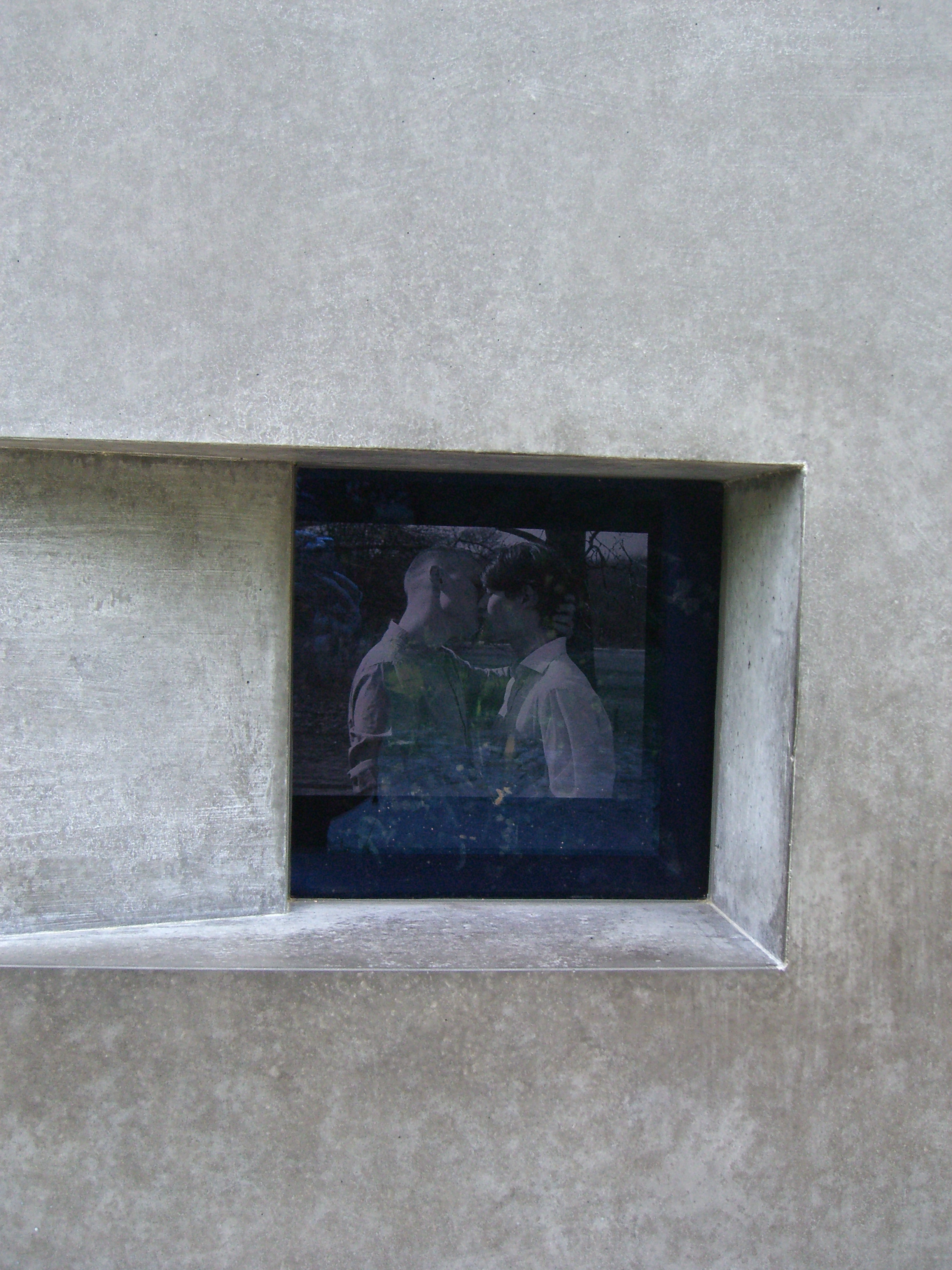
Memorial to Homosexuals Persecuted Under Nazism
There is a window cut into one face of the concrete cuboid. Stand close, lean in, and you will see a short film of two men kissing. Every two years, the film changes; sometimes it is two women instead. The stele opened in May 2008 on the edge of the Tiergarten, directly across the road from the field of stelae that marks the murder of Europe's Jews. It was the third memorial of its kind in Germany, after the Frankfurter Engel of 1994 and the Cologne pink triangle of 1995. It took the German parliament until 2003 even to authorize building it, sixty years after the persecution it commemorates began.
Paragraph 175
Paragraph 175 of the German criminal code outlawed sexual acts between men. Imperial Germany had it on the books, but the Nazi regime hardened it in 1935, broadened what counted as an offense, and turned it into a tool for systematic persecution. Between 1933 and 1945, around 100,000 men were arrested under Paragraph 175. About 50,000 were sentenced to prison. Between 5,000 and 15,000, by the most cited estimates, were sent to concentration camps, marked with the pink triangle the Nazis assigned them. Survival rates inside the camps were lower for pink triangle prisoners than for almost any other category. Lesbians were not prosecuted under Paragraph 175 because the law applied only to men, but lesbian bars in Berlin were closed, women were sent to camps as 'asocials,' and the public lesbian culture that had flourished in Weimar Berlin was crushed.
The Long Postwar Silence
When the camps were liberated in 1945, pink triangle survivors were not freed. The Allies left Paragraph 175 in place, and the Federal Republic of West Germany kept it on the books almost unchanged through the 1950s and 1960s. Men who had survived the camps were sometimes re-arrested under the same statute, and their convictions barred them from postwar reparations. The law was softened in 1969, narrowed further in 1973, and finally removed entirely in 1994, four years after reunification. East Germany had effectively stopped enforcing it by 1968. It took the German Bundestag until 2002 to formally pardon those convicted under the Nazi-era statute, and until 2017 to extend pardons to men convicted in West Germany after 1945. Many of those men had been waiting half a century.
The Push for a Memorial
The campaign for a memorial began in 1992 with a group called Der homosexuellen NS-Opfer gedenken, working with the Lesben- und Schwulenverband. President Richard von Weizsacker had named gay men as a victim group in 1985, but official recognition came slowly. In December 2003 the Bundestag finally approved the memorial. The Danish-Norwegian artists Michael Elmgreen and Ingar Dragset won the design competition. Their concrete stele echoes the form of Peter Eisenman's stelae across the road, deliberately, but it is a single block rather than a field. Berlin's then-mayor Klaus Wowereit, openly gay since 2001, gave the dedication speech on 27 May 2008.
The Argument About Lesbians
The original design showed only two men kissing in the looped video. The feminist magazine EMMA protested. Lesbians under Nazism had not been prosecuted under Paragraph 175, but they had been persecuted, and the surviving documentation of their lives in Weimar Berlin had largely been lost when their bars and publishers were shut down. The compromise reached was that the film inside the window would alternate every two years, sometimes showing two men, sometimes two women. The Holocaust historian Israel Gutman objected to the memorial's location near the Jewish memorial, arguing that the scale of persecution should not be conflated. The location stayed. So did the alternation. The argument itself became part of what the memorial holds.
Vandalism and Witness
The window glass was smashed within months of the opening, and again in 2009, and again in subsequent years. Each time it has been replaced. Far-right vandalism of the memorial is documented and ongoing, which is part of why it exists. Wreaths are laid here on 27 January each year, the international day of remembrance for the victims of the Holocaust. People stop, lean toward the small window, and watch a film that lasts only seconds before it loops. It is a quieter monument than the field of stelae across the road, easy to walk past if you do not know what you are looking at. That, too, is part of what it is. The men and women it remembers were targeted, in part, for being inconspicuous. The memorial asks you to slow down and look.
From the Air
Located at 52.513 N, 13.376 E on the eastern edge of the Tiergarten, directly across Ebertstrasse from the Memorial to the Murdered Jews of Europe. The stele is a single dark concrete block, easily lost from altitude among the trees of the park. Berlin Brandenburg (EDDB) is about 18 km southeast. Look for the Brandenburg Gate two blocks north and the Reichstag immediately north of that for orientation.