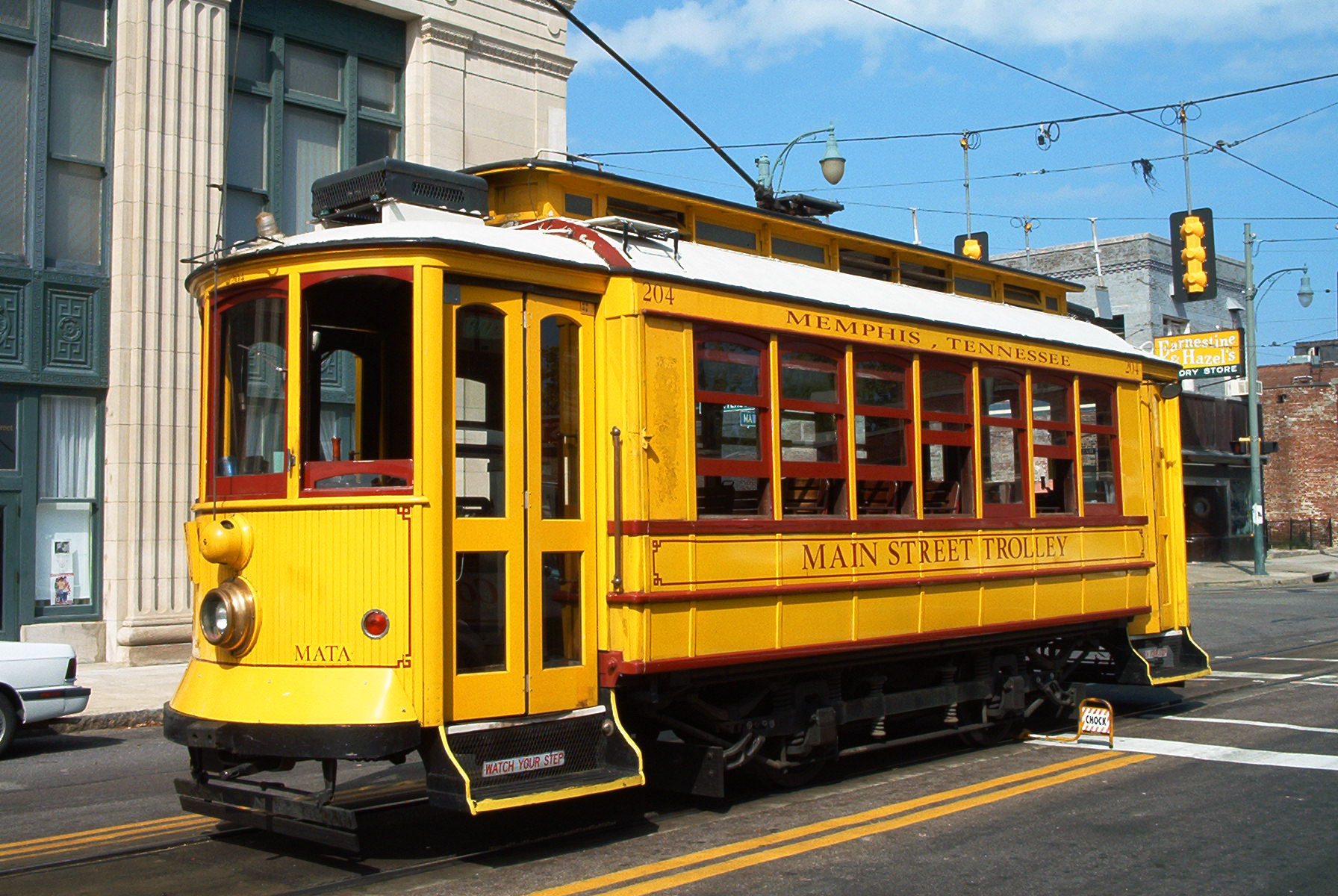
Memphis Union Station
It closed on the same date it opened, fifty-two years apart to the day. Memphis Union Station, the largest stone structure in the city when it was built, began receiving passengers on April 1, 1912, and shuttered for the first time on April 1, 1964. That kind of symmetry feels almost scripted -- as if the station itself understood the arc of its own story. Built in the Beaux-Arts style on Calhoun Street in south Memphis, Union Station was designed to be the knot tying together railroads of the Southwest and the Southeast, a place where the Missouri Pacific and the Cotton Belt met the Louisville and Nashville, the Southern Railway, and the Nashville, Chattanooga and St. Louis Railway.
Where East Met West
The Memphis Union Station Company was chartered in Tennessee on September 25, 1909, specifically to unite the passenger and express operations of the major rail lines terminating in or passing through Memphis. Architect J.A. Galvin designed the building, with Walter F. Schultz as construction engineer. When it opened on April 1, 1912, the station was a point of civic pride -- the main building was the largest stone structure in the city. Its terminal tracks used a stub-end design, meaning every train had to back in from the main line via a wye. The station also had storage tracks, a roundhouse, and a turntable for servicing locomotives on-site. Just two blocks to the west, the Illinois Central Railroad operated its own Central Station for north-south traffic, giving Memphis two grand terminals within easy walking distance of each other.
The Golden Age of Named Trains
During the golden years of American rail travel, a roster of elegantly named trains called at Union Station. The Louisville and Nashville brought the Humming Bird and the Pan-American, both bound for Cincinnati. Missouri Pacific's Texas Eagle ran to Laredo and Galveston via San Antonio and Houston. The Nashville, Chattanooga and St. Louis Railway dispatched the City of Memphis to Nashville, while the Southern Railway's Tennessean linked Memphis all the way to Washington, D.C., via Huntsville and Chattanooga. The Cotton Belt ran the Lone Star and Morning Star to Dallas via Texarkana. These named trains connected Memphis to virtually every corner of the country -- a web of routes radiating outward from a single Beaux-Arts hall in south Memphis.
A Slow Unraveling
After World War II, passenger rail traffic declined steadily, and the tenant railroads that once filled Union Station began to leave. The St. Louis Southwestern Railway dropped Memphis passenger service in 1952. The Nashville, Chattanooga and St. Louis merged into the Louisville and Nashville in 1957, cutting the station's tenants from five to three. In early 1964, Missouri Pacific relocated its last Memphis train to a former freight station. The remaining two railroads -- the L&N and Southern -- found the revenues far too small to justify maintaining the grand building alone. When Union Station closed on April 1, 1964, it had served Memphis for exactly fifty-two years.
Forced Reopening and Final Curtain
The closure was not the end. The City of Memphis argued that Union Station had been abandoned without proper approval from the Tennessee Public Service Commission. After a prolonged court battle, appeals courts ruled against the railroads, and both the L&N and Southern were forced to partially reopen the station on December 1, 1966. But passenger traffic was negligible, and the added expense of operating a station nobody used pushed both railroads to pursue formal discontinuance proceedings. They succeeded. The last Southern Railway passenger train departed Memphis on March 30, 1968, and Union Station closed for the second and final time. The property was sold to the United States Postal Service for a new mail sorting facility. By February 1969, the station was demolished -- its stone walls, its roundhouse, its turntable all reduced to rubble to make room for mail.
From the Air
Memphis Union Station stood at approximately 35.132N, 90.056W, on Calhoun Street between South Second and South Third Streets in south Memphis. The site is now occupied by a postal facility. Nearby airports include Memphis International (KMEM) about 8 miles to the south. The former station location is roughly two blocks east of where Central Station (now a hotel and transit hub) still stands. Best viewed at 2,000-3,000 feet AGL to appreciate the South Main Street district context.