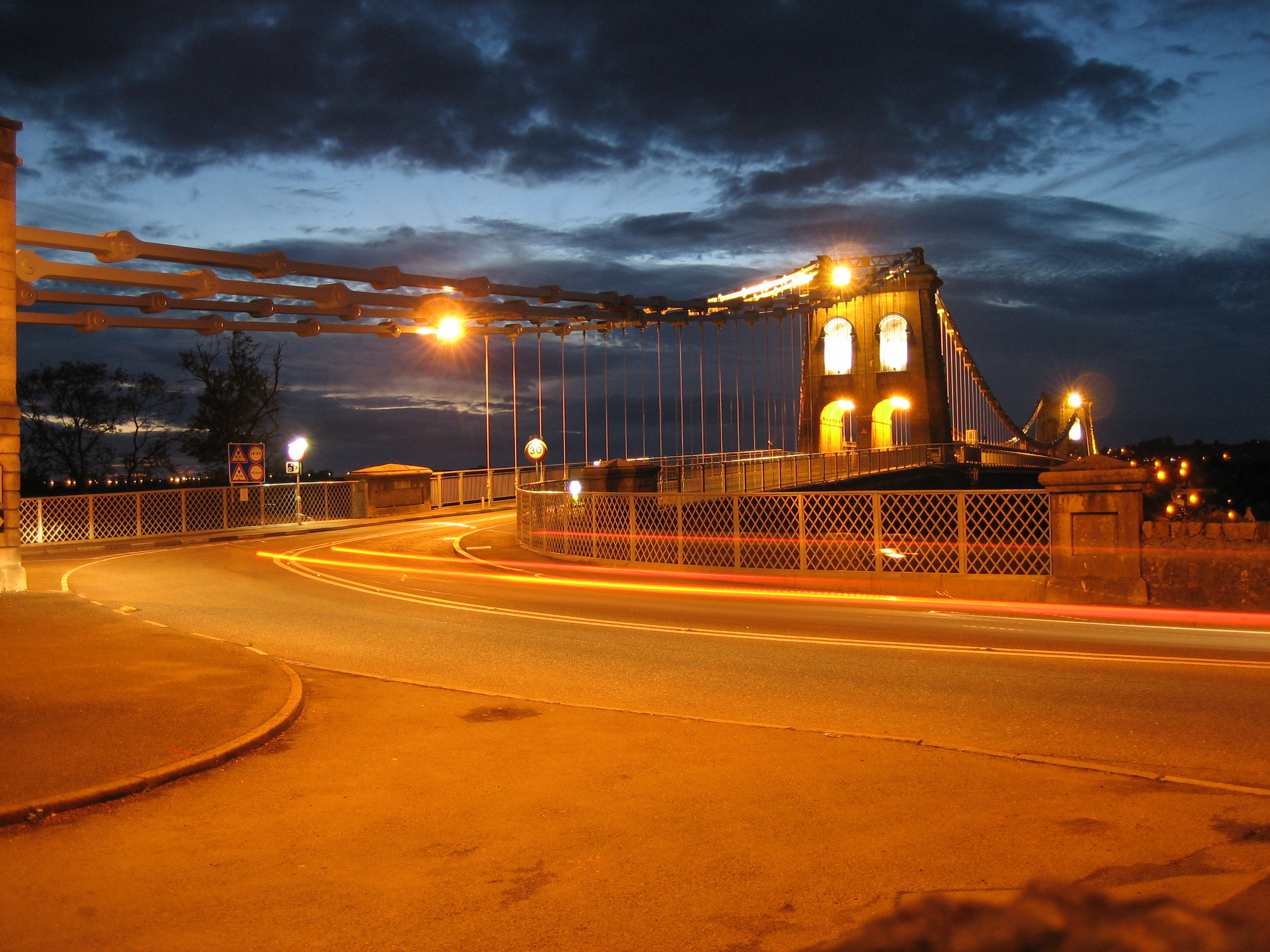
Menai Suspension Bridge
Before Thomas Telford's bridge, getting cattle to market from Anglesey meant driving them into the Menai Strait and hoping they could swim. The strait's four daily tidal surges created currents and whirlpools that swallowed animals and people alike. In 1785, a ferry carrying fifty-five passengers sank in a gale at the strait's southern end; one person survived. Anglesey's wealth came from its cattle trade, and its isolation from the mainland was measured in livestock lost and lives ended. When Telford completed his suspension bridge in 1826, he did not merely solve an engineering problem. He changed the geography of Wales.
The Road to Dublin
The bridge exists because of politics. When Ireland joined Great Britain in the Act of Union of 1800, traffic between London and Dublin surged, and the fastest route ran through Holyhead on Anglesey's western coast. Parliament passed the Holyhead Roads Act in 1815, commissioning Telford to build a road from London to the port. The route demanded passage through Snowdonia's mountains and across the Menai Strait -- obstacles that would have stopped a lesser engineer. Telford surveyed the options and proposed a bridge from a point near Bangor on the mainland to the village of Porthaethwy, now known simply as Menai Bridge, on the Anglesey shore.
Chain by Chain
Telford's design was revolutionary for its scale. The bridge's wrought iron chains were assembled link by link on-site, built outward from platforms near the tunnel mouths where the chains were anchored into the rock. Workers in suspended cradles attached links high above the water until the chains drooped to the strait's surface. The final central portion of each chain was floated across on a four-hundred-foot raft and hoisted into place by a hundred and fifty men hauling on pulleys. Cast iron saddles with rollers carried the chains over the stone piers, allowing the metal to expand and contract with temperature changes. On both sides of the strait, the chains passed through tunnels into chambers carved from solid rock, held fast by nine-foot bolts in cast iron sockets.
Iron Gives Way to Steel
The original wrought iron chains served for over a century, but the bridge's four-ton weight limit became increasingly problematic as freight vehicles grew heavier. In 1938, engineers replaced the wrought iron chains with steel ones -- a feat accomplished without closing the bridge to traffic. The new chains carried greater loads, but the structure has required constant attention ever since. In 2005, one carriageway was closed for six months for the bridge's first major repainting in sixty-five years. More dramatic closures followed: in October 2022, the bridge was shut without warning after structural engineers flagged safety concerns, remaining closed until February 2023.
The Bomber Under the Bridge
During the Second World War, a Wellington bomber was flown under the bridge to win a bet. The pilot was Ken Rees, who would later take part in the Great Escape from Stalag Luft III, the mass breakout from a German prisoner-of-war camp that became one of the war's most celebrated stories. After the war, Rees settled on Anglesey and ran the Sandymount Club in Rhosneigr. The stunt is the kind of detail that resists verification and demands retelling -- a moment of reckless bravery that connects the bridge to a larger narrative of wartime daring.
An Enduring Span
Two centuries after its completion, the Menai Suspension Bridge remains a working road crossing and a Grade I listed structure. It has been proposed as a World Heritage Site by the British government. A representation of the bridge appeared on the reverse of British one-pound coins minted in 2005. The Anglesey Coastal Path passes beneath it; the Wales Coast Path passes over it. From the bridge, the view stretches across the strait to the mountains of Snowdonia in one direction and the flat farmland of Anglesey in the other -- the same two landscapes that Telford's chains first joined together, ending an isolation that had lasted as long as human memory.
From the Air
The Menai Suspension Bridge is located at 53.2201N, 4.1631W, spanning the Menai Strait between Bangor and Anglesey. It is clearly visible from the air, with the parallel Britannia Bridge (rail and road) approximately 1 km to the southwest. The two bridges together are excellent orientation landmarks. Nearest airports: Caernarfon (EGCK), RAF Valley (EGOV). Recommended viewing altitude: 1,500-2,500 ft AGL for the best perspective on both bridges and the strait. Look for the town of Menai Bridge on the Anglesey side.