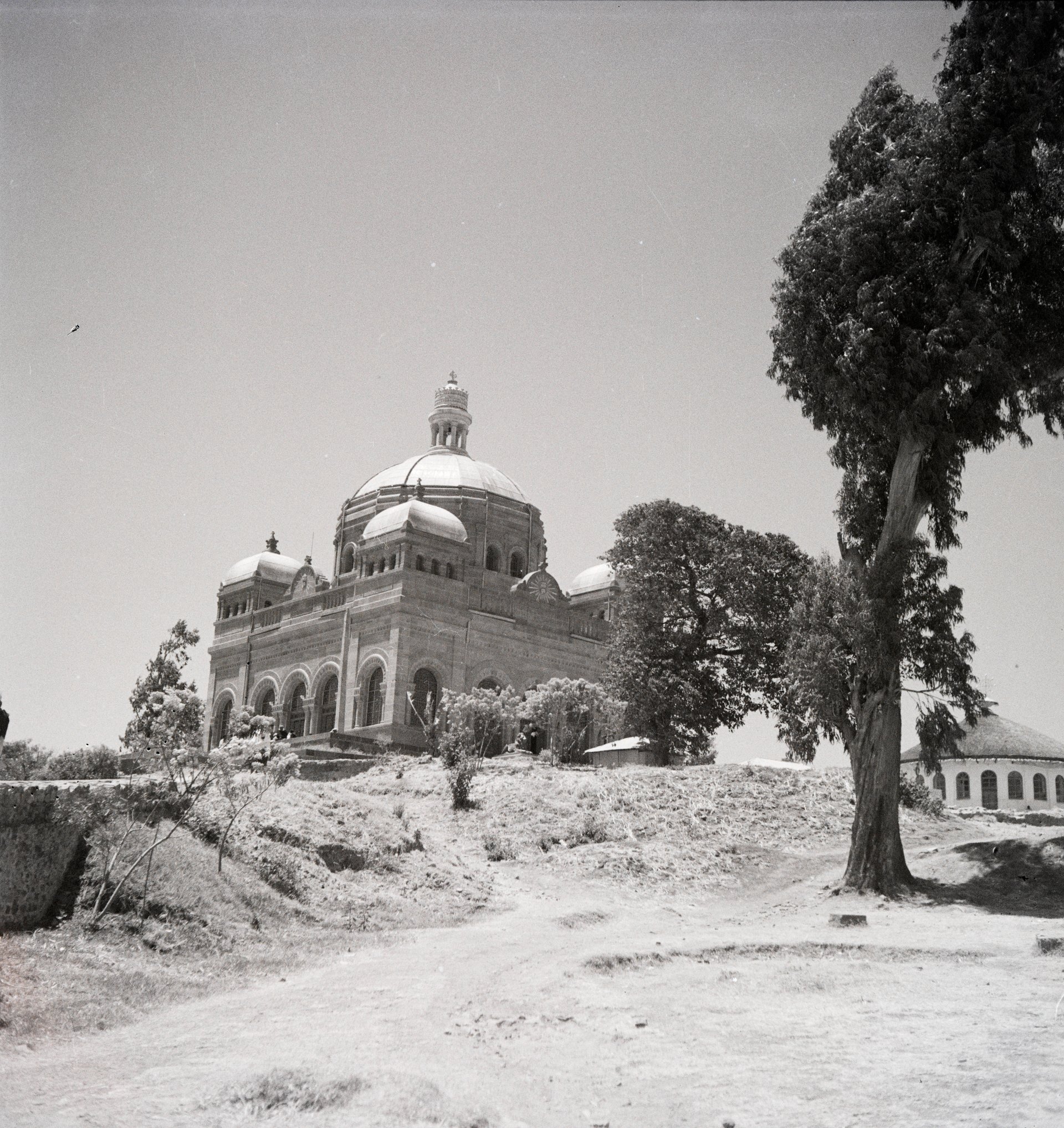
Menelik Palace
Every government that has ruled Ethiopia since the 1880s has governed from the same hilltop. The Menelik Palace -- also known as the Great Ghebbi or the Imperial Palace -- has outlasted the emperors who built it, the dictator who turned it into a prison, and the revolutionaries who remade it in their image. Today it houses the offices and residence of the Prime Minister of Ethiopia, rebranded as Unity Park, its gardens open to the public for the first time in its history. The compound sits on a rise in central Addis Ababa, its walls enclosing churches, monuments, government buildings, and the layered memories of a nation that has never been easily governed.
The Emperor Who Built a Capital
Emperor Menelik II established the palace compound in the 1880s as he was consolidating his rule and founding Addis Ababa as Ethiopia's capital. The complex grew around his residence into a sprawling seat of imperial power -- halls for governance, chapels for prayer, grounds for ceremony. The most significant church on the grounds is the Ta'eka Negest Ba'eta Le Mariam Monastery, the 'Resting Place of Kings,' crowned with a large imperial dome. It serves as the mausoleum for Menelik II himself, his wife Empress Taitu, and their daughter Empress Zewditu, who succeeded him on the throne. Two other churches stand within the walls: the Se'el Bet Kidane Meheret Church and the Debre Mengist St. Gabriel Church. For decades, the Ghebbi was the unquestioned center of Ethiopian authority -- a place where foreign ambassadors presented credentials and where the fate of the Horn of Africa was shaped.
Prison, Parliament, and Propaganda
When the communist Derg regime seized power in 1974, the palace's purpose inverted. Mengistu Haile Mariam, who ruled from 1977 to 1991, turned the imperial grounds into a prison. Emperor Haile Selassie himself was held here, along with many officials from his government. The Derg also built new structures on the grounds to project their own vision of Ethiopian governance. The Shengo Hall, a massive assembly building prefabricated in Finland -- at the time the largest prefabricated structure in the world -- was opened on September 9, 1987 to house the country's legislature. Presidents Kenneth Kaunda of Zambia, Hassan Gouled Aptidon of Djibouti, and Hosni Mubarak of Egypt attended the inauguration. After Mengistu's fall in 1991, the Ethiopian Parliament returned to its older chambers, and the Shengo Hall became an occasional meeting venue rather than the seat of legislative authority.
From Ghebbi to Unity Park
The compound's most recent transformation came in 2019 when Prime Minister Abiy Ahmed opened portions of the palace grounds to the public as Unity Park. For the first time, ordinary Ethiopians could walk through gardens that had been sealed behind walls for over a century. The Prime Minister's Office itself occupies a building originally constructed for President Mengistu, renovated in 2018-2019. In 2010, construction began on a new prime ministerial residence, estimated at 80 million birr, with additional guest houses worth 25 million birr. The palace gardens received a thorough refurbishment as part of the same project. The compound today is a palimpsest of Ethiopian power -- Menelik's churches standing beside Mengistu's assembly hall, imperial mausoleums sharing space with modern government offices. Each regime has added its architectural layer without quite erasing what came before, as if the grounds themselves insist on remembering.
The Weight of Continuity
What makes the Menelik Palace remarkable is not any single building but the unbroken thread of governance it represents. Emperors claiming descent from Solomon and the Queen of Sheba gave way to a Marxist military junta, which gave way to a revolutionary front, which gave way to today's administration. Through it all, the hilltop compound in Addis Ababa remained the address of power. The churches still function as places of worship. The mausoleums still hold their imperial dead. The offices still hum with the daily work of governing a nation of over 120 million people. From the air, the compound reveals its scale -- a walled enclave of green amid the dense urban fabric of a city Menelik II founded, still anchored to the hill he chose.
From the Air
Located at 9.025N, 38.764E in central Addis Ababa at approximately 2,400 meters (7,874 feet) elevation. The walled palace compound and its green gardens are visible from above amid the dense urban fabric. Addis Ababa Bole International Airport (HAAB) lies approximately 8 km to the southeast. High-altitude airport; expect reduced aircraft performance.