Mengjiang
The name was an act of linguistic diplomacy. In Chinese, "Mengjiang" meant the Mongol Territories were an autonomous region of China. In Mongolian, the same word -- ulus -- translated as "country." Both readings were intentional. Japan's puppet state in Inner Mongolia, formally the Mengjiang United Autonomous Government, existed from 1939 to 1945 in a space between fictions: independent enough to satisfy its Mongol figurehead, subordinate enough to serve Tokyo's strategic needs.
A Prince's Bargain
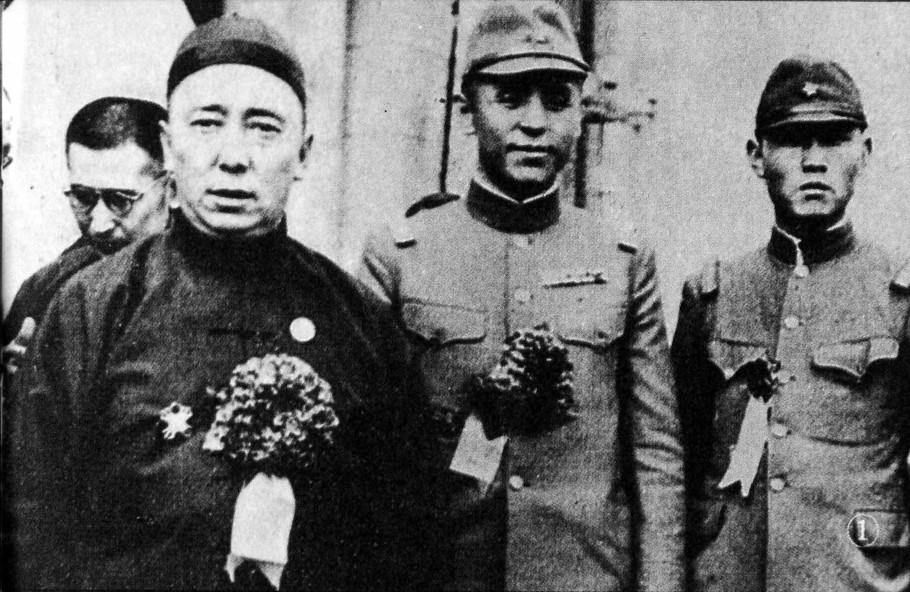
Demchugdongrub, a Mongol nobleman of the Chahar aristocracy, became the face of Mengjiang. His stated goal -- "to recover the territories originally owned by the Mongols" -- gave the enterprise a veneer of self-determination. But the architecture of control was Japanese. After occupying Manchuria in 1931 and establishing Manchukuo, Japan pushed westward into the provinces of Chahar and Suiyuan, absorbing them through military operations in 1936 and 1937. The Mongol Military Government, proclaimed in 1936 under Prince Yondonwangchug, was renamed and reorganized repeatedly -- becoming the Mongol United Autonomous Government in 1937, then merging with Han Chinese administrations in South Chahar and North Shanxi to form Mengjiang in September 1939. The capital settled at Kalgan, present-day Zhangjiakou, with authority extending toward Hohhot.
The Machinery of Extraction
Japan's interest in Mengjiang was material, not ideological. The iron mine at Xuanhua Longyan held reserves of over 91 million tonnes. Coal deposits in Suiyuan were measured in the hundreds of millions of tonnes. These resources were extracted and shipped directly to Japan to feed its war machine. The Bank of Mengjiang printed its own currency -- notably without years on the notes, as if the state existed outside of time. Japanese-controlled schools mandated Japanese as the sole permitted secondary language, and students were required to pay respect to the Emperor of Japan and Shinto. The government and its army were, as one historian put it, "complete puppets of the Japanese."
Cavalry Without Tanks
The Inner Mongolian Army, Mengjiang's military force, was organized as a mobile cavalry and light infantry force under the direct command of the Japanese Kwantung Army. Equipped with rifles, machine guns, and mortars, it lacked tanks and aircraft. At its peak, it fielded between 4,000 and 10,000 men, all cavalry. Its purpose was threefold: to support Japanese operations against Outer Mongolia, to act as a local security force, and to protect Prince Demchugdongrub. The army was rebuilt after the failed Suiyuan Campaign from defeated remnants, reorganized into eight Mongol cavalry divisions of roughly 1,500 men each. By the war's end, it comprised six divisions, three independent brigades, and a security regiment -- a force that looked imposing on paper but could not withstand the Soviet onslaught that came in August 1945.
Aftershocks
Mengjiang collapsed in 1945 when the Soviet Red Army and the Mongolian army swept through as part of the Manchurian Strategic Offensive Operation. Most of its territory was absorbed into what became Inner Mongolia in the People's Republic of China. But the puppet state's legacy carried a lethal afterlife. During the Inner Mongolia incident of 1967 to 1969, tens of thousands to hundreds of thousands of Mongols were massacred. One of the accusations leveled against them was that they were collaborator remnants from the Mengjiang army -- a charge that turned wartime complicity, often coerced, into a death sentence a generation later. The landscapes around Zhangjiakou bear no visible trace of Mengjiang today. The Shinto shrines are gone. But the questions the puppet state raised -- about sovereignty, collaboration, and the cost of occupation -- have not disappeared with them.
From the Air
Located at 40.82N, 114.88E. Mengjiang's capital was Kalgan (modern Zhangjiakou), visible as a large urban area in northwestern Hebei Province where the Mongolian Plateau meets the North China Plain. Nearest airport is Zhangjiakou Ningyuan Airport (ZBZJ). The terrain transition from steppe grassland to cultivated plains is visible from cruising altitude.