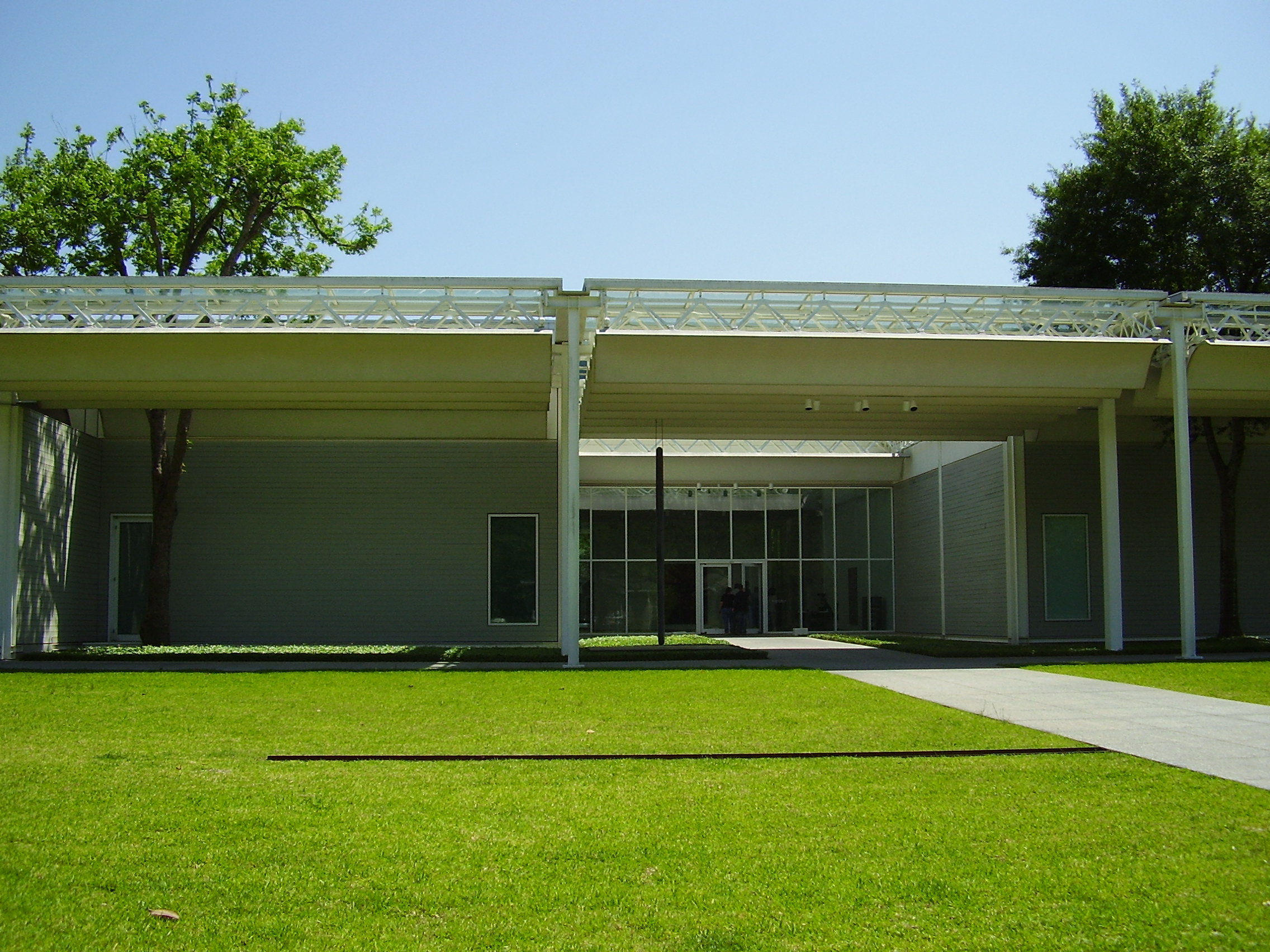
Menil Collection
Every bungalow on the block is painted the same shade of gray. It is a deliberate, slightly unsettling uniformity - the visual signature of a neighborhood that Dominique de Menil began quietly purchasing, house by house, starting in the 1960s. When Renzo Piano designed the museum building that would anchor this campus, he matched it to the bungalows, and the color became known simply as 'Menil gray.' The effect is of an entire district organized around a single idea: that great art deserves a setting of calm rather than spectacle. The Menil Collection in Houston's Neartown neighborhood holds roughly 17,000 works spanning antiquity to the present, from Byzantine gold to Warhol silk screens, and charges nothing for admission. It is one of the most important private art collections in the world, disguised as a neighborhood.
Refugees, Oil, and the Art of Seeing
John and Dominique de Menil arrived in Houston in 1941 as refugees from wartime France. Dominique was born a Schlumberger - her family had built a fortune in oilfield services technology - and the couple channeled that wealth into one of the twentieth century's most ambitious private art collections. Their taste was eclectic and fearless: Surrealists like Max Ernst, Rene Magritte, and Yves Tanguy alongside tribal art from Africa and Oceania, Byzantine icons, Medieval devotional objects, and the explosive canvases of Abstract Expressionists like Jackson Pollock and Mark Rothko. They collected not as decorators but as scholars, driven by a conviction that art from different cultures and eras could illuminate shared human experience. By the time John died in 1973, the collection numbered in the thousands. Dominique spent the next two decades planning a permanent home for it.
Piano's Quiet Revolution
When the Renzo Piano-designed museum opened in June 1987, critics recognized it as something genuinely new. Piano's building is long, low, and profoundly understated - a single-story structure topped with a system of ferro-cement 'leaves' that filter natural light through the roof and distribute it evenly across the galleries below. The effect is of standing in gentle, perpetual daylight, the paintings illuminated without glare or harsh shadows. The structure sits lightly on the land, its scale deliberately modest against the surrounding bungalows. Inside, the collection moves from ancient to modern with a fluidity that reflects the de Menils' own vision: a Paleolithic carving a few rooms from a Cy Twombly canvas, a Medieval reliquary near a Robert Rauschenberg combine. The Menil Foundation, established in 1954, governs the museum and has maintained free admission from the start - Dominique's insistence that art should be accessible to everyone, not just those who could afford a ticket.
Satellite Worlds
The Menil campus has expanded well beyond its original building. In 1995, Piano returned to design the Cy Twombly Gallery, a sand-colored concrete pavilion containing nine galleries dedicated to the artist's looping, calligraphic work. Like the main museum, it is lit from above, but through a layered system of louvers, glass, and fabric that brings the interior illumination down to around 300 lux - bright enough to see clearly, dim enough to preserve the work. The Dan Flavin Installation at Richmond Hall, completed in 1998, houses Dominique de Menil's final commission: three site-specific fluorescent light installations that transform an industrial building into a cathedral of color. The Byzantine Fresco Chapel once displayed two thirteenth-century frescoes - an apse depicting the Virgin Panagia and a dome of Christ Pantocrator - recovered from a looted church in Lysi, Cyprus. The frescoes were returned to Cyprus in 2012, and the space was reconceived for contemporary installation art.
Drawings, Courtyards, and Stolen Picassos
The Menil Drawing Institute, opened in 2018, stands as the first purpose-built facility in the United States dedicated to the exhibition, study, and conservation of modern and contemporary drawings. Designed by Los Angeles firm Johnston Marklee, the flat-roofed building deliberately stays no taller than the neighboring gray bungalows, with half its space devoted to underground storage. The ground level wraps around three courtyards, housing exhibition galleries, a conservation lab, a scholars' cloister, and seminar rooms. The campus has also weathered misadventure: in 2012, a self-proclaimed artist spray-painted a Picasso canvas, claiming he wanted to make a statement. He was sentenced to two years in prison for felony graffiti and criminal mischief. The incident underscored the vulnerability that comes with the Menil's open, welcoming philosophy - and the museum's determination not to let one act of vandalism change its character.
The Color of Generosity
Under director Josef Helfenstein, who served from 2004 to 2015, the Menil doubled its annual attendance, increased its endowment by nearly 54 percent, and added more than a thousand works to the collection, including pieces by Jasper Johns, Claes Oldenburg, Richard Serra, and Kara Walker. The foundation's endowment reached $200 million by 2001, sustained by the Schlumberger fortune and bolstered by major Houston donors including the Cullen Foundation and the Brown Foundation, each of which contributed $5 million toward construction. Rebecca Rabinow succeeded Helfenstein in 2016. Throughout these transitions, the Menil has held to its founding principles: free admission, natural light, neighborhood scale, and the conviction that a Surrealist painting and a tribal mask belong in the same conversation. In a city often defined by bigness, the Menil Collection proves that restraint can be the most radical gesture of all.
From the Air
Located at 29.737N, 95.399W in Houston's Neartown / Montrose neighborhood, approximately 3nm southwest of downtown Houston. The museum campus is identifiable from low altitude by the distinctive long, low profile of the Renzo Piano main building and the surrounding grid of gray-painted bungalows. The Rothko Chapel and University of St. Thomas campus are immediately adjacent. Nearby airports: William P. Hobby Airport (KHOU) approximately 11nm southeast; George Bush Intercontinental (KIAH) approximately 21nm north-northeast. Best viewed at 1,500-2,500 feet AGL to appreciate the campus layout within the residential neighborhood. The museum district extends southeast toward Hermann Park and the Texas Medical Center.