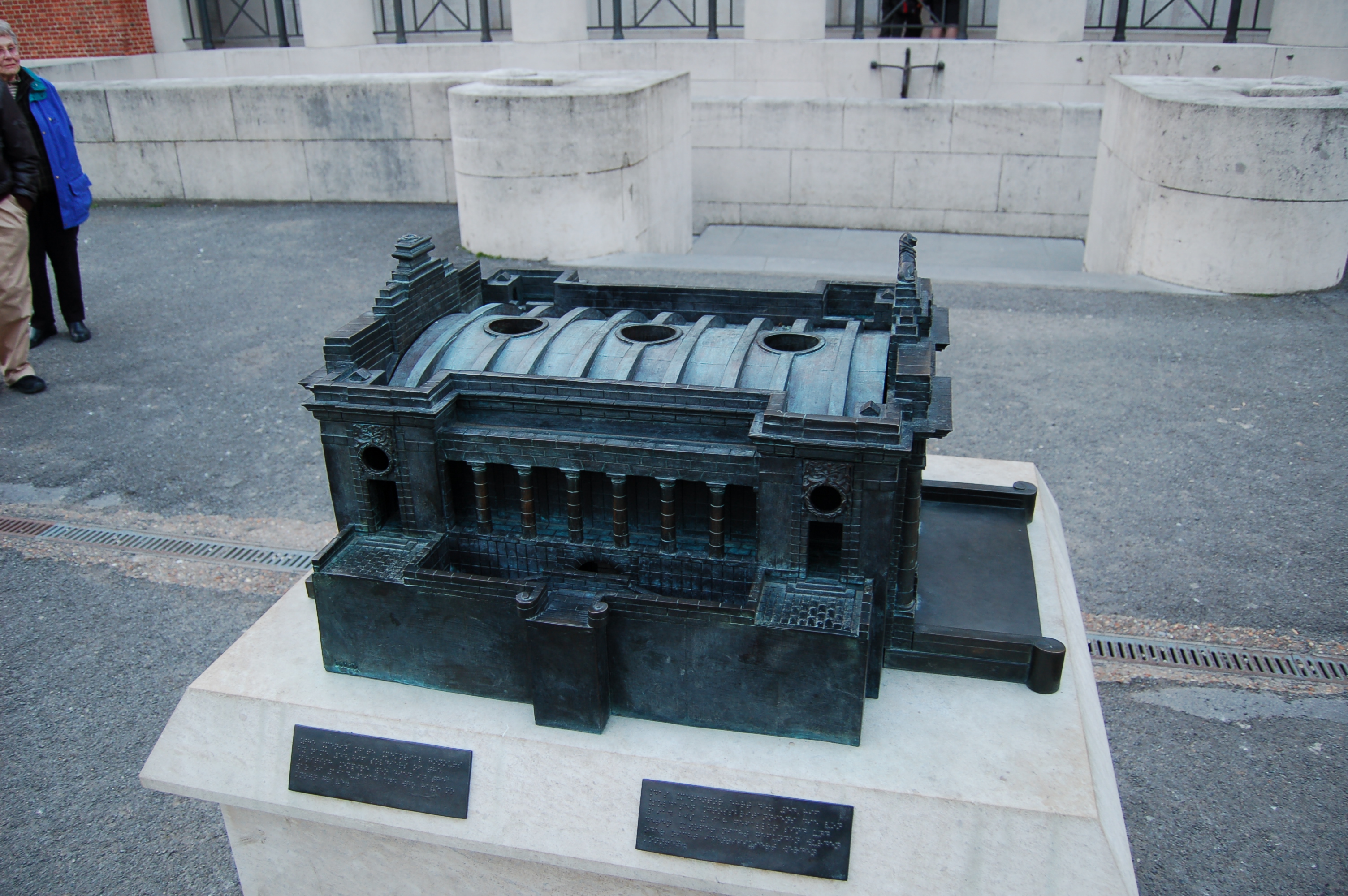
Menin Gate
At 8 PM every evening, the traffic flowing beneath the Menin Gate stops. Buglers from the Last Post Association step forward and sound the military call that marks the end of a soldier's day. The ceremony has continued uninterrupted since July 2nd, 1928, suspended only during the German occupation of World War II, when it was performed instead at Brookwood Cemetery in England. On September 6th, 1944, the evening that Polish forces liberated Ypres, the ceremony resumed at the Menin Gate even as fighting continued in other parts of the town.
The Gate to the Front
In medieval times, this was the Hangoartpoort, a narrow gateway in the eastern wall of Ypres. By 1914, it had become the Menenpoort, named for the road leading through it to the town of Menen. During the First World War, Ypres occupied a strategic position at the center of a road network, the last major Belgian town not under German control. The German army surrounded the city on three sides and bombarded it for years. British and Commonwealth soldiers marching to the front lines often passed through this gate. Some 300,000 of them would die in the Ypres Salient. Ninety thousand have no known graves.
A Memorial Inadequate to Its Purpose
Sir Reginald Blomfield designed the triumphal arch that stands here today, unveiled on July 24th, 1927. The massive Hall of Memory inside contains stone panels inscribed with 54,395 names of Commonwealth soldiers who died in the Salient but whose bodies were never identified or found. Yet when the memorial was completed, it proved too small. An arbitrary cutoff date of August 15th, 1917 was chosen, and the 34,984 UK soldiers missing after that date were instead commemorated at the Tyne Cot Memorial. Missing soldiers from New Zealand and Newfoundland are honored on separate memorials. The Menin Gate, enormous as it is, could not contain the scale of loss.
Praise and Condemnation
The memorial drew sharply divided reactions. Siegfried Sassoon, the war poet who had served in the Salient, condemned it in verse: the dead, he wrote, would "deride this sepulchre of crime." The Austrian writer Stefan Zweig saw it differently, praising the simplicity and lack of triumphalism, calling it "more impressive than any triumphal arch or monument to victory that I have ever seen." Blomfield himself considered it one of three works he wanted to be remembered by. The patient lion atop the arch serves a dual purpose: it is both the lion of Britain and the lion of Flanders, a gesture of respect to the Belgian city that sheltered the memorial.
Those Inscribed in Stone
Eight recipients of the Victoria Cross are commemorated on the panels, including Brigadier-General Charles FitzClarence, the highest-ranking name inscribed. But the memorial also holds ordinary men caught up in extraordinary circumstances: George Archer-Shee, whose childhood wrongful accusation inspired Terence Rattigan's play The Winslow Boy; Edgar Mobbs, an England rugby international who raised his own battalion; Arthur O'Neill, the first British Member of Parliament killed in the war. Scientists, athletes, poets, farmers, they came from across the British Empire. Now they exist only as names carved in Portland stone, their bodies scattered somewhere in the clay of Flanders.
The Search That Never Ends
To this day, construction workers and farmers in the fields around Ypres occasionally uncover human remains. When identified, the soldier receives a proper burial in one of the many war cemeteries in the region, and the name is removed from the Menin Gate. The memorial thus serves as both a monument and a registry, slowly diminished as the lost are found. Rudyard Kipling, who lost his own son in the war and whose body was never conclusively identified, composed the inscription that runs across the arch: "Here are recorded names of officers and men who fell in Ypres Salient, but to whom the fortune of war denied the known and honoured burial given to their comrades in death." The ceremony every evening at 8 PM ensures that the names are never forgotten, that the gate through which so many marched to their deaths remains a place of remembrance rather than just another thoroughfare in a small Belgian city.
From the Air
Located at 50.852N, 2.892E at the eastern exit of Ypres (Ieper), West Flanders, Belgium. The Menin Gate spans the Menin Road (N8) at the edge of the old town, easily identifiable from low altitude by its monumental arch structure. The town of Ypres lies to the west with its distinctive Cloth Hall tower, while the former battlefield extends east along the N8 toward Polygon Wood and Passchendaele. The ramparts of the old town, where the 177th Tunnelling Company built the first British tunnelled dugouts in the Salient, run along either side of the gate. Nearest airports: Kortrijk-Wevelgem (EBKT) 15km south, Ostend-Bruges International (EBOS) 35km northwest.