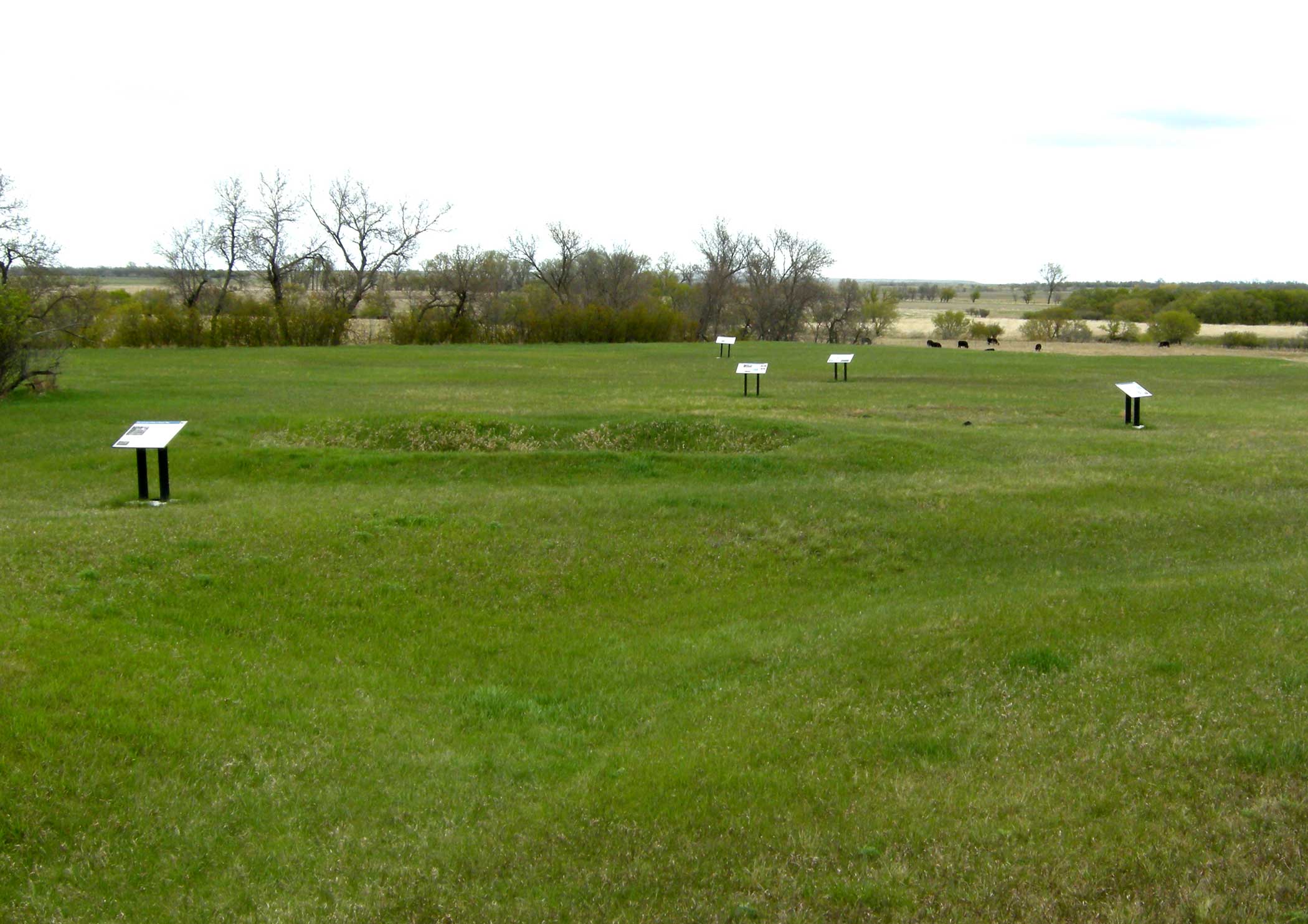
Menoken Indian Village Site
For decades, archaeologists were certain they knew what lay beneath the prairie east of Bismarck. The Menoken Indian Village Site, they believed, was a Mandan settlement visited by the French explorer Pierre Gaultier de Varennes, sieur de La Verendrye, in the 1730s. The name "Verendrye Site" stuck for years. Then came the excavations of the 1990s and early 2000s, and the neat historical narrative fell apart. Radiocarbon dating pushed the occupation back to somewhere between 1100 and 1300 CE, centuries before La Verendrye ever set foot on the Northern Plains. The people who built these fortified earthen walls, who quarried stone tools from sites to the west and shaped ceramic pottery by hand, were not Mandan at all. They were someone older, someone whose identity remains an open question in Plains archaeology.
Fortified Against the Unknown
The village that once stood along Apple Creek was not a casual campsite. It was fortified, a deliberate defensive settlement built by people who expected trouble. The occupants used the site as a semi-permanent home, venturing out to hunt bison and other wildlife across the surrounding grasslands before returning to their earthen walls. Stone tools recovered from the site were predominantly quarried from the Lynch Quarry vicinity to the west, indicating established trade routes or seasonal travel patterns that stretched across what is now central North Dakota. Ceramic pottery fragments and bone tools round out the picture of a community that was organized, resourceful, and deeply connected to the landscape. What makes Menoken extraordinary is its isolation in the archaeological record. It predates the villages more clearly tied to the Hidatsa, Mandan, and Arikara peoples, standing as evidence that the Northern Plains supported complex communities long before European contact.
A Name Misplaced
The site's tangled naming history tells a story of shifting understanding. First known as the Apple Creek Site for its location, it was later called the Verendrye Site after the French explorer presumed to have visited it. When the state acquired the land in 1937, it became known as the Menoken Site, after the nearby community. Each name carried assumptions about who had lived there and when. The 1930s excavations, conducted during the initial wave of Plains archaeology, assigned the village to the Mandan people largely because Mandan villages were what researchers expected to find along this stretch of the Missouri River basin. It took sixty years and modern dating techniques to reveal that the site belonged to a different era entirely. The people of Menoken lived and vanished before the historical tribes that would come to define the region ever established their villages along the Missouri.
Depression-Era Preservation
The Menoken site owes its survival partly to the Great Depression. When the state acquired the land in 1937, work relief programs put laborers to constructing improvements at the historic site, building infrastructure that would protect and present the archaeological remains to the public. These Depression-era construction features, stone walls and pathways built by workers from federal relief programs, earned their own listing on the National Register of Historic Places in 2010, recognized as historically significant artifacts in their own right. The site was declared a National Historic Landmark in 1964, cementing its importance to the region's prehistory. Today, a walking trail with interpretive signage guides visitors across the prairie where those unnamed people once lived, hunted, and defended their homes against whatever threats the Northern Plains delivered.
Older Than Memory
Stand at Menoken and you confront a humbling gap in the historical record. The Mandan, Hidatsa, and Arikara peoples whose villages dot the Missouri River corridor have rich oral traditions, documented encounters with European explorers, and well-studied archaeological sites. Menoken predates all of that. Its occupants left behind tools and pottery but no names, no stories that survive in any tradition we can access. They were ancestors, perhaps, of one of the region's major tribal groups, but which one remains uncertain. The site asks a question that archaeology has not yet answered: who were the first people to build permanent, fortified communities on the Northern Plains? The prairie grass has grown over their walls, Apple Creek still winds past their settlement, and the answer lies somewhere in the layers of earth that have kept this place for seven hundred years.
From the Air
Located at 46.84°N, 100.52°W, about 8nm east of Bismarck along Apple Creek. Bismarck Municipal Airport (KBIS) is the nearest field, roughly 8nm west. The site sits on flat prairie terrain east of the Missouri River. From the air, look for the interpretive site along Apple Creek, southeast of the I-94/US-83 interchange near the small community of Menoken. Best viewed at 2,000-3,000 ft AGL for context of the creek valley and surrounding grasslands.