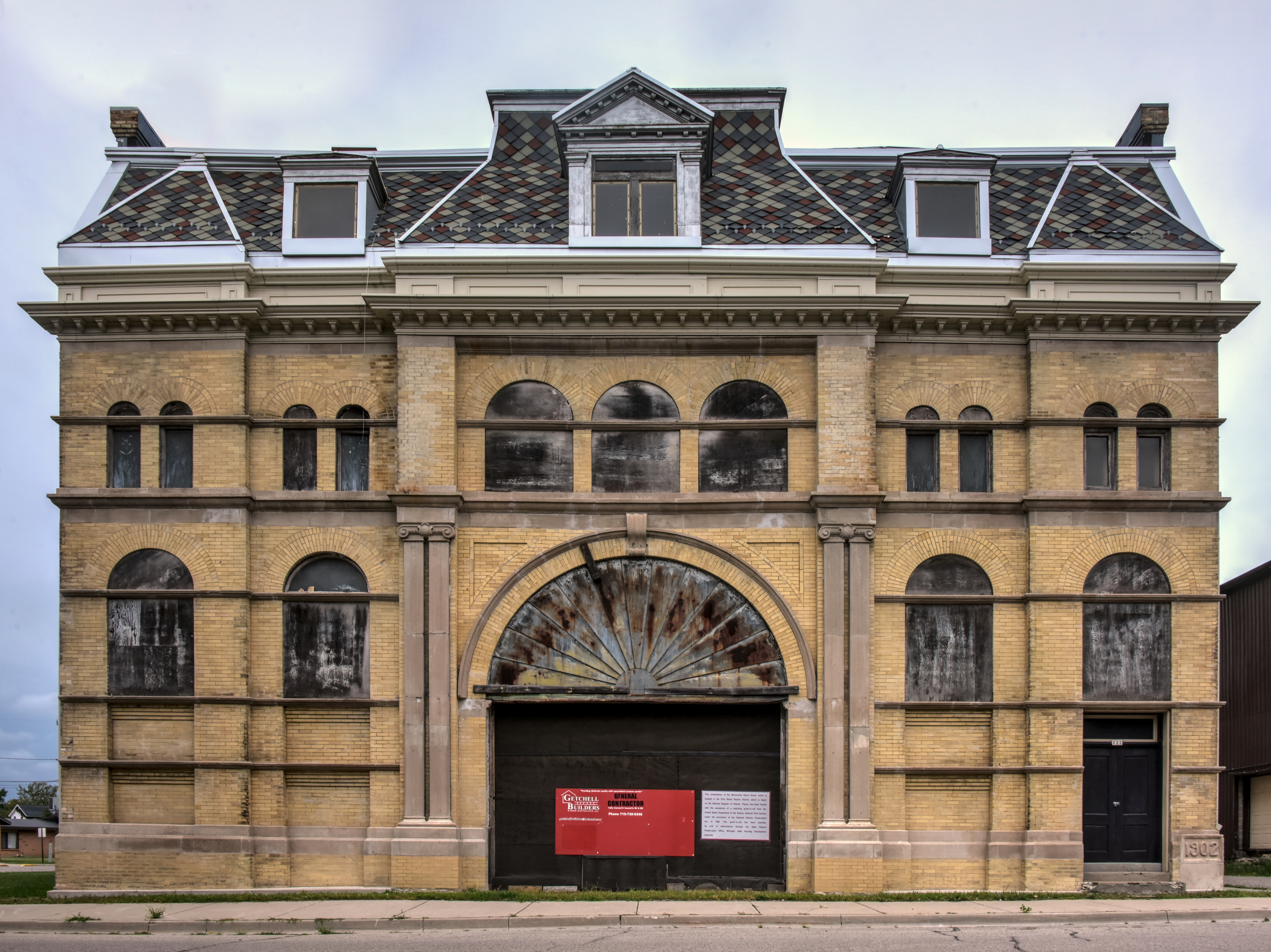
The Menominee Opera House: A Lumber Baron's Gift That Refused to Die
John Philip Sousa played here. Maude Adams -- the original Peter Pan on Broadway -- performed on its stage. Texas Guinan, the nightclub queen who would later greet Prohibition-era patrons with "Hello, suckers!", appeared before its audiences. The Menominee Opera House opened in 1902 as the cultural jewel of a Michigan lumber town, and for a few decades it delivered exactly the kind of refined entertainment its founders intended. Then movies killed vaudeville, a competing theater killed the movies, a fire killed the building's second life, and a bankruptcy sale turned it into a warehouse. The story should have ended there. It did not.
Lumber Barons and High Culture
The Menominee Opera House was born from an unlikely ambition: lumber barons who wanted opera. In the early 1900s, Menominee, Michigan, was a timber boomtown on the shores of Green Bay, and its wealthiest citizens decided their community deserved more than sawdust and saloons. They funded the opera house primarily through the sale of stock, pooling resources to commission architect George O. Garnsey, a well-known designer whose portfolio included the Ogle County Courthouse in Oregon, Illinois, and elegant Queen Anne-style homes like the Ellwood House in DeKalb, Illinois. Garnsey delivered a building worthy of their aspirations, sited in what is now the Historic Waterfront District of downtown Menominee. The opera house hosted not only musical and theatrical performances but political rallies, suffrage meetings, and local productions.
The Slow Fade
The rise of motion pictures in the 1920s ended the opera house's original purpose. Live entertainment gave way to film screenings, but even that could not save it -- a competing movie theater opened nearby and siphoned away audiences. The Menominee Opera House closed its doors in 1929. The city took ownership and repurposed the building as a civic auditorium through the 1930s and into the war years. Around 1945, it reopened yet again as The Menominee Theater, showing movies and occasionally hosting live acts like big band leader Tiny Hill. The building was proving resilient, adapting to each new era of entertainment. Then, around 2 AM on March 9, 1950, a fire broke out in the boiler room beneath the stage.
Fire and Ice
By the time the fire was discovered, flames were already rising through the roof. Firefighters contained the blaze before it reached the auditorium, but the damage was compounded by a cruel detail: it was the dead of a Michigan winter, and the water used to battle the fire froze on contact. The combination of fire damage and ice damage was estimated at around $30,000 -- a total loss for the era. The building went through bankruptcy proceedings and was purchased by a new owner who converted it into a warehouse. This unglamorous fate was also, paradoxically, its salvation. A warehouse needs walls and a roof, and so the structure that Garnsey had designed half a century earlier was maintained just enough to survive.
Theatre in the Ruin
The Menominee Opera House has spent the last several decades in a tug-of-war between restoration and condemnation. The Vennema family corporation owned it from 1979 until 2006, when they deeded the building to a nonprofit group called The Menominee Opera House Committee, Inc., formed by local volunteers in 2004. Their stated goal: restoring the historic opera house to become a multifunctional performing arts center. Progress has been painstaking. The State Historic Preservation Office of Michigan awarded the committee a $45,000 grant in June 2012 and a $27,000 grant in May 2015. On September 14, 2014, the group held its first live event, titled "Theatre in the Ruin" -- four musical acts performing in the gutted but still standing opera house. It was the first scheduled live performance in the building in over 70 years, an act of faith in bricks and mortar that echoed the faith of the lumber barons who built the place.
From the Air
Located at 45.10°N, 87.60°W in downtown Menominee, Michigan, on the western shore of Green Bay at the Michigan-Wisconsin border. The Historic Waterfront District where the opera house stands is visible along the Menominee River waterfront. Nearest airports include Menominee-Marinette Twin County Airport (KMNM) just south of town and Green Bay-Austin Straubel International Airport (KGRB) roughly 50 miles to the south. From altitude, Menominee appears as a small lakeside city at the river mouth -- the kind of place where lumber money once built grand things.