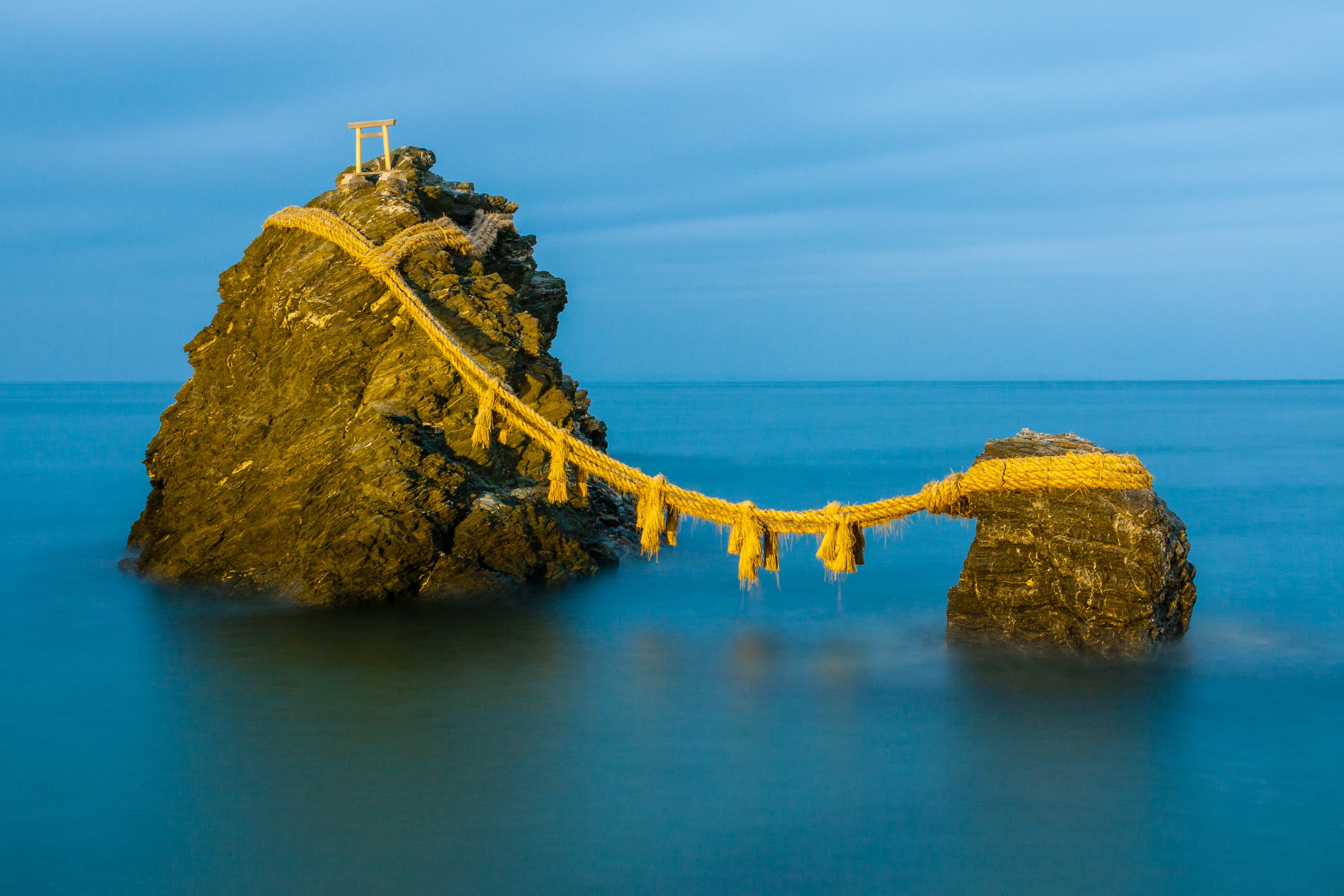
Meoto Iwa
Five heavy ropes of braided rice straw stretch between two rocks in the sea, and three times a year a crowd gathers on the shore to watch them replaced. The ceremony is not routine maintenance. It is a renewal of one of the oldest symbolic marriages on Earth. The Meoto Iwa -- the Wedded Rocks -- stand just offshore from Futami in Ise, Mie Prefecture, a larger stone and a smaller one leaning toward each other like partners in mid-conversation. The shimenawa binding them weighs over 200 kilograms across its five strands, each strand 40 kilograms of woven straw, and its total length stretches 35 meters. When salt air and Pacific storms finally fray the ropes beyond repair, Shinto priests wade into the water and tie new ones. They have been doing this, in one form or another, for as long as anyone can remember.
A Marriage That Made the World
In Shinto cosmology, the rocks represent Izanagi and Izanami, the creator deities whose union produced the Japanese archipelago. According to the Kojiki, Japan's oldest written chronicle, these two gods stood on the Floating Bridge of Heaven, stirred the primordial ocean with a jeweled spear, and from the brine that dripped from its tip, islands formed. Their marriage was the first act of creation, and the Meoto Iwa stand as its geological echo. The larger rock, nine meters tall and identified as male, carries a small torii gate at its summit -- a marker that a deity resides within. The smaller rock, four meters tall and female, tilts slightly toward its partner. At low tide, the water recedes entirely and the rocks stand on dry ground, their bases fully exposed, like a couple caught mid-embrace when the curtain drops.
The Sunrise Between Them
The most celebrated moment at Meoto Iwa comes during the summer months, between May and July. At dawn, the sun rises directly between the two rocks, framed in the gap as though the stones were placed there precisely for this purpose. On the clearest mornings, when atmospheric conditions align, Mount Fuji appears in the far distance behind the rising sun, 200 kilometers to the northeast. The summer solstice draws the largest crowds, photographers and pilgrims alike staking out positions along the rocky shore well before first light. The alignment is not accidental in the Shinto worldview. The rocks serve as a kind of natural torii gate -- a threshold between the material world and the realm of the divine -- and the sun passing through them is understood as a daily theophany, the visible manifestation of Amaterasu, the sun goddess, emerging from behind the veil.
The Rope That Holds Everything Together
The shimenawa is the most visible expression of what the rocks mean. In Shinto, a shimenawa marks sacred space, delineating the boundary between the profane and the holy. The one connecting the Meoto Iwa is among the most famous in Japan. Composed of five individual strands, it must withstand salt spray, typhoons, and the constant pull of gravity between two rock faces that are slowly, imperceptibly, being worn away by the Pacific. The replacement ceremonies in May, September, and December are public events, drawing visitors who watch as priests and helpers stretch new ropes between the stones. During the ritual, a traditional woodcarving song is sung, and some spectators take pieces of the old rope home as talismans for marital harmony. The old shimenawa is not discarded -- it is sacred material, carrying the residue of its service.
Duality Written in Stone
The Meoto Iwa at Futami are the most famous, but they are far from the only paired rocks in Japan. A National Married Couple Rocks Summit Liaison Council connects ten tourist sites across the country that feature similar formations, from Hokkaido to Okinawa. The phenomenon reflects a deep current in Shinto thought: the belief that the world is fundamentally organized in complementary pairs. Utsushi-yo and Tokoyo -- the visible world and the eternal realm. Ebisu and Daikoku, two of the Seven Lucky Gods often understood as aspects of a single divinity. Even the Japanese habit of counting chopsticks and shoes in pairs rather than individual units is said to trace back to this worldview. American composer Roger Reynolds visited the Futami rocks in 1966 and later built the first movement of his second symphony, "Symphony [Myths]" (1990), around their form -- two densely textured sections representing the rocks, separated by a quiet passage for the space between.
From the Air
Located at 34.509N, 136.788E, just offshore from the Futami coast in Ise, Mie Prefecture. The rocks are small sea stacks and not individually distinguishable from cruising altitude, but the coastline where the Kii Peninsula curves eastward is clearly visible. The adjacent Futami Okitama Shrine marks the onshore location. Nearest major airport: Chubu Centrair International (RJGG), approximately 60nm north-northeast across Ise Bay. Toba is about 7km southeast along the coast. Best viewed at low altitude following the shoreline from the northeast. Ise Bay weather patterns bring frequent haze and occasional sea fog, particularly in spring.