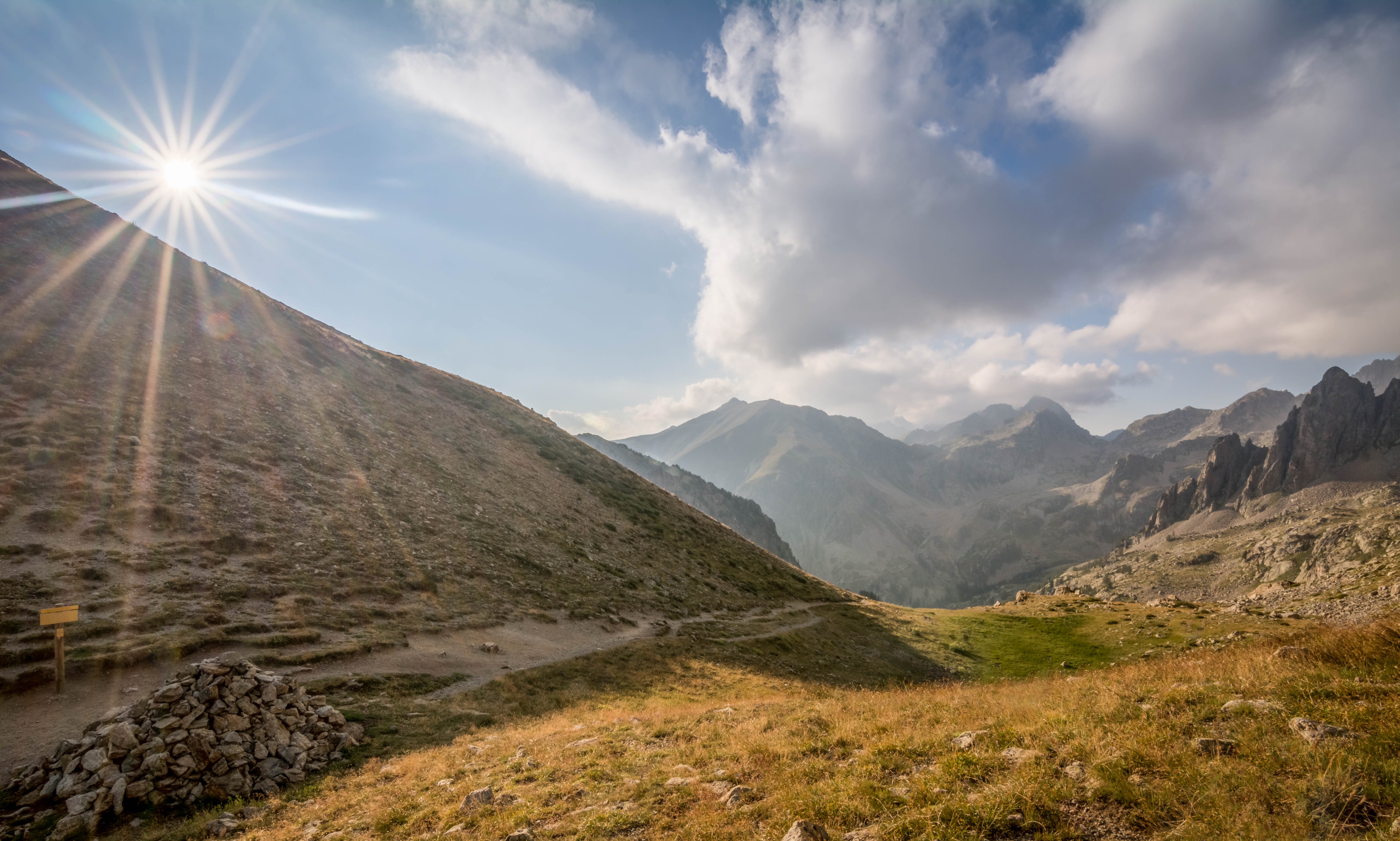
Mercantour National Park
Somewhere around 37,000 marks are pecked into the granite and schist faces around Mont Bego: weapons, cattle, geometric shapes, and human figures that no one fully understands. They date from the late Neolithic and Bronze Ages, and they gave the valley its name -- the Vallee des Merveilles, the Valley of Marvels. Mercantour National Park, established in 1979 in the southernmost reaches of the French Alps, protects not only this open-air gallery of prehistoric art but also 679 square kilometers of vertiginous summits, alpine lakes, and biodiversity that spans from Mediterranean olive groves to snowfields above 3,000 meters.
Seven Valleys, Seven Worlds
The park encompasses seven valleys spread across two departments: Roya, Bevera, Vesubie, Tinee, Haut Var, and Cians in the Alpes-Maritimes, plus the Verdon and Ubaye in the Alpes-de-Haute-Provence. Each valley has its own character. The Gordolasque valley, entered through the perched village of Belvedere, conceals churches decorated with murals by primitive Nicois painters. More than 150 rural sites dot the park, and 28 villages ring its central uninhabited zone. Many are perched settlements -- built on hilltops and cliff edges during centuries when elevation meant security -- their stone architecture blending into the landscape as if the villages grew from the rock rather than being placed upon it.
The Valley of Marvels
At the foot of Mont Bego, where the summits include the Cime du Gelas -- the third-highest peak in the Maritime Alps at 3,143 meters -- the petroglyphs tell a story that predates writing. The 37,000 carvings represent cattle, daggers, halberds, and figures whose meaning has been debated for generations. Some appear to depict rituals or celestial observations; others are enigmatic geometric patterns. The entire site is classified as a Historical Monument. For those unable to make the challenging climb to the rock faces themselves, the Musee des Merveilles in the town of Tende displays reproductions and artifacts that contextualize the carvings within the broader Bronze Age world of alpine pastoral cultures.
Two Thousand Flowers and Fifty Wolves
Mercantour's position where Mediterranean and alpine climates collide produces extraordinary biodiversity. Over 2,000 species of flowering plants grow here, 200 of them very rare -- edelweiss and martagon lily are the best known, but saxifrage, houseleek, moss campion, and gentian paint the meadows in spring. The park hosts a major All Taxa Biodiversity Inventory to catalog every living species within its boundaries. Chamois number in the thousands, marmots whistle from rocky slopes, and ibex and mouflon can be spotted during the cool hours. But the most dramatic biological story is the return of the Italian wolf. Around 50 wolves migrated into the Mercantour from Italy in the early 1990s, recolonizing territory from which they had been absent for decades. A Wolves Centre in Saint-Martin-Vesubie welcomes visitors interested in these controversial new residents.
Water and Stone
Alpine lakes punctuate the park -- the Lac d'Allos, the Lac du Lauzanier, the lakes of Vens and Morgon -- each a remnant of glacial action now ringed by wildflowers in summer and ice in winter. The vegetation changes dramatically with altitude: holm oak and olive trees at the lowest elevations give way to rhododendrons, firs, and spruces, then to Swiss pines and larches, and finally to bare rock and snow. Eight hundred thousand visitors walk the park's 600 kilometers of marked footpaths each year, moving through these vegetation zones in the space of a single day's hike. The Mercantour offers something rare in Western Europe: genuine wilderness within a few hours' drive of the Cote d'Azur.
From the Air
Located at 44.17N, 7.08E in the southern French Alps, near the Italian border. The park's rugged terrain includes peaks above 3,000 meters. Nice Cote d'Azur Airport (LFMN) is 60 km to the south. Cannes-Mandelieu Airport (LFMD) also nearby. Be aware of mountain weather and turbulence. Best viewed at 8,000-12,000 ft, where the contrast between alpine peaks and the Mediterranean coast to the south is visible.