Mercury Control Center: The Room That Launched America Into Space
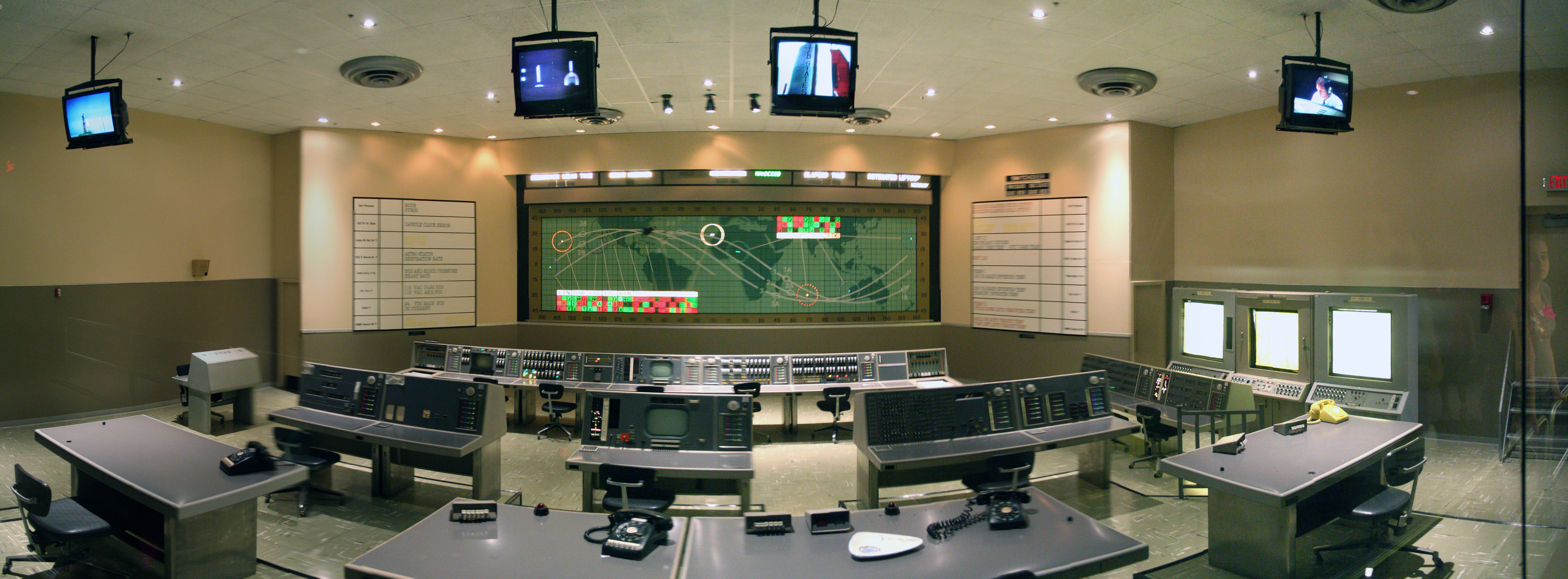
Three rows of consoles. A backlit map of the world with a tiny illuminated capsule sliding across it. No computer-generated graphics, no giant projection screens -- just men in short-sleeved white shirts watching dials, speaking in clipped radio shorthand to tracking stations scattered from Nigeria to Australia. This was Mercury Control, Building 1385 at Cape Canaveral, the room where America's space program learned to fly. When Alan Shepard rode his Freedom 7 capsule on a 15-minute suborbital arc in May 1961, the people in this room held their breath. When John Glenn orbited Earth three times in February 1962, they sweated through a warning light that suggested his heat shield had come loose. Every heartbeat of every Mercury astronaut passed through these consoles. The building was smaller than a suburban high school gymnasium, and from it, a superpower found its footing in the space race.
Eighteen Stations, One Room
Mercury Control did not work alone. It sat at the nerve center of a worldwide tracking network spanning 18 stations, from Grand Bahama Island to Zanzibar to a ship positioned in the Indian Ocean. Each station relayed telemetry back to Cape Canaveral during the brief windows when an orbiting capsule passed overhead. The backlit status map on the wall tracked the capsule's position in real time -- not with pixels, but with a physical model suspended and illuminated in front of a two-dimensional map. Controllers monitored spacecraft systems, astronaut vital signs, and the all-important go/no-go decisions for each successive orbit. In an era before satellite relay, this patchwork of ground stations and radio links was the only thread connecting a lone astronaut to Earth.
Built for 36 Hours
The MCC was designed for simplicity. Mercury missions lasted no longer than 36 hours, and the spacecraft carried a single astronaut performing a limited set of tasks. The control room needed only three rows of consoles: one for flight dynamics, one for spacecraft systems, and one for communications and recovery coordination. Compared to the sprawling Mission Control that would later fill an entire building in Houston, Mercury Control was almost intimate. Controllers could hear each other without headsets. The Flight Director could see every console from his chair. That compactness became a limitation as the program grew. When NASA expanded the facility in 1963 to support Project Gemini -- adding space for data analysis, meetings, and a Gemini spacecraft trainer -- Pan American World Airways handled the construction. But even expanded, the building could not accommodate the complexity of later Gemini missions or the Apollo program.
The Move to Houston
As spacecraft grew more capable, so did the demands on mission control. The two-person Gemini capsule and its rendezvous maneuvers required more controllers, more data processing, and more room. After supporting the first three Gemini flights -- including the uncrewed Gemini 1 and Gemini 2 and the crewed Gemini 3 with Gus Grissom and John Young aboard -- operations shifted to the new Manned Spacecraft Center in Houston. The Christopher C. Kraft Jr. Mission Control Center, with its rows of modern consoles and computer-driven displays, became the new nerve center for American spaceflight. Mercury Control's consoles went quiet. The room that had guided six crewed missions and defined an era of exploration became a training facility, then a tour stop. On June 1, 1967, it opened its doors to the public, a shrine to the audacity of those early flights.
Demolished but Not Forgotten
The building earned a place on the National Register of Historic Places on April 16, 1984, recognized as a contributing property to Cape Canaveral Air Force Station. But recognition could not halt decay. Asbestos contaminated the structure, salt air corroded it, and restoring it to its original state would have cost $6 million. NASA made a difficult choice: preserve the equipment and tear down the building. In 1999, the consoles, displays, and status map were carefully disassembled and moved to the Kennedy Space Center Visitor Complex. There, inside the Kurt Debus Center, the flight control room was reassembled. Many of the original consoles are powered on, their dials and switches restored. Visitors can stand where Chris Kraft stood, see the same status map that tracked Glenn's orbits, and feel the scale of what was accomplished in a room not much bigger than a living room.
From the Air
Located at 28.463°N, 80.583°W on Cape Canaveral Space Force Station, Florida. The original Building 1385 was demolished, but the site remains within the restricted launch facility area. The recreated Mercury Control room can be visited at the Kennedy Space Center Visitor Complex (28.52°N, 80.68°W). From the air, Cape Canaveral's launch pads are visible along the coastline. Nearby airports include KTIX (Space Coast Regional, Titusville), KMLB (Melbourne Orlando International), and KSFB (Orlando Sanford International). Patrick Space Force Base (KCOF) is directly south. Best viewed at 3,000-5,000 feet AGL in clear conditions.