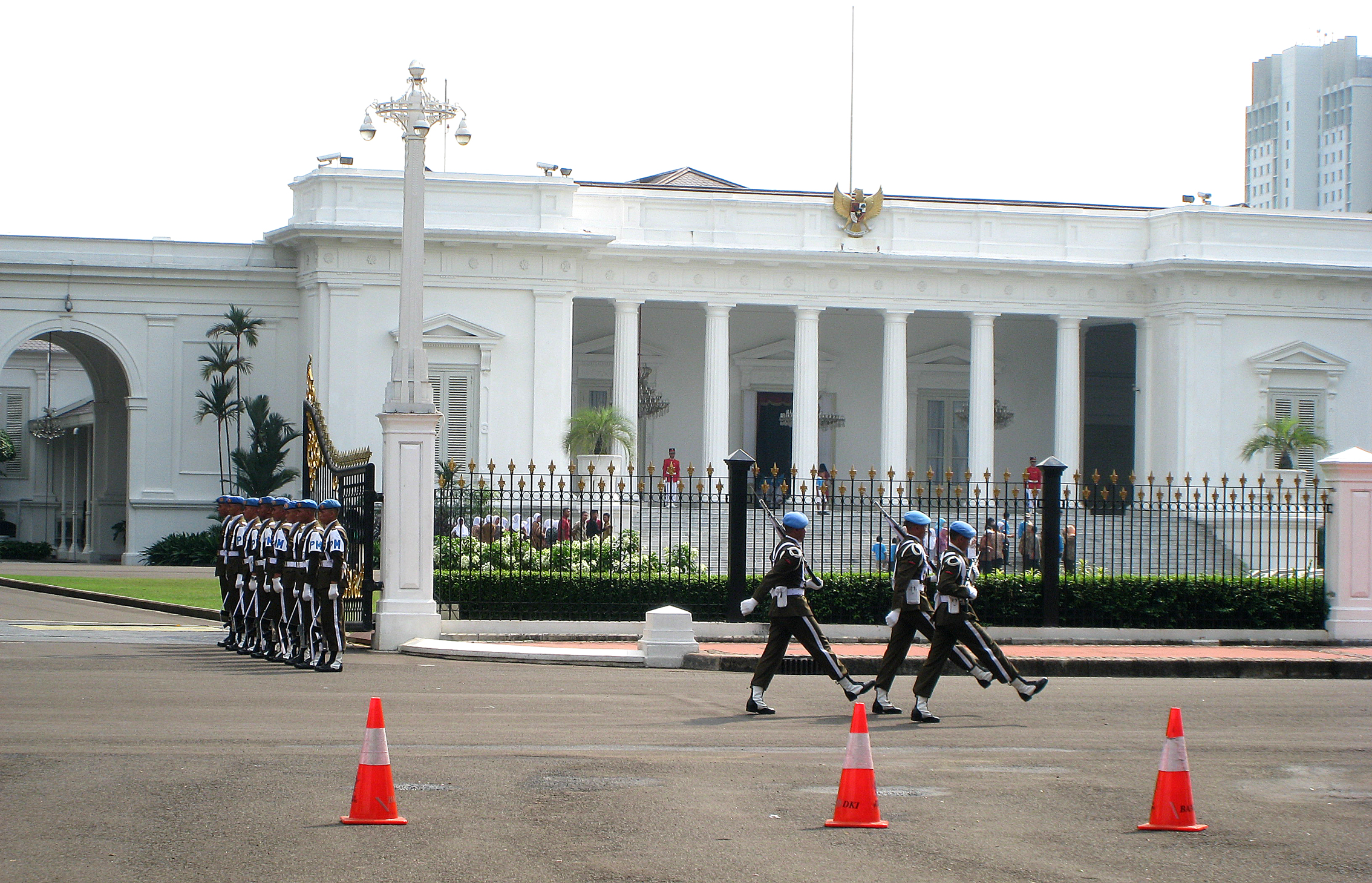
Merdeka Palace
The word merdeka means freedom in Indonesian, and it is not a name the Dutch chose. When the palace on the north side of Jakarta's great central square was renamed in 1949, the act was deliberate -- a colonial residence rebranded as a symbol of sovereignty. For seventy years, Dutch governors-general had lived behind its white Neo-Palladian facade, hosting receptions, signing decrees, governing an empire that stretched across thousands of islands. Then, in the space of a few tumultuous years of occupation, revolution, and diplomacy, the palace changed hands. The building stayed the same. Everything else about it shifted.
A Palace for the Governor-General
By the mid-nineteenth century, the older Rijswijk Palace -- now known as Istana Negara -- could no longer accommodate the administrative demands of the Dutch East Indies. Receptions had outgrown its rooms, and conferences required more space than the colonial-era residence could offer. In 1869, Governor-General Pieter Mijer ordered construction of a new palace on the southern lawn of the Rijswijk grounds, facing the vast Koningsplein -- the King's Square that would one day become Merdeka Square. Work began in 1873 under Governor-General James Loudon. The architect Jacobus Bartholomeus Drossaers designed the building in a Neo-Palladian style, and his contracting firm built it for 360,000 Dutch East Indies guilders. Construction finished in 1879, and Governor-General Johan Wilhelm van Lansberge became the first to take up residence. The last Dutch occupant, Tjarda van Starkenborgh Stachouwer, left the palace when the Japanese invaded in 1942.
Occupation and Independence
Three Japanese army commanders occupied the palace during the wartime years of 1942 to 1945. When Indonesia declared independence on 17 August 1945, the palace became part of a broader contest over sovereignty that would not fully resolve until the Dutch recognized Indonesian independence in 1949. That year, the building received its new name: Istana Merdeka, the Freedom Palace. President Sukarno made it his official residence, and the building became the center of Indonesian executive authority. It remains part of the Jakarta Presidential Palace Complex, which includes the adjacent Negara Palace, the Wisma Negara state guest house, the State Secretariat, and the Bina Graha building. Together they form a compound that has anchored Indonesian governance since the republic's earliest days.
Rooms That Remember
When Suharto succeeded Sukarno as president, the palace's interior was reshaped to match a new era. Sukarno's personal bedroom was converted into the Ruang Bendera Pusaka -- the Regalia Room, where national symbols and ceremonial objects are kept. The room that had belonged to Sukarno's wife Fatmawati became the new presidential bedroom. Each administration has left its mark on the interior, but the exterior has remained largely as Drossaers designed it: white columns, formal symmetry, a facade that communicates authority through restraint rather than extravagance. The 7th president, Joko Widodo, chose not to live here at all, preferring the cooler climate of Istana Bogor in the hills south of Jakarta. The palace continued to serve its ceremonial and administrative functions regardless.
Ceremony at the Gates
Since 17 July 2016, the Merdeka Palace has opened its forecourt to the public for a monthly changing of the guard ceremony. Performed by the Paspampres -- the Presidential Security Force -- the event takes place at 8 a.m. on the last Sunday of every month. Crowds gather along the iron fence to watch uniformed guards execute their precise choreography in the tropical heat, with the white palace rising behind them. It is a small gesture of openness for a building that spent most of its history behind closed gates, first as a colonial residence off-limits to the colonized, then as a presidential compound in a country that oscillated between authoritarianism and democracy. The ceremony draws tourists and locals alike, offering a rare chance to see the palace grounds up close.
From the Air
Located at 6.17S, 106.82E on the north side of Merdeka Square in Central Jakarta. The palace is identifiable from the air as a white Neo-Palladian structure at the northern edge of the large green square, adjacent to the Negara Palace. The 132-meter Monas obelisk at the center of Merdeka Square serves as the dominant visual landmark for orientation. Nearest major airport is Soekarno-Hatta International Airport (WIII), approximately 25 km northwest. Halim Perdanakusuma International Airport (WIIH) is closer, roughly 12 km to the southeast. Best viewed at lower altitudes in clear conditions.