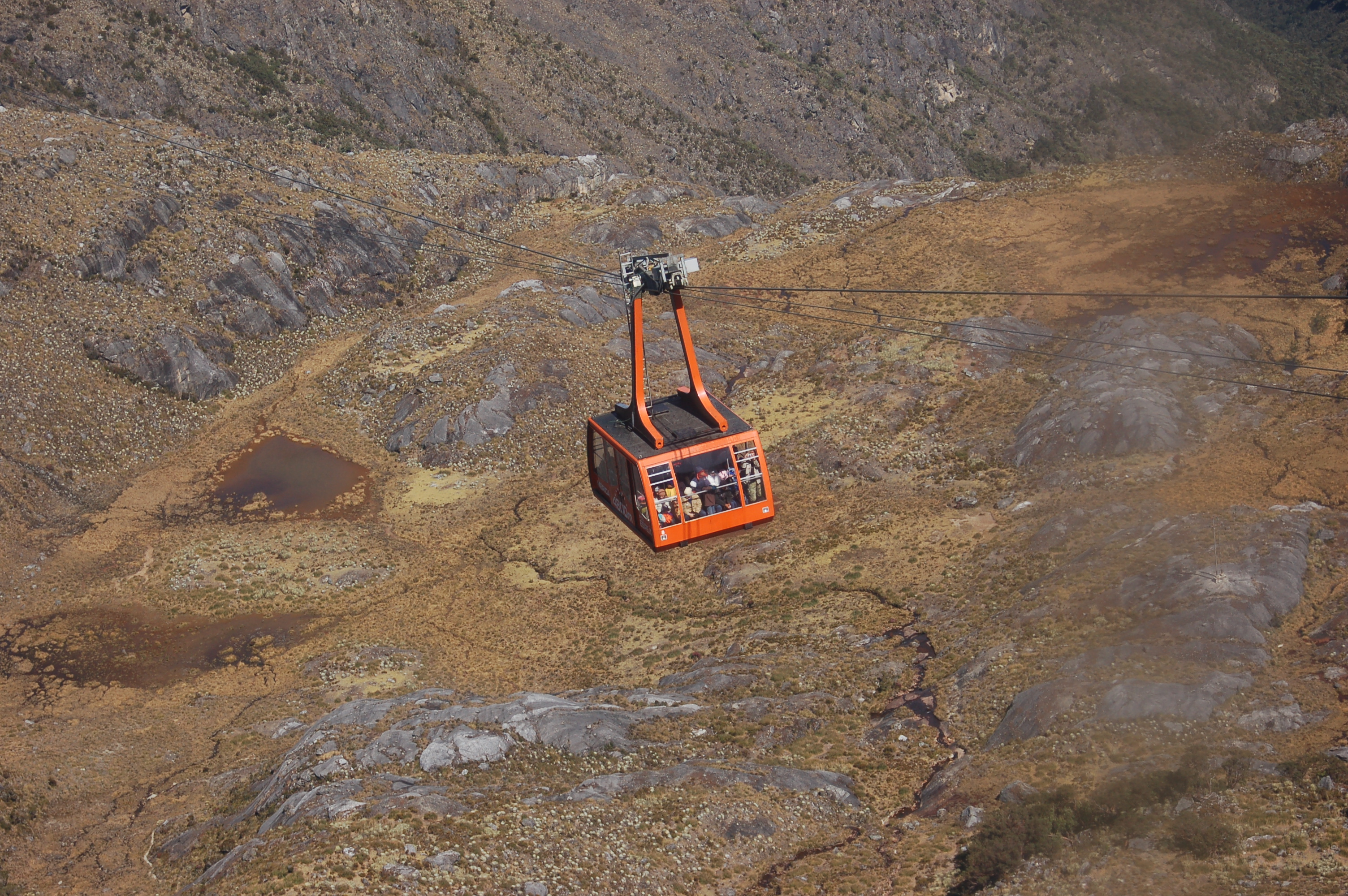
Merida Cable Car
The name Mukumbari means "place where the sun sleeps" in the indigenous language, and the cable car that bears it climbs to a place where the sun feels close enough to touch. From a base station in the city of Merida at 1,577 meters, the system ascends 12.5 kilometers across rugged Andean terrain to Pico Espejo at 4,765 meters -- nearly 16,000 feet above sea level. It is the highest cable car in the world, and the second longest. Passengers who board at the bottom in short sleeves arrive at the top in a landscape of rock, ice, and thin air, where the temperature can drop below freezing even when the valley below basks in tropical warmth. The original system opened to the public in March 1960. After 48 years of service, it was closed, demolished, and rebuilt from scratch. The new Mukumbari cable car reopened in October 2016.
An International Construction Project
The idea was born in 1952 from the Club Andino Venezolano, a mountaineering club whose members wanted easier access to the Sierra Nevada de Merida. The Venezuelan government approved the concept, and by 1955, construction had begun. The project was staggeringly international. The French firm Applevage coordinated the work, hiring 25 different companies. German company Heckel built the first three cable car sections; Swiss firm Habegger built the fourth. Civil works went to Eggeca, metal structures to Egecom, and essential mechanical systems to Sucre-Barret. The project director was Maurice Comte, from France. Workers came from Merida state, but technicians and engineers arrived from Poland, Yugoslavia, Colombia, and Haiti. This international character persisted for decades -- even in its final years of operation, cable car operators were more likely to speak French than Spanish.
Scaling the Sierra
The route comprises four cable car sections connected in series, each with two lanes carrying a cabin that holds 60 passengers. The cabins move at five meters per second along suspended cables powered by engines at two stations: La Montana, which drives the lower section, and Loma Redonda, which powers the upper reaches. The journey passes through distinct ecological zones. Passengers leave the city's temperate valley and climb through Andean cloud forest, where moisture clings to every surface and visibility can drop to a few meters. Higher, the forest thins into paramo -- the tropical alpine grassland unique to the northern Andes, where frailejones plants stand like silver sentinels against a stark sky. At Pico Espejo, the landscape is barren rock and ice, the air holds roughly half the oxygen of sea level, and on clear days the view stretches to the plains of the Llanos and the shimmer of Lake Maracaibo.
Closure and Rebirth
On August 11, 2008, the Venezuelan Ministry of Tourism shut the cable car indefinitely. The Doppelmayr Group, the Austrian firm that is the world's leading cable car manufacturer, inspected the system and recommended against further repairs -- after 48 years of continuous service, the infrastructure had reached the end of its useful life. A complete reconstruction was announced, with an optimistic opening date of 2012. The project ran years over schedule, a casualty of Venezuela's deepening economic crisis and the logistical complexity of building at extreme altitude. When the new system finally opened in October 2016, it was a modern marvel: the Mukumbari cable car featured new stations, new cabins, and upgraded safety systems, while preserving the original route that threads between two of the Cordillera de Merida's most dramatic peaks.
Where the Sun Sleeps
Pico Espejo, the cable car's terminus, stands directly across from Pico Bolivar, Venezuela's highest mountain at 4,978 meters. The two peaks are separated by a saddle that mountaineers use as a staging point for summit attempts. For most visitors, though, the cable car station is destination enough. At nearly 16,000 feet, the body registers the altitude immediately -- breathing quickens, movements slow, and the cold bites through any clothing not designed for it. But the reward is a panorama that spans from snow-dusted Andean ridges to the green lowlands of the Orinoco basin. Merida, the city of 300,000 that felt so substantial at the base station, shrinks to a cluster of rooftops in the valley below. The cable car has been making this transformation possible since 1960: in under an hour, it carries ordinary travelers from a bustling university town to the roof of Venezuela.
From the Air
The Merida cable car base station is located at approximately 8.529N, 71.064W in the city of Merida, Venezuela, at 1,577 meters elevation. The cable car line extends 12.5 km southeast to Pico Espejo at 4,765 meters (15,633 feet). The cable car route and its stations are visible as a thin line ascending the northern face of the Sierra Nevada de Merida. Nearest airport: Alberto Carnevalli Airport (SVMD/MRD), approximately 3 km southwest of downtown Merida. Caution: significant terrain in all directions, with peaks exceeding 4,900 meters. Mountain weather conditions can change rapidly with cloud formation along the ridgeline.