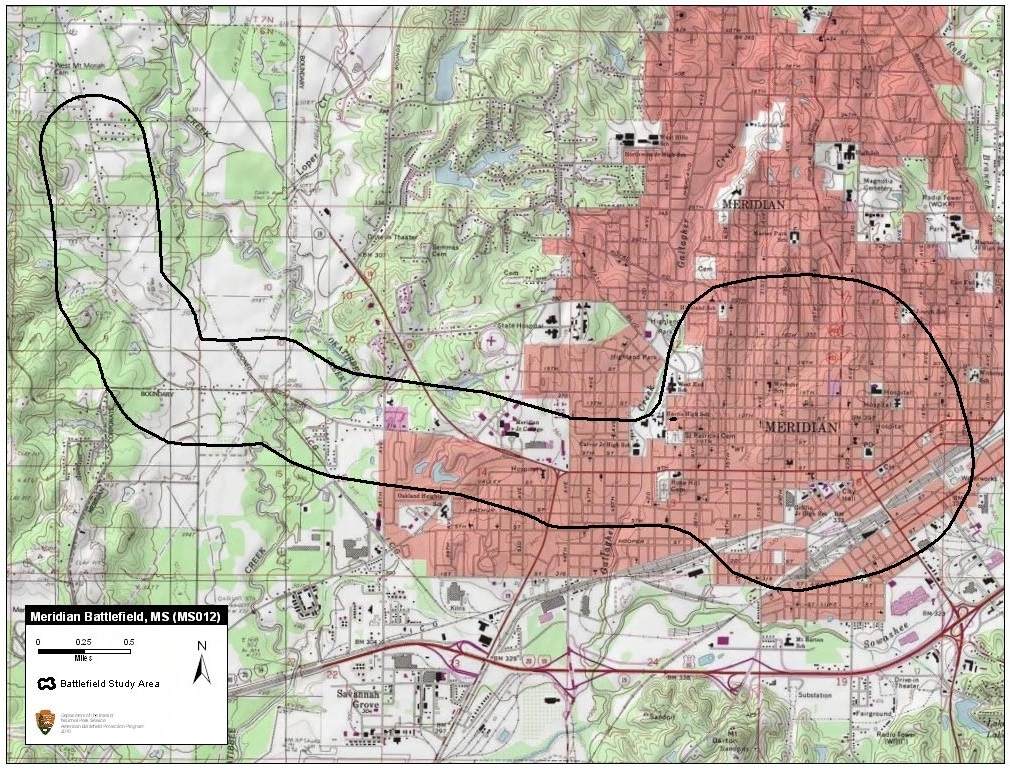
Meridian Campaign
Six days. That was all it took for William Tecumseh Sherman to erase Meridian, Mississippi, from the Confederate war map. In February 1864, while the wider Civil War ground on in Virginia and Tennessee, Sherman launched a swift, brutal expedition eastward from Vicksburg with 20,000 men, tearing through the heart of Mississippi with an audacity that stunned both sides. The campaign would last barely three weeks, but its significance would echo far beyond the pine forests and red clay of central Mississippi. Historians regard it as the blueprint for Sherman's far more famous March to the Sea later that year, a trial run in total war that proved a Union army could survive deep in enemy territory by living off the land and leaving destruction in its wake.
A Railroad Town in the Crosshairs
Meridian in 1864 was no ordinary Mississippi town. It sat at the junction of two vital Confederate rail lines, the Mobile and Ohio Railroad running north-south and the Southern Railroad running east-west. This crossroads made it a logistics hub for the Confederacy, home to a military arsenal, a hospital, a prisoner-of-war stockade, and the headquarters for several state offices. Sherman understood that destroying Meridian meant severing a critical artery. His plan was ambitious and multi-pronged: the main column would march east from Vicksburg, while Brigadier General William Sooy Smith would drive south from Memphis with 7,000 cavalry to meet him. A third column under Colonel James Henry Coates would push up the Yazoo River as a diversion. Sherman also arranged for gunboats to feint toward Mobile, forcing the Confederates to scatter their attention across half the Deep South.
The March Nobody Could Stop
Sherman's main force left Vicksburg on February 3, 1864, moving with a speed that kept Confederate General Leonidas Polk perpetually off balance. Feints into multiple regions of the state left Polk guessing about Sherman's true objective. Cavalry under Confederate General Stephen D. Lee skirmished with Sherman's columns near Clinton, Morton, and Brandon, but could not slow the advance. Day after day the blue columns pushed east, brushing aside resistance. By February 14, Polk recognized the inevitable and evacuated Meridian, falling back to Demopolis, Alabama. It was, by all accounts, a well-executed withdrawal. Confederate work crews managed to save nearly all stores and rolling stock, spiriting them away before Sherman's troops arrived. But the town itself was now in Union hands.
Wiping It Off the Map
Sherman occupied Meridian for six days, waiting for Sooy Smith's cavalry to arrive from the north. They never came. Smith had run into Nathan Bedford Forrest's cavalry near West Point, Mississippi, and was routed at the Battle of Okolona on February 22. But Sherman did not waste his time waiting. He ordered his troops to systematically destroy Meridian's military value. The numbers tell the story: 61 bridges demolished, 20 locomotives wrecked, 28 rail cars burned, 3 steam sawmills leveled, and miles of railroad track torn up and twisted beyond repair. The Memphis Daily Appeal noted wryly that the speed with which Polk's work crews rebuilt the Mobile and Ohio line would "compare with Yankee Enterprise." By March 24, barely a month later, the railroad was running again. But the precedent had been set.
The Shadow Campaign on the Yazoo
While Sherman devastated Meridian, a quieter drama unfolded along the Yazoo River. Colonel Coates led 947 men from the 11th Illinois Infantry and the 8th Louisiana Infantry Regiment (African Descent) up the river aboard six transports and five gunboats. They occupied Yazoo City on February 9, pushed upriver to Greenwood, and seized over 1,700 bales of cotton before withdrawing. On March 5, Coates' force repulsed an attack by two Confederate cavalry brigades under Lawrence Sullivan Ross at the Battle of Yazoo City. The Yazoo expedition accomplished its diversionary goal, tying down Confederate forces that might otherwise have reinforced Meridian. It also marked one of the campaign's notable contributions by African American troops, who fought in both the river operations and held their ground under fire.
Rehearsal for the March to the Sea
Sherman returned to Vicksburg on March 4, 1864, having inflicted heavy damage but fallen short of his larger ambitions to push into Alabama. Federal casualties totaled 729, Confederate losses 432. By conventional measures, the campaign was a modest Union success. But its true significance lay in what Sherman learned. He had marched a large army 150 miles through enemy territory, sustained it by foraging, and demonstrated that Confederate forces in Mississippi could not concentrate fast enough to stop a determined advance. Eight months later, Sherman would apply these lessons on a grander scale, leading 62,000 men on a 300-mile march from Atlanta to Savannah, cutting a swath of destruction across Georgia that broke the Confederacy's will to fight. The Meridian campaign was the proof of concept, a dress rehearsal performed on the red clay roads and rail junctions of central Mississippi.
From the Air
Coordinates: 32.3654N, 88.7043W. Meridian sits at the junction of I-20 and I-59, visible as a modest urban area in east-central Mississippi. The nearest airport is Meridian Regional Airport / Key Field (KMEI), 3nm southwest of the city. From 3,000-5,000 feet AGL, the railroad corridors that made Meridian strategically vital are still visible cutting through the pine forests. The route of Sherman's march roughly follows modern US-80 from Vicksburg (KVKS) eastward through Jackson (KJAN) to Meridian, a corridor of approximately 150 miles across Mississippi's central lowlands.