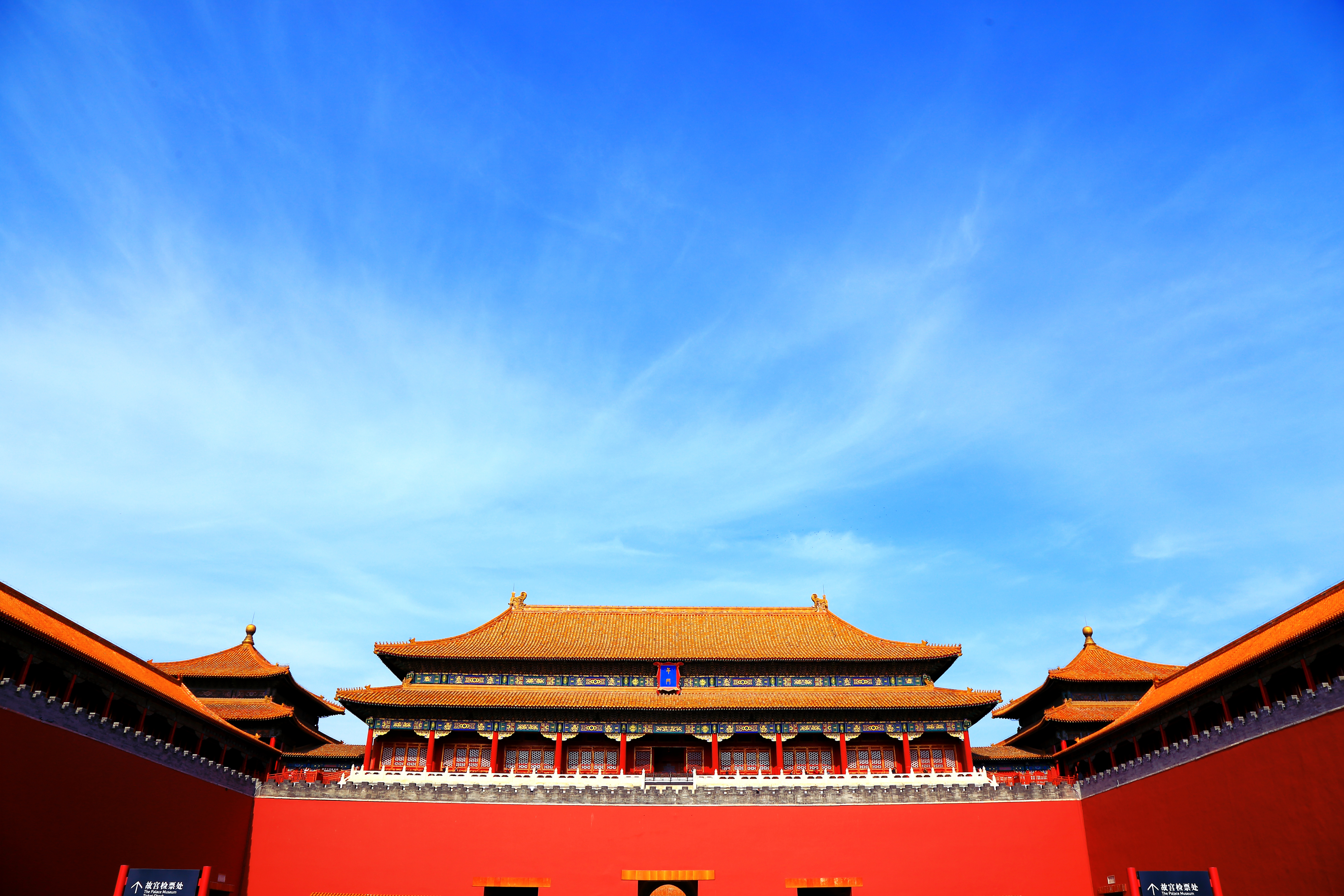
Meridian Gate
Five arches, five different answers to the question of who you are. The Meridian Gate, or Wumen, is the southern and largest entrance to the Forbidden City, and for centuries its central passage was reserved for exactly one person: the Emperor. Only two exceptions existed. An empress could pass through the center arch once, on the day of her wedding. And the top three scholars of the triennial civil service examinations could exit through it after completing their tests, a reward for intellectual achievement that placed them, for a single walk, in the company of the Son of Heaven.
Architecture of Authority
The Meridian Gate is not a simple doorway. It is a complex of buildings arranged in a U-shape, with two protruding arms extending south from the main structure, derived from ancient que towers that traditionally decorated the entrances to palaces, temples, and tombs. The central building is a pavilion nine bays wide with double eaves. On each protruding arm, a thirteen-bay structure connects to a pyramidal-roofed pavilion representing the que towers. The entire superstructure is known as the Five Phoenix Turrets for the five buildings that compose it. From above, the gate's shape resembles a pair of arms reaching outward to embrace those who approach, though for most of imperial history, the embrace was highly selective. Officials and servants used the four side arches. Everyone else, regardless of rank or purpose, entered through the flanking passages between the central section and the outstretched wings.
Where Power Made Itself Visible
Imperial proclamations and almanacs were issued from the Meridian Gate's upper pavilion, transforming the structure into a stage for the performance of state authority. After successful military campaigns, the Emperor received prisoners of war at the gate, ceremonies that sometimes concluded with mass executions. An urban legend persists that senior officials were executed here, but historical records indicate that only corporal punishment was carried out at the gate. The distinction matters: the Meridian Gate was a place where the state demonstrated control, not a killing ground. Its power was theatrical rather than lethal, designed to impress rather than terrify. Passing through the gate meant entering a sequence of spaces that progressively amplified the experience of approaching the throne. Behind the Meridian Gate lay the Upright Gate, the principal entrance to the imperial palace grounds, and beyond that, the Gate of Supreme Harmony, each threshold adding another layer of ritual separation between the outside world and the emperor.
Ceremonies in the Courtyard
The broad courtyard immediately inside the Meridian Gate served as a gathering place for the elaborate rituals that punctuated imperial life. On the first day of the lunar new year and the winter solstice, the emperor would stand in the upper pavilion while officials assembled below, arranged by rank in precise rows. The gate framed these ceremonies, its massive walls creating an enclosed theater where the relationship between ruler and ruled was enacted in choreographed detail. The five arches below channeled movement through the gate according to strict hierarchical rules, turning the simple act of walking through a doorway into a statement of social position. Even the sound of the gate carried meaning. Drums in the turrets announced the emperor's arrival and departure, their rhythm audible across the palace complex and, in the silence of old Beijing, well beyond its walls.
Standing at the Threshold
Today the Meridian Gate functions as the main entrance to the Palace Museum, and visitors pass through the same arches that once sorted emperors from scholars from servants. The hierarchical restrictions are gone, but the architecture still communicates something about scale and purpose. The gate is enormous, and entering the Forbidden City through it produces the same compression of space followed by sudden expansion that its designers intended. The courtyard beyond opens dramatically, and the progression toward the Hall of Supreme Harmony begins to unfold. From the air, the Meridian Gate's U-shaped plan is visible as a distinct notch in the southern wall of the Forbidden City, its protruding arms creating shadows that mark it as different from the palace's other entrances. It sits on Beijing's central axis, the same line that runs from Jingshan Park through the palace to Tiananmen Square, a hinge point in the city's geometry and in the experience of anyone who passes through it.
From the Air
Located at 39.91°N, 116.39°E, at the southern wall of the Forbidden City. The U-shaped gate structure is visible from altitude as a distinctive notch in the palace wall. Best viewed at 2,000-4,000 feet. Nearest airport: Beijing Capital International (ZBAA), approximately 25 km northeast.