Merry Cemetery
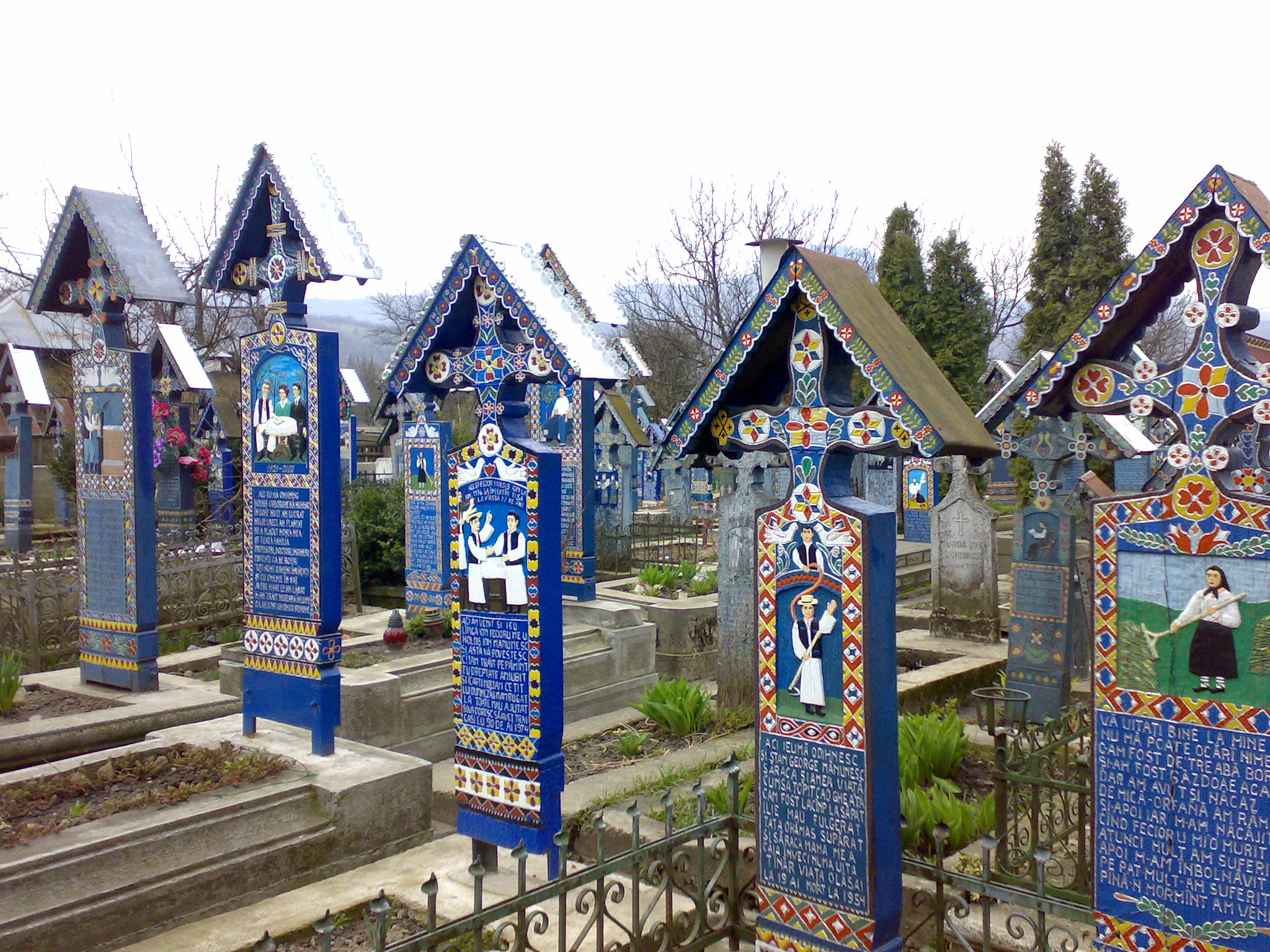
Most cemeteries ask for silence. This one tells jokes. In the village of Sapanta, tucked into Romania's Maramures County near the Ukrainian border, more than 800 oak crosses stand in rows, each painted a distinctive shade of blue and carved with scenes from the life of the person buried beneath. A shepherd tends his flock. A weaver works her loom. A man drinks too much and his wife scolds him -- forever, in paint. The epitaphs are often funny, sometimes biting, and always specific. One husband's tribute to his mother-in-law reads like a roast. This is the Merry Cemetery, a place that rejects the European tradition of treating death as something indelibly solemn, and chooses laughter instead.
One Man's First Cross
The cemetery's transformation began with a single carver. In 1935, Stan Ioan Patras, a local woodworker born in 1908, carved his first epitaph on an oak cross. The style was naive -- folk art, not fine art -- but the effect was startling. Instead of the usual somber inscriptions, Patras wrote short, rhyming verses that described who the dead person actually was: their trade, their habits, their quirks. He painted each cross in a vivid blue that became the cemetery's signature color, then added scenes rendered in bright yellows, greens, and reds. By the 1960s, more than 800 of these crosses filled the cemetery grounds. Patras continued carving until his death in 1977, and the inscription on his own cross -- carved by his apprentice, Dumitru Pop -- honors the man who gave Sapanta's dead their voices.
Epitaphs That Bite and Bless
What makes the Merry Cemetery singular is not the art but the words. The epitaphs are written in first person, as if the dead are introducing themselves to visitors. A woman describes her years at the loom. A soldier recounts how he fell. A drinker admits, with apparent pride, to his excesses. Some are tender: a mother's cross shows her children and names them one by one. Others are merciless -- a man's epitaph for his mother-in-law is an extended complaint, preserved in oak for the ages. The humor is village humor, specific and unvarnished. It assumes that the dead would rather be remembered honestly than eulogized vaguely. Two published collections preserve these texts: Roxana Mihalcea's 2017 volume Crucile de la Sapanta and photographer Peter Kayafas's book The Merry Cemetery of Sapanta, which pairs the crosses with their translations.
A Philosophy in Blue Paint
The Merry Cemetery's cheerful defiance has deep roots. The Dacian civilization, which occupied this region before the Romans arrived, believed death was a joyful passage -- a reunion with the god Zalmoxis. Whether or not Patras consciously drew on this pre-Christian tradition, his crosses reflect something older than Orthodox solemnity: the conviction that death is not an ending to mourn but a life to celebrate. The cemetery sits beside an Orthodox church, and the two coexist without apparent tension. Visitors from across Europe come to walk the rows, reading epitaphs they cannot fully understand but whose spirit translates easily. The cemetery has been listed among the Seven Wonders of Romania and now functions as an open-air museum, though burials still occur and new crosses still go up in the old style, painted in that unmistakable blue.
Sapanta at the Edge of Everything
Sapanta itself is a small village in the northwesternmost corner of Romania, just kilometers from the Ukrainian border. Maramures County is one of the most traditional regions in Europe -- a place where wooden churches with impossibly tall spires still serve their congregations, where hay is cut by hand, and where embroidered traditional dress is worn not for tourists but for Sunday services. The Merry Cemetery fits this landscape perfectly. It is folk art made by a folk artist for a folk audience, using materials -- oak, paint, a good story -- that the village understood. That it became internationally famous is almost incidental. The crosses were never made for outsiders. They were made for neighbors, who knew exactly which epitaph was accurate and which was generous, and who could appreciate both.
From the Air
Located at 47.97N, 23.70E in the village of Sapanta, Maramures County, Romania, near the Ukrainian border. The cemetery sits adjacent to an Orthodox church and is visible as a cluster of blue markers from low altitude. Best viewed at 2,000-3,000 feet AGL. The surrounding Maramures landscape features rolling hills, wooden churches, and traditional villages. Nearest significant airport: Baia Mare Airport (LRBM), approximately 50 km southeast. Satu Mare Airport (LRSM) is also within range to the west.