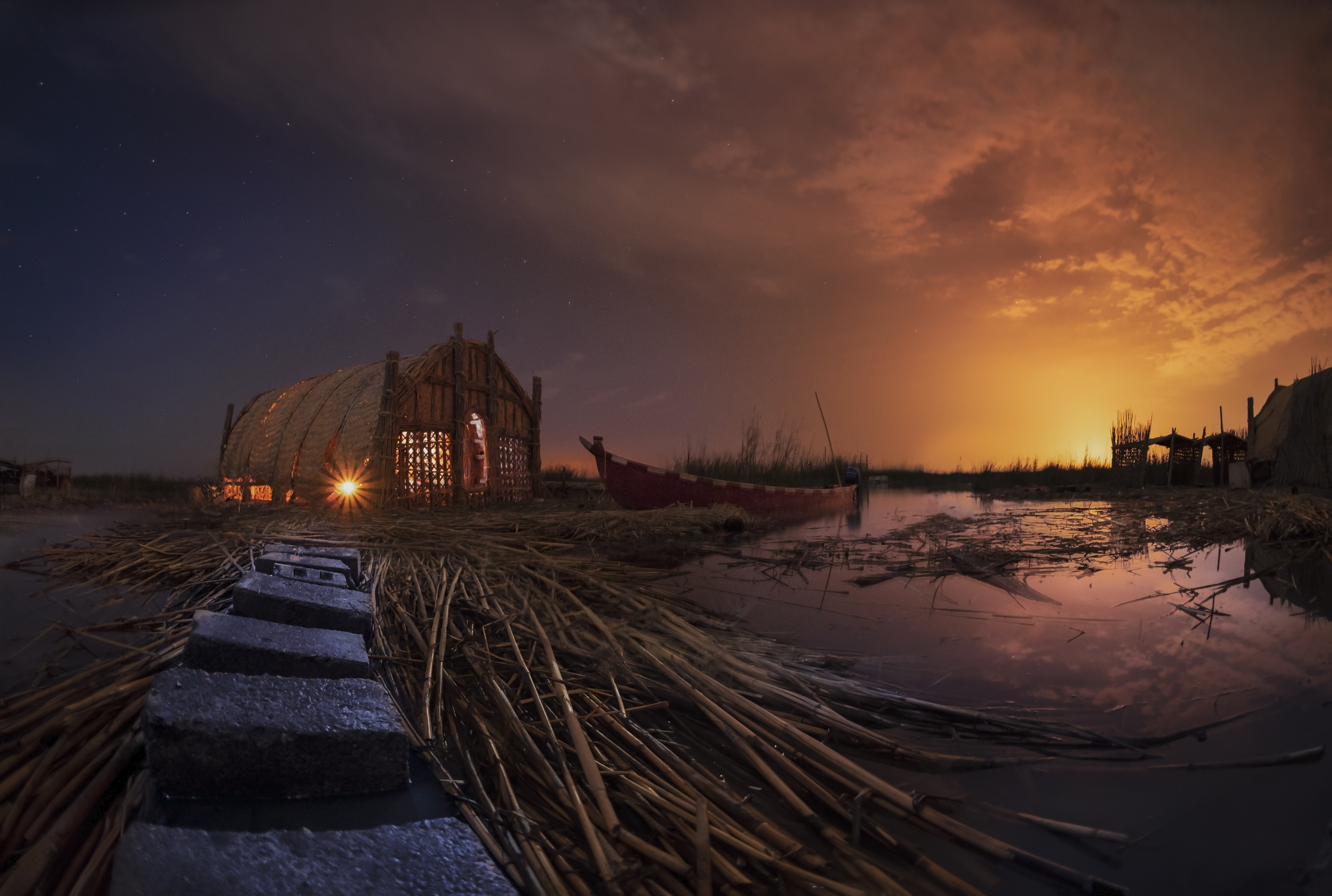
Mesopotamian Marshes
Some called it the Garden of Eden. For five thousand years, the marshes where the Tigris and Euphrates slow to a crawl across southern Iraq sustained a civilization of reed houses, water buffalo, and narrow canoes gliding through corridors of papyrus. Then, in the 1990s, the water vanished. Saddam Hussein's engineers diverted the rivers, and 20,000 square kilometers of wetland shrank to a tenth of their former size. Half a million Marsh Arabs scattered. The birds stopped coming. UNESCO recognized these marshes as a World Heritage Site in 2016, but the honor arrived alongside a harder truth: the water that returned after 2003 has been draining away again, this time claimed by drought and upstream dams in Turkey, Syria, and Iran.
Where Two Rivers Exhale
The marshes occupy the flattest land imaginable. Over its final 300 kilometers, the Euphrates drops just 12 meters in elevation. The Tigris falls only 24. At gradients that gentle, rivers stop behaving like rivers. They meander, split into distributaries, and spill across the plain. Three distinct marshes formed this way: the Central Marshes between the two rivers, the Hammar Marshes south of the Euphrates stretching from Nasiriyah to the Shatt al-Arab, and the Hawizeh Marshes east of the Tigris along the Iranian border. During flood season, the three merged into a single interconnected wetland. Hammar Lake alone stretches 120 kilometers long and up to 25 kilometers wide, though its depth rarely exceeds three meters. In summer, the retreating water exposes islands where farmers plant crops, only for the marshes to reclaim the land when the floods return.
A Civilization Built on Reeds
The Ma'dan, the Marsh Arabs, developed a way of life perfectly adapted to this amphibious world. Their villages sit on floating islands of compacted reeds, their arched houses woven from Phragmites so skillfully that the structures can last for decades. Transportation means the mashoof, a slender canoe that threads through channels barely wider than the boat itself. Water buffalo provide milk, meat, and labor. Rice grows in the shallows. Fish are everywhere. In the 1950s, roughly 500,000 people lived this way. Then came the draining. Saddam's campaign reduced the population to about 20,000, and between 80,000 and 120,000 fled to Iran. After the 2003 invasion, returning families hacked down the dikes with their own hands. But the Ma'dan who came back found their marshes increasingly saline and polluted. Many have been forced to the perimeters, trading reed houses for grain farming on dry ground. They remain among Iraq's most underserved people, struggling for clean drinking water and basic healthcare.
An Ecosystem on the Flyway
Before the draining, the marshes served as a critical waystation on the migratory corridor between Siberia and Africa. Flamingos, pelicans, and herons bred here. The wetlands harbored 40 to 60 percent of the world's marbled teal population and 90 percent of the Basra reed-warbler, a species found almost nowhere else. Sacred ibis and African darters waded through the shallows. A subspecies of hooded crow unique to this region, the Mesopotamian crow, still persists in southern Iraq. Seven species have gone extinct from the marshes entirely, including the Indian crested porcupine and the marsh gray wolf. But the news is not all grim. Recent surveys confirmed that both the Eurasian otter and the endemic Maxwell's smooth-coated otter still survive here, after years of uncertainty about their status. The marshes also function as a natural filter for the Persian Gulf, trapping pollutants before they reach coastal waters, though that capacity suffered enormously from the draining.
Draining as Warfare
The destruction of the marshes was deliberate, methodical, and political. Planning began in the 1950s with British engineer Frank Haigh's report recommending canals, sluices, and dikes on the lower Tigris and Euphrates to reclaim farmland. Construction of the Third River, also called the Main Outfall Drain, started in 1953. But what began as agricultural engineering became a weapon after the 1991 Gulf War, when Shia Muslims in southern Iraq rebelled against Saddam Hussein. He crushed the uprising and accelerated the draining of the Central and Hammar marshes to flush out those who had taken refuge in the reeds. The Glory River diverted Tigris tributaries away from the marshlands entirely. By the early 2000s, satellite images showed a moonscape where a wetland had been.
The Unfinished Restoration
After 2003, restoration came quickly at first. By 2008, roughly 75 percent of the original marshes had been reinundated. Then progress reversed. By 2015, the wetlands had receded to 58 percent of their pre-draining average. The culprit was no longer a dictator but hydrology itself. Turkey's dam projects on the upper Euphrates and Tigris reduce downstream flow. Iran diverts tributaries. Drought, worsened by climate change, squeezes what remains. As water levels dropped, salinity soared to 15,000 parts per million in some areas, up from 300 to 500 ppm in the 1980s. The low-saline Tigris once washed through the marshes and pushed salt residue into the Euphrates, but now the Tigris runs too low, and the saltier Euphrates provides most of the water instead. Iraq's government prioritizes urban water supply along the Tigris and the Shatt al-Arab, leaving the marshes last in line. The Garden of Eden, it turns out, depends on decisions made hundreds of kilometers upstream.
From the Air
Centered at approximately 31.00N, 47.00E, the Mesopotamian Marshes spread across a vast area of southern Iraq between the Tigris and Euphrates rivers. From cruising altitude, look for the distinctive patchwork of open water, reed beds, and exposed mudflats south of Amarah and east of Nasiriyah. The nearest major airport is Basra International (ORMM) to the southeast. The marshes extend toward the Iranian border to the east. In clear weather, the contrast between the green wetlands and surrounding desert is striking.