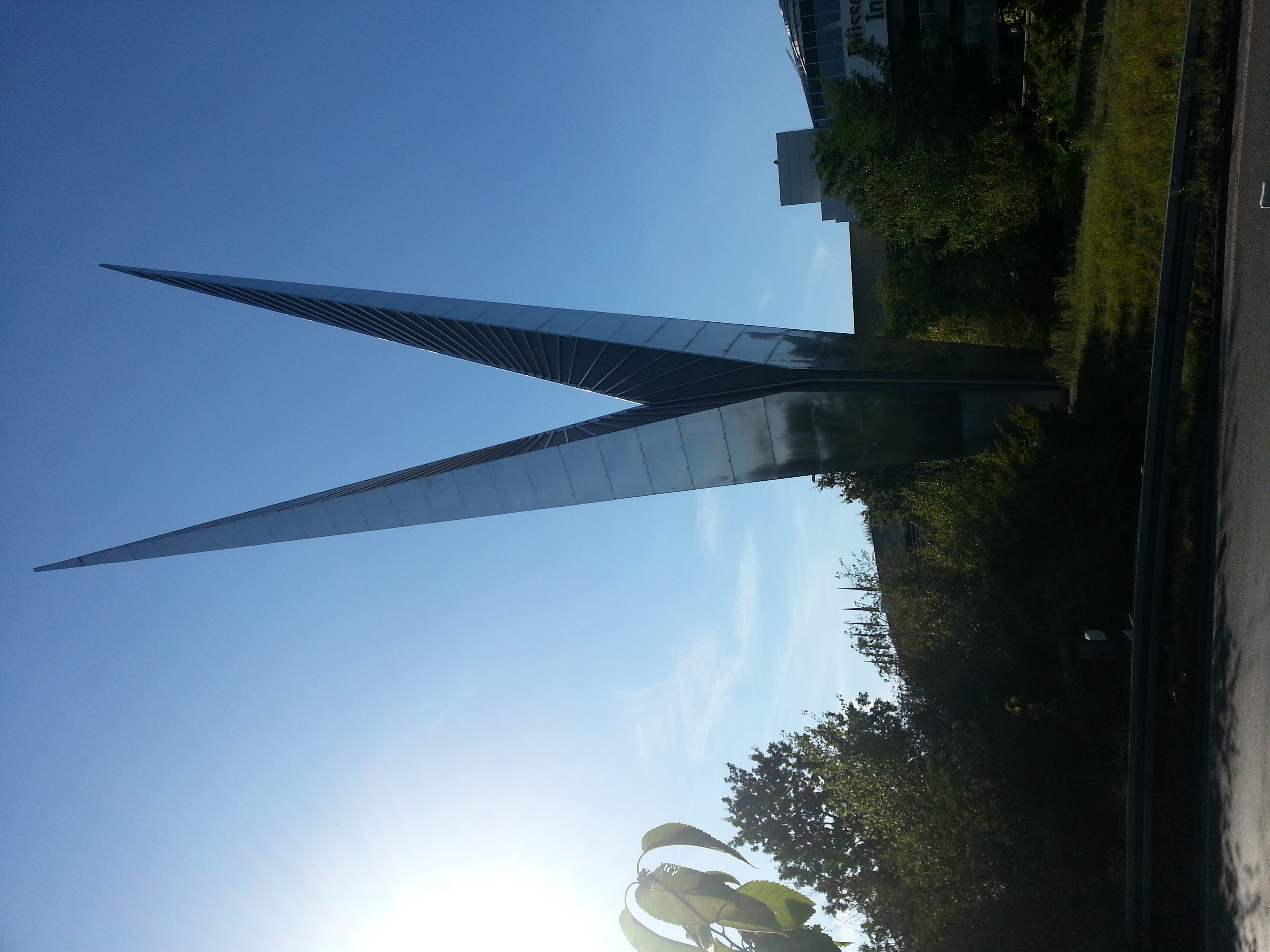
Messe Dusseldorf
Once every four years, ink-stained engineers from forty countries fly into Dusseldorf for Drupa. They come to see new printing presses the size of city buses, robotic binders, ink chemistry that wasn't possible at the last show, and packaging lines that fold cereal boxes faster than the eye can track. Drupa is the global summit of the printing industry, and it has happened in Dusseldorf since 1951. Between Drupas, the same enormous halls host the world's largest water sports fair (Boot, every January), the world's largest medical-technology fair (Medica, every November), the plastics industry's biggest gathering (K, every three years), and roughly twenty-five other major trade fairs. Messe Dusseldorf is a permanent industrial summit in motion, and the rest of the year you can stand in the empty halls and hear your footsteps echo for hundreds of meters.
Napoleon Started It
The fairground tradition here is older than the trade fair company. In 1811, the First Rhenish Trade Exhibition opened in Dusseldorf under the patronage of Napoleon Bonaparte, who had absorbed the Rhineland into his empire and wanted to show off the technical capacity of his new territory. The Rhine province was about to become one of Europe's industrial heartlands. By 1880, the Rhenish Exhibition for Industry and Trade had cemented Dusseldorf's reputation as a place where industries met to bargain. In 1902, the Industrial, Commercial and Art Exhibition drew over 2,500 exhibitors including Krupp, Hoerder Bergwerks- und Hutten-Verein, and Bochumer Verein, with halls built specifically for the event. The fairs got bigger. The companies grew rich. The Messe was, in everything but name, already in business decades before the company was formally founded.
GeSoLei: Seven and a Half Million Visitors
The single most extraordinary exhibition in Dusseldorf's history happened in 1926. The Great Exhibition for Health Care, Social Welfare and Physical Exercise, known by the acronym GeSoLei, sprawled across 400,000 square meters in the Pempelfort and Golzheim districts and drew approximately 7.5 million visitors over six months. For comparison, the city's own population at the time was around 430,000. GeSoLei was the largest trade fair Germany had ever held. It built the Tonhalle concert hall and the Ehrenhof courtyard, both of which still shape Dusseldorf today, and it positioned the city as a serious modern metropolis just eight years after the country had lost a world war. Two decades later, the same fairground tradition was put to a darker use: the 1937 Nazi Reichsausstellung Schaffendes Volk was built on the site of today's Nordpark as a showcase for the National Socialist worldview.
1947: Starting Over
Postwar Dusseldorf was rubble. Many exhibition buildings were destroyed or damaged, the economy was on its knees, and the country itself was an occupation zone. In 1947, the operating company Messe Dusseldorf was formally established in its current form. Two years later, the Export Fair of 1949 became the first major postwar event, helping West German industry to rebuild international contacts and announce to the world that it was open for business again. The 1950s brought continuous expansion. In 1951 the K plastics fair launched, and in 1963 Boot Dusseldorf opened as an international water sports trade fair and quickly grew into the largest of its kind on earth. In 1971, the company moved to a new, larger site on the Rhine in Stockum, the location it still occupies today.
The Calendar That Runs the City
Roughly 25 trade fairs and 50 other events flow through the Stockum grounds each year. Dusseldorf hotels know the Messe calendar better than they know the Bundesliga schedule. Boot in January fills the city with boat dealers from Croatia, Florida, and Hong Kong. Drupa, every four years, brings 250,000 printing industry attendees who book rooms two years in advance. Medica in November is a medical-technology pilgrimage. K in October, every three years, fills hotels for two weeks straight. The Messe is run as a limited liability company owned by the City of Dusseldorf, the State of North Rhine-Westphalia, the Dusseldorf Chamber of Industry and Commerce, and the Dusseldorf Chamber of Crafts, so its profits and losses are quite literally shared by the local economy. Add seven foreign subsidiaries (in China, India, the United States, and elsewhere) and the company functions as a roving emissary of German industrial culture, exporting trade-fair format to wherever new markets are opening.
The Pylon
At the entrance to the older fairground area stands the Pylon, a slim white tower that has served as the visual landmark of Messe Dusseldorf for decades. By day it is a marker. By night, lit from within, it is a beacon visible across the Rhine. To Dusseldorfers, the Pylon is the first sign that the city is about to fill with strangers speaking forty languages, all of them looking for halls 4 through 17. To delegates flying in to Dusseldorf International, the Pylon is the first piece of the trade fair grounds they spot from the descent. The Messe is one of the largest exhibition operations on earth, with an estimated 262,000 square meters of indoor space across 19 halls, and the Pylon is its modest, almost shy, way of pointing the door.
From the Air
Messe Dusseldorf occupies the Stockum district at 51.26 north, 6.74 east, on the east bank of the Rhine on the city's northern edge. The closest major airport is Dusseldorf International (EDDL), only 2 km north of the fairground, which is part of why the venue works at the scale it does. From the air, look for the large rectangular hall complex parallel to the Rhine, the white Pylon tower at one entrance, and the broad Nordpark just south of the grounds. The MERKUR SPIEL-ARENA, Dusseldorf's covered football stadium, sits adjacent to the fairground on the south side.