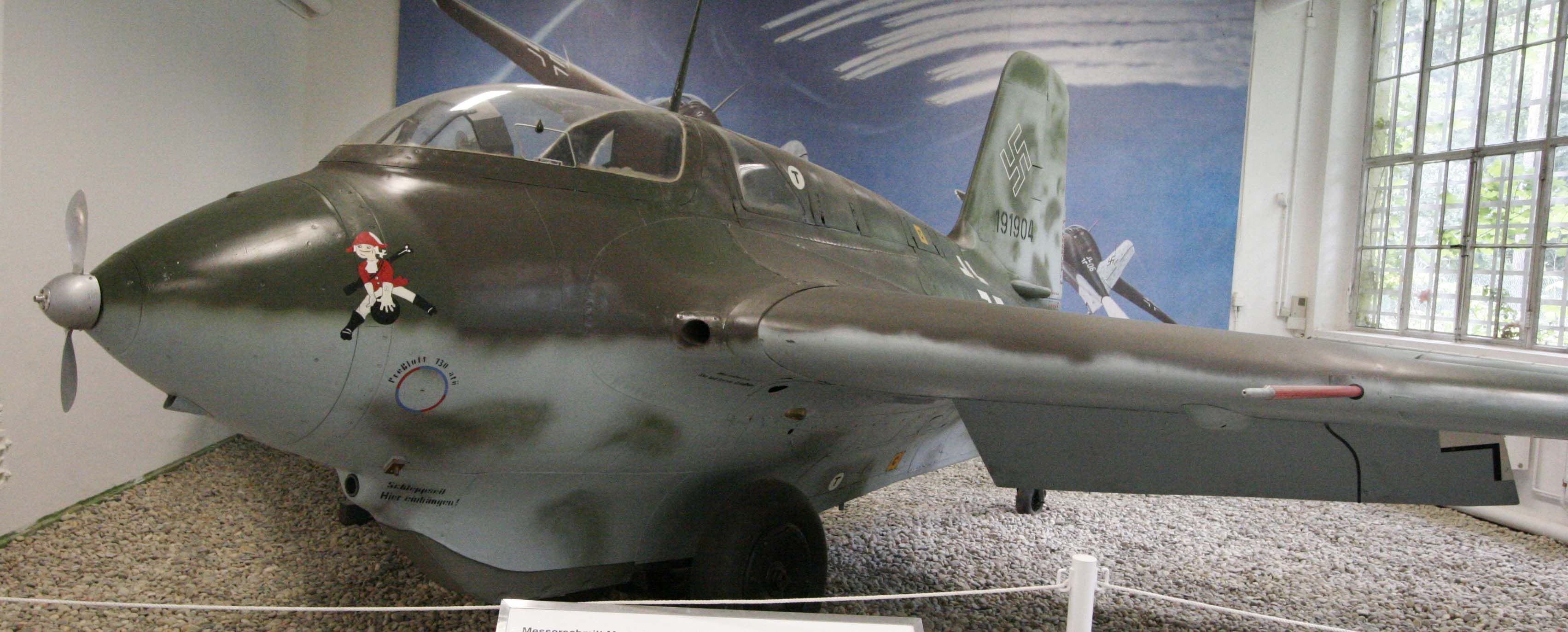
Messerschmitt Me 163 Komet
On 6 July 1944 a German test pilot named Heini Dittmar lifted off from a flat field in Lower Saxony in a stubby, tailless aircraft that looked more like a glider with a hangover than a fighter. He climbed at an angle that would have stalled anything else flying. He levelled off and pushed the throttle. The needle reached 1,130 kilometres per hour - just over 700 mph - and the rudder began tearing itself apart from flutter. He landed with most of the vertical surface gone. No turbojet aircraft would match that speed for another nine years. The Messerschmitt Me 163 Komet was the only rocket-powered fighter ever to enter combat, and one of the most dangerous aircraft anyone has ever flown.
Lippisch's Tailless Dream
The Komet was born from a long, patient line of glider research. Alexander Lippisch had been designing tailless and delta-wing aircraft since the late 1920s, including the rocket-modified glider *Ente* that made one of the world's first piloted rocket flights at Wasserkuppe in 1928. By 1937, Lippisch and his team at the Deutsche Forschungsanstalt für Segelflug were sketching the lineage that would lead to the Me 163 - tailless, swept-back wings, designed for centre-of-gravity reasons rather than high-speed aerodynamics, but happening to be ideal for both. In 1939 the team moved to Messerschmitt in Augsburg. They dropped the planned propeller version and went straight to a rocket motor: Hellmuth Walter's HWK 109-509, eventually a bipropellant burning T-Stoff (concentrated hydrogen peroxide) and C-Stoff (a methanol-hydrazine mix). On 2 October 1941, the prototype set an unofficial speed record of 1,004 km/h - and would not be matched on a normal runway takeoff until 1953.
The Chemistry of Self-Destruction
What made the Komet revolutionary also made it murderous to its own crews. T-Stoff was 80-per-cent hydrogen peroxide. It ignited spontaneously on contact with almost anything organic - cloth, skin, hair. C-Stoff would explode on contact with T-Stoff, which was the whole point in the engine but the nightmare everywhere else. The pilot sat with 120 litres of T-Stoff in two auxiliary tanks at his hips and a 1,040-litre main tank behind his back. Ground crews wore acid-resistant protective gear. The engines and propellant lines were flushed with water before and after every flight to wash out any traces. In 1943 the German fighter ace Josef Pöhs ruptured a fuel line in a takeoff accident at Bad Zwischenahn; T-Stoff exposure combined with his injuries killed him. He was not the last. Crashes that elsewhere would have meant a survivable hard landing here meant a pilot dissolving inside his cockpit. The Allied test pilot Eric 'Winkle' Brown, who flew almost everything else of his era, called four of the five tailless aircraft he ever piloted 'killers.' He meant the Komet kindly: he said it was the only one with good flight characteristics. The other four were worse.
Eight Minutes of Glory
Operationally the Komet was almost a contradiction. Its powered flight lasted at most seven and a half minutes. Its combat radius was about 40 km. The pilot took off on a jettisoned two-wheel dolly, climbed almost vertically through enemy bomber formations at speeds Allied fighters could not match in a dive, made a few firing passes with two 30mm MK 108 cannon, and then - propellant gone - became a glider, riding the air down to a belly-skid landing on a grass field. Allied pilots quickly learned to wait. They would loiter at the edge of the Komet's reach, watch the rocket plume cut out, and pounce on the suddenly unpowered fighter. Or they would strafe the airfields, knowing that a landed Komet was helpless on its skid until a Scheuch-Schlepper tractor could winch it back to shelter. Operational deployments included Erprobungskommando 16 at Bad Zwischenahn from August 1943 to August 1944, and the first dedicated Komet wing, Jagdgeschwader 400, at Brandis near Leipzig, guarding the Leuna synthetic-fuel plant. In all, between 9 and 18 Allied aircraft were destroyed by Me 163s for the loss of 10 Komets in combat. Many more Komet pilots were killed by their own aircraft.
The Hidden Crew
There is a part of this story that the breathless aviation histories often leave out. The Me 163 was largely built by forced labour. Like much of late-war Luftwaffe production, the airframes came together in plants where prisoners of the Nazi regime - foreign civilians deported from across occupied Europe, concentration-camp inmates assigned to armaments work - did the grinding, dangerous assembly. The pilots who flew these aircraft were volunteers; the workers who built them were not. Some of those workers died of exhaustion, disease, accidents or summary execution before a single Komet they had touched ever flew. The Komet's place in any honest history of aviation has to include them. So does its place in the story of Bad Zwischenahn, where the rocket fighters were tested, and where the airfield is now a golf course built over the runway from which Heini Dittmar took off for that 1,130 km/h flight.
What Remains
Roughly 370 Me 163s were completed. At the end of the war, the British captured 48 of them, mostly from JG 400 at Husum; about 24 were shipped to the UK for evaluation. Only one, VF241, was ever test-flown by the British - and only unpowered, with the rocket motor removed and replaced by test instrumentation. Eric Brown's unauthorised powered flight, made on 17 May 1945 with the help of a German ground crew and a signed disclaimer, was a one-off. Today around ten Komets survive in museums - at the Smithsonian's National Air and Space Museum, at the Royal Air Force Museum at Cosford, at the Australian War Memorial in Canberra, at the Canadian Aviation and Space Museum, and elsewhere. The Soviet successor design, the Mikoyan-Gurevich I-270, came out of captured Me 163 and Me 263 work but never entered service. The Komet's real legacy is more sobering than its top speed. It demonstrated that an aircraft could be too dangerous to fly safely, that revolutionary performance could be bought at a price no human being should be asked to pay. The pilots who flew it understood that. So did the workers who built it. Both deserve to be remembered.
From the Air
The Me 163 Komet's primary test field was the Luftwaffe base 'Adlerhorst' at Rostrup, Bad Zwischenahn, in Lower Saxony - 53.18 degrees north, 8.01 degrees east - from August 1943 to August 1944. The field today is a golf course. The first operational wing, Jagdgeschwader 400, was based at Brandis near Leipzig, defending the Leuna synthetic-fuel works. Surviving Komets are on static display at the National Air and Space Museum (Washington DC area), RAF Museum Cosford (UK), Australian War Memorial (Canberra), Canadian Aviation and Space Museum (Ottawa), Deutsches Museum (Munich), Planes of Fame (Chino, California) and a small number of other collections. From cruising altitude over Bad Zwischenahn, the former airfield site appears as a green oval north of the Zwischenahner Meer; nearest active airports today are Bremen (EDDW), about 60 km east.