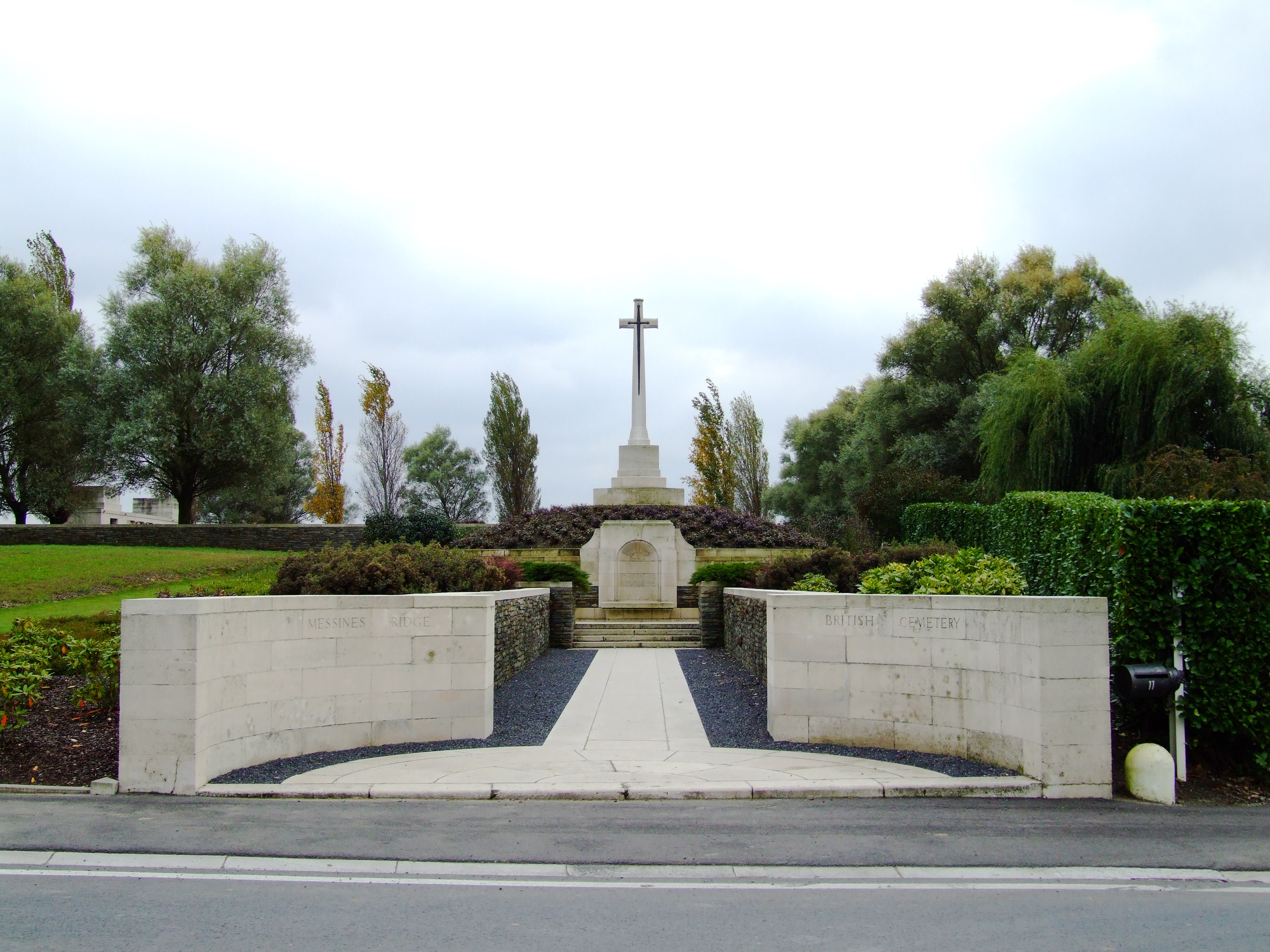
Messines Ridge British Cemetery
George Sellars played hooker for the All Blacks. Two test caps. He was killed on the morning of 7 June 1917, somewhere on the slope below Messines, in the same attack that ended with nineteen vast craters opened along the Messines Ridge. His body was never identified. His name is on a panel of the New Zealand Memorial to the Missing, on the rim of the cemetery that holds the men he fought beside — Messines Ridge British Cemetery, on the road that leads down off the ridge toward Wulvergem. He is one of eight hundred and twenty-seven New Zealanders the memorial commemorates. Behind him, in the cemetery itself, lie nearly fifteen hundred more soldiers, more than half of them never named at all.
The Town on the Ridge
Mesen — known to the British as Messines, the name that lives on in the battles fought around it — sits on the highest point in this part of Flanders. From its little hill you can see the whole of the Ypres Salient laid out to the north. That view was why the Germans took the town in the first weeks of the war, in late October 1914, and why the British could not really hold a defensible line until they took it back. The town changed hands three times: captured by the Germans in 1914, retaken by the New Zealand Division in 1917, lost again in the German Spring Offensive of March 1918, and seized for the last time in September 1918 during the Hundred Days that ended the war. Each time it changed hands, it changed hands violently. By 1919, nothing of the medieval town was left standing.
Three Hours in June
The Battle of Messines began at ten past three on the morning of 7 June 1917, with the simultaneous firing of nineteen deep mines under the German line. The Spanbroekmolen mine, a few kilometres up the ridge, made the largest crater. By breakfast the ridge was British again. The New Zealand Division took the town of Messines itself, fighting up through cellars and shell-broken streets, in what was one of the cleanest set-piece operations of the war on the Western Front. They took three thousand seven hundred casualties in the process. The dead were gathered up afterwards from where they had fallen — from Bell Farm and Onraet Farm and Bristol Castle and the River Douve, from a dozen small cemeteries scratched into the ridge by burial parties working between barrages — and brought, eventually, to a single place.
Charles Holden's Cemetery
The cemetery is the work of Charles Holden, the English architect who would later design Senate House at the University of London and most of the Piccadilly line stations between the wars. His CWGC cemeteries have a recognisable austerity: white stone, low walls, restrained geometry, nothing trying too hard. Messines Ridge British Cemetery, opened on a piece of land that had belonged to a Catholic foundation called the Institution Royale, holds the remains of 1,493 Allied soldiers. Over half are unknown — the headstone reads, in Rudyard Kipling's chosen phrase, A Soldier of the Great War, Known unto God. The cemetery faces west, down off the ridge. On a clear day you can see Kemmel from the back wall.
The New Zealand Memorial
At the entrance stands the New Zealand Memorial to the Missing, also Holden's design, a Cross of Sacrifice raised on a circular base ringed with stone panels. The panels carry the names of 827 New Zealand soldiers killed in this area whose bodies were never recovered or never identified. Most are men of the New Zealand Division killed in the June 1917 attack and the fighting that followed it through the rest of that summer. The memorial is one of seven such New Zealand sites on the Western Front — the New Zealanders chose to commemorate their missing close to where they fell, rather than collecting all the names in one place. The result is that the war has a smaller, more local shape in New Zealand memory than in British. George Sellars is named here, on the rim of the cemetery, looking out toward the ridge he was trying to take when he died.
The View From the Top
The town below the cemetery has been rebuilt — Mesen is now the smallest city in Belgium, with about a thousand inhabitants, a single church, and a peace school for Irish and German children that opened in the 1990s. The peace school sits in a former convent. The hill it sits on is the hill the New Zealanders took. The fields below the cemetery are farmed again. Tractors turn up shell fragments every spring; the Belgian army still removes unexploded ordnance from this stretch of Flanders on a regular schedule, almost a century later. Most of the visitors come for the mines and the craters. The cemetery, on the ridge above the town, tends to be quieter. Holden wanted it that way. So did Kipling. So, you imagine, would the men who lie there.
From the Air
Located at 50.7645 degrees north, 2.89103 degrees east, on the Mesen-Wulvergem road just west of Mesen (Messines) in West Flanders, Belgium. The cemetery sits on the southern edge of the Ypres Salient ridge. Nearest major airport is Lille (LFQQ) about 30 km south; Brussels (EBBR) is 115 km east. The cemetery occupies a small hilltop — visible in clear weather from low altitude as a white-walled rectangle on the high point of the otherwise flat Flanders plain.