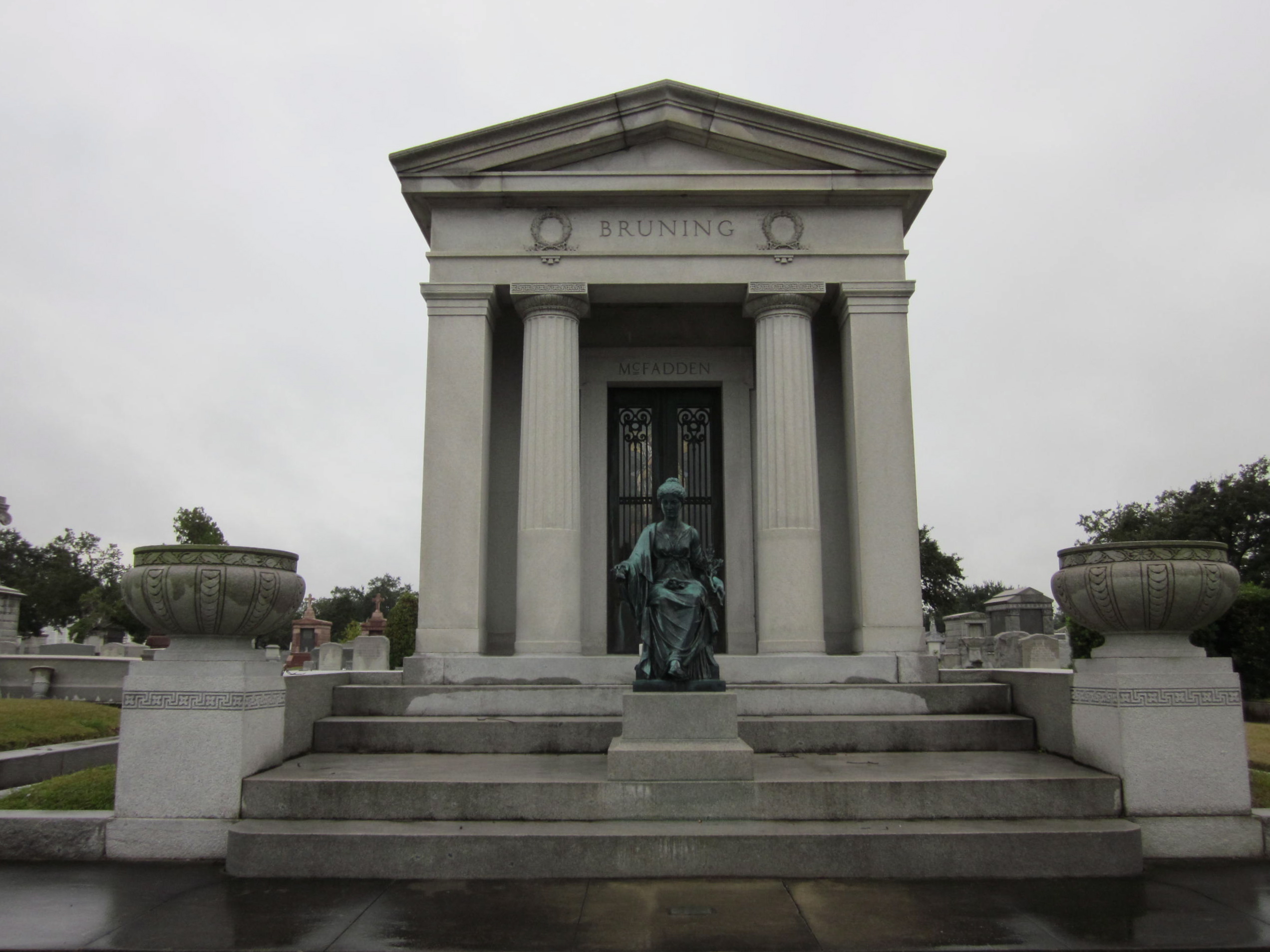
Metairie Cemetery
Charles T. Howard made his fortune running the first Louisiana State Lottery, but money could not buy him membership in the Metairie Jockey Club. The track's elite gatekeepers considered his wealth too new, too coarse for their society. Rejected and furious, Howard made a vow: he would see the Metairie Race Course turned into a cemetery. It was the kind of threat that sounds like bluster until it comes true. After the Civil War and Reconstruction bankrupted the track, Howard helped purchase the property in 1872 and converted it into Metairie Cemetery -- burying the institution that had snubbed him, quite literally, under six feet of New Orleans soil. Today Howard rests in his own tomb on Central Avenue, interred on the grounds of his triumphant revenge. He died in 1885 in Dobbs Ferry, New York, when he fell from a newly purchased horse.
From Thundering Hooves to Eternal Silence
Before the headstones, there were thoroughbreds. Colonel James Garrison and Richard Adams founded the Metairie Race Course in 1838, establishing it on a high-and-dry ridge along Bayou Metairie. The track became one of the premier horse racing venues in the antebellum South, drawing enormous crowds and entrance fees that ran as high as $1,000 per race. In 1848, Richard Ten Broeck purchased the course and officially founded the Metairie Jockey Club. The track hosted the famous Lexington-Lecomte Race on April 1, 1854, billed as the "Great States" race, with former President Millard Fillmore in attendance. The Civil War interrupted the races -- the track served as a Confederate camp, Camp Moore, until Admiral David Farragut captured New Orleans for the Union in April 1862. Racing never fully recovered, and the track's bankruptcy handed Howard his opportunity.
An Oval of the Dead
The cemetery's most striking feature is visible only from above: its roads follow the original oval layout of the race track. What was once a course for horses is now a circuit for mourners, and the irony is baked into the geography. Within those curving lanes lies the largest collection of elaborate marble tombs and funeral statuary in New Orleans. The Army of Tennessee, Louisiana Division monument holds the remains of Confederate soldiers, topped by an 1877 equestrian statue of General Albert Sidney Johnston on his horse "Fire-eater," sculpted by Alexander Doyle. A pseudo-Egyptian pyramid rises nearby. Laure Beauregard Larendon's tomb features Moorish details and stained glass. The Moriarty monument stands so tall that builders had to construct a temporary railroad spur just to transport the building materials to the site. Ruth Fertel, founder of Ruth's Chris Steak House, rests in a mausoleum that cost an estimated $125,000 to $500,000.
Governors, Generals, and Gangsters
The roster of Metairie Cemetery's permanent residents reads like a compressed history of Louisiana itself. P.G.T. Beauregard, the Confederate general who ordered the first shots of the Civil War at Fort Sumter, lies here alongside William C.C. Claiborne, the first U.S. governor of Louisiana. Jefferson Davis was buried here before his remains were moved to Richmond, Virginia, in 1893. P.B.S. Pinchback, the first African American governor of Louisiana, rests in the same grounds as Confederate general John Bell Hood. The cemetery holds crime bosses Silvestro Carollo and Carlos Marcello side by side with civic reformers and philanthropists. Andrew Higgins, inventor of the landing craft that carried Allied troops onto the beaches of Normandy, shares the soil with Al Hirt, the jazz trumpeter whose horn defined a generation of New Orleans music.
The Stories Between the Stones
Some of the most compelling tales at Metairie Cemetery belong to its lesser-known residents. Isaac Cline, chief meteorologist in Galveston from 1889 to 1901, was an integral figure in the devastating Galveston Hurricane of 1900 -- the deadliest natural disaster in American history. Margaret Norvell, a lighthouse keeper, earned enough distinction to have a Coast Guard cutter named after her. Al Copeland, who founded Popeyes Louisiana Kitchen, rests near Josie Arlington, the famed Storyville madam whose ornate tomb once attracted so many visitors that her family had her remains quietly moved. Police chief David Hennessy's memorial marks a man whose 1890 murder sparked the mass lynching of eleven Italian Americans -- one of the largest in United States history. Anne Rice, whose vampire novels made New Orleans synonymous with the gothic, was laid to rest here in 2022.
Where the Track Bends
Despite its name, Metairie Cemetery sits within the New Orleans city limits, not in the suburb of Metairie -- a confusion that traces back to its location on Metairie Road, formerly the banks of the since-filled Bayou Metairie. From the air, the oval footprint of the old race track is unmistakable, its curves preserved in the cemetery's winding roadways. The marble monuments catch the light like white chess pieces arranged on green felt. It is a place where the living visit the dead along the same path where horses once ran for thousand-dollar purses, where a man's grudge reshaped the landscape, and where the full spectrum of New Orleans history -- its triumphs, its sins, its music, its violence -- lies together in permanent proximity.
From the Air
Metairie Cemetery sits at 29.99N, 90.12W near the intersection of Metairie Road and Pontchartrain Boulevard in New Orleans. From the air, look for the distinctive oval shape of the old race track -- the cemetery's roads still trace the original course layout, making it one of the most recognizable landmarks in the city from above. Nearest airports: Louis Armstrong New Orleans International (KMSY) approximately 10 nm west, New Orleans Lakefront Airport (KNEW) about 4 nm northeast. Best viewed at 1,500-2,500 feet AGL where the oval layout and white marble monuments are clearly visible against the green lawns.