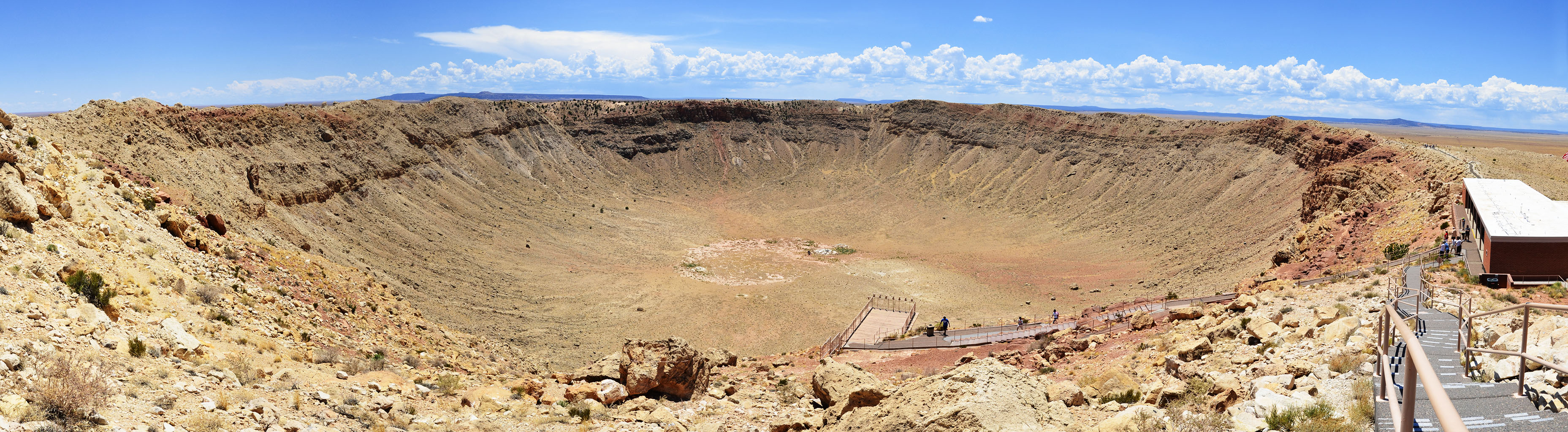
Meteor Crater: A Fortune Vaporized
Daniel Barringer died ten days after learning the truth. For 27 years, the mining engineer had drilled into the Arizona desert floor, certain that a massive iron meteorite worth millions lay buried beneath the mile-wide crater he owned. In 1929, astronomer F. R. Moulton delivered the verdict: the impactor had weighed far less than Barringer estimated, and the violence of its arrival had generated enough heat to vaporize it instantly. There was no buried treasure. There never had been. But Barringer's obsessive, bankrupting quest had accomplished something no amount of iron could buy -- he had forced science to accept that objects from space could, and did, slam into Earth.
When Mammoths Watched the Sky
Fifty thousand years ago, the Colorado Plateau was cooler and wetter, covered in grassland dotted with woodlands where mammoths and giant ground sloths grazed. A nickel-iron meteorite roughly 150 feet across entered the atmosphere and struck the plain at catastrophic speed. The impact released energy estimated at 10 megatons of TNT. About half the meteorite's mass had already vaporized during its descent through the atmosphere; the rest was destroyed on contact. The explosion excavated a crater about 4,000 feet in diameter and 570 feet deep, surrounded by a rim rising 150 feet above the surrounding plain. The center filled with rubble. The Arizona desert's dry climate then did something remarkable -- it preserved the wound almost perfectly. While erosion erased most impact craters across the planet, Meteor Crater kept its sharp rim and distinct bowl, making it the best-preserved meteorite impact site on Earth.
Diamonds in the Iron
The crater caught scientific attention through its scattered metal. In 1891, mineralogist Albert E. Foote received an iron rock from a railroad executive, recognized it as a meteorite, and led an expedition to collect more samples near what locals called Coon Butte. Among the fragments, Foote found microscopic diamonds -- carbon compressed by unimaginable force. That same year, Grove Karl Gilbert, chief geologist of the U.S. Geological Survey, investigated and declared the crater volcanic. It was the obvious conclusion in an era when lunar craters were attributed to volcanoes and nobody believed rocks fell from space with enough energy to reshape landscapes. Barringer, a mining engineer who had already made a fortune from the Commonwealth Mine in Cochise County, read about the scattered iron and saw opportunity. He filed mining claims, received a land patent signed by Theodore Roosevelt in 1903, and began to dig.
Twenty-Seven Years of Drilling
Barringer estimated the meteorite at 10 million tons -- a staggering deposit of nickel-iron worth a fortune. He incorporated the Standard Iron Company and drilled to great depths. Year after year, the borings turned up nothing significant. Impact physics was poorly understood, and Barringer could not have known that most of the meteorite had been converted to vapor and scattered fragments upon impact. The pieces of Canyon Diablo meteorite found on the surface had broken away before and during the collision. The main body simply no longer existed. By 1929, Barringer had spent 27 years and his fortune on the search. Moulton's report estimated the impactor at only 300,000 tonnes -- far smaller than Barringer imagined -- and confirmed total vaporization. Barringer died ten days later. But as one historian noted, by that time the great weight of scientific opinion had swung to accept the impact hypothesis. An idea too radical for 1905 had grown respectable.
Shocked Quartz and Moon Walkers
The definitive proof came in 1960. Eugene Shoemaker and Edward C. T. Chao identified coesite in the crater rocks -- a rare form of silica created only under the extreme pressures of an impact event or nuclear explosion. No volcano could produce it. The discovery settled the debate permanently and established Meteor Crater as the first conclusively proven impact crater on Earth. Then NASA came calling. During the 1960s and 1970s, Apollo astronauts trained inside the crater, learning to read impact geology before traveling to the Moon. The crater that Barringer had tried to mine became a classroom for lunar explorers. Today, roughly 270,000 visitors a year stand on the north rim, peer into the hole, and try to comprehend the moment 50,000 years ago when the sky fell on Arizona. The Barringer family still owns it all.
The Cessna That Couldn't Climb Out
On August 8, 1964, two commercial pilots in a Cessna 150 flew low over the crater. After crossing the rim, the small aircraft could not maintain level flight in the turbulent air inside the bowl. The pilot tried to circle and climb back over the rim. The plane stalled, crashed, and caught fire. Both occupants were severely injured but survived. A small portion of the wreckage remains visible on the crater floor -- a reminder that the hole in the desert commands respect from the air as well as the ground. The crater was designated a National Natural Landmark in November 1967, recognition of a place where a 50,000-year-old scar changed our understanding of Earth's place in a violent cosmos.
From the Air
Located at 35.03N, 111.02W in the high desert of northern Arizona, roughly 35 miles east of Flagstaff and west of Winslow along I-40. From altitude, Meteor Crater is unmistakable: a near-perfect circle punched into flat terrain. The rim casts distinct shadows. Nearest airports include Flagstaff Pulliam (KFLG) and Winslow-Lindbergh (KINW). The 1964 Cessna 150 crash is a cautionary tale -- turbulence and downdrafts inside the crater bowl can trap light aircraft. Best viewed at lower altitudes in clear conditions; the desert offers excellent visibility most days.