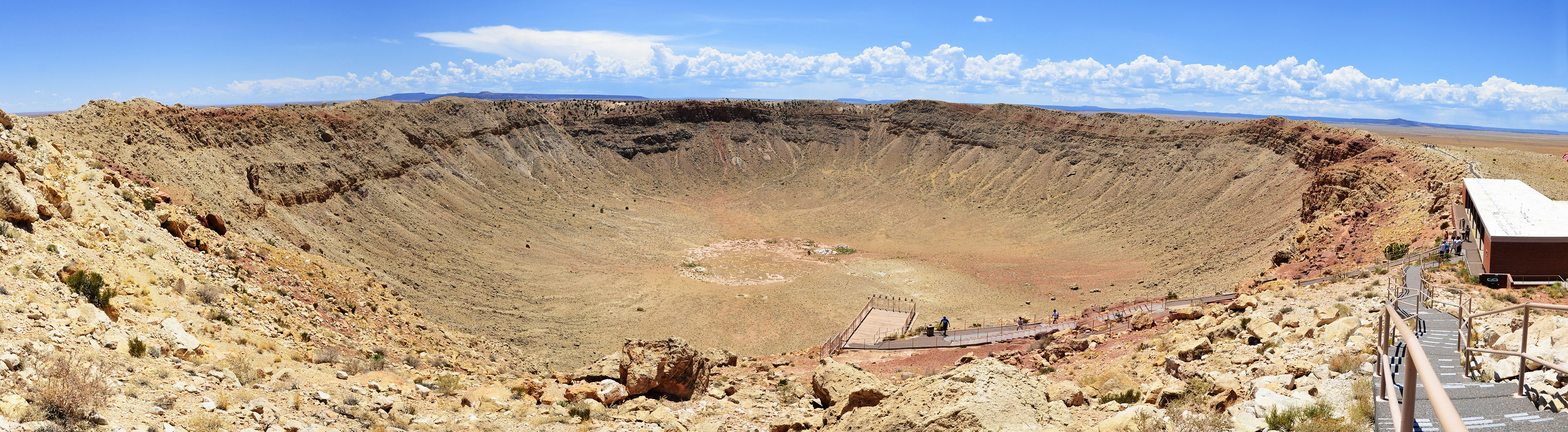
Meteor Crater: The Hole That Proved Impacts Happen
For fifty years, geologists looked at the mile-wide hole in the Arizona desert and said: volcano. The crater was too perfect, too circular, too dramatic to be anything else. Daniel Barringer disagreed. The mining engineer bought the land in 1903, convinced a massive iron meteorite lay buried beneath - worth millions if he could find it. He spent 26 years drilling, found nothing, and died broke in 1929. He was right anyway. The meteorite had vaporized on impact, leaving only scattered fragments and the best-preserved impact crater on Earth. Barringer didn't find his fortune, but he proved something scientists had denied was possible: rocks from space had crashed into our planet. Meteor Crater is the scar that changed geology.
The Impact
Fifty thousand years ago, a nickel-iron meteorite roughly 150 feet across struck the Arizona desert at approximately 26,000 miles per hour. The collision released energy equivalent to 10 megatons of TNT - roughly 650 times the Hiroshima bomb. The meteorite vaporized almost instantly; the shock wave excavated 175 million tons of rock, throwing debris for miles. What remained was a crater 4,000 feet across and 570 feet deep, with a rim rising 150 feet above the surrounding plain. The impact killed everything for miles. And then the desert went quiet for 50,000 years, waiting to be noticed.
The Denial
When European Americans found the crater in the 1870s, the scientific consensus was firm: volcanic. Craters came from volcanoes. Meteors were atmospheric phenomena - shooting stars that burned up harmlessly. The idea that rocks from space could strike Earth with catastrophic force seemed medieval, superstitious, incompatible with an orderly universe. Grove Karl Gilbert, the preeminent geologist of his era, visited in 1891 and declared it volcanic. Case closed. Daniel Barringer ignored the experts. He examined the scattered iron fragments, the shocked quartz, the rim structure, and bet his fortune on impact. The experts were wrong.
The Proof
Barringer died before vindication came. In the 1960s, Eugene Shoemaker - who would later co-discover Comet Shoemaker-Levy 9 - provided definitive proof. He identified coesite and stishovite in the crater rocks: minerals that form only under the extreme pressures of impact or nuclear explosion. No volcano could create them. The crater was suddenly important for another reason: NASA needed to train astronauts for the Moon. Meteor Crater became a classroom. Every Apollo astronaut who walked on the lunar surface practiced here first, learning to read impact geology in Arizona before reading it on another world.
The Preservation
Meteor Crater remains the best-preserved impact structure on Earth because the Arizona desert is cruel to erosion and kind to geology. Other craters have been weathered, flooded, vegetated, or buried. This one sits in high desert receiving eight inches of rain annually, its rim sharp, its bowl distinct, its ejecta blanket still visible. It looks almost fresh - a wound in the landscape that hasn't healed because the climate won't let it. The Barringer family still owns it, still profits from the tourists who come to stare into a hole that rewrote our understanding of cosmic violence.
Visiting Meteor Crater
Meteor Crater is located off Interstate 40, roughly 35 miles east of Flagstaff, Arizona. The site is privately owned; admission includes the visitor center museum and crater rim access. Guided rim tours offer closer views and geological interpretation. The crater floor is closed to the public. An astronaut wall of fame honors the Apollo crews who trained here. The gift shop sells meteorite fragments - actual pieces of the object that made the hole. Visit morning or evening for the best light on the crater walls; midday flattens the shadows. Flagstaff has lodging and services. The Painted Desert and Petrified Forest are nearby.
From the Air
Located at 35.03°N, 111.02°W in northern Arizona's high desert. From altitude, Meteor Crater is unmistakable - a near-perfect circle punched into the flat terrain, its rim casting shadows that emphasize the depression. Interstate 40 passes to the south. The crater is surprisingly small from cruising altitude yet perfectly geometric - clearly not a natural landform. The visitor center is visible on the north rim. The surrounding landscape is sparse high desert, the crater the only dramatic feature for miles. This is the best-preserved impact crater on Earth, looking almost exactly as it did 50,000 years ago.