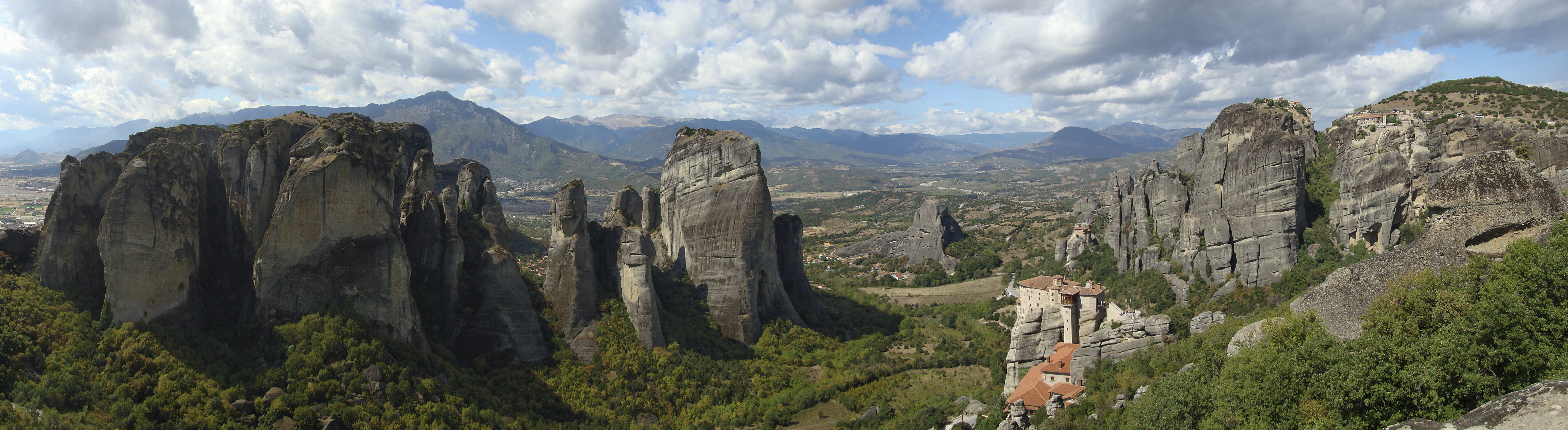
Meteora: The Monasteries Built on Impossible Pillars
The monks who built Meteora wanted to be unreachable. In the 14th century, fleeing Turkish invasions, they climbed sandstone pillars rising 1,000 feet above the Thessalian plain and built monasteries on top. There were no stairs, no paths - only rope ladders and nets hauled up by windlass. Visitors and supplies were lifted in baskets. When asked how long the ropes lasted, one monk replied: 'Until the Lord lets them break.' Of the 24 monasteries built on Meteora's impossible pillars, six survive today, still functioning, accessible now by bridges and carved steps but still breathtakingly isolated.
The Pillars
Meteora ('suspended in air' in Greek) is a geological wonder: massive sandstone pillars rising from the Thessalian plain like fingers reaching for heaven. The pillars formed 60 million years ago when an ancient sea deposited sediments that later compacted and eroded into towers. Some pillars exceed 1,000 feet in height.
Hermits began living in the caves and fissures of these pillars as early as the 9th century, seeking isolation and proximity to God. But the great monastery-building period came in the 14th century, when the Byzantine Empire was crumbling and monks needed refuge from Turkish raiders. The pillars offered perfect protection - anyone trying to climb uninvited would be seen and stopped.
The Construction
Building monasteries on pinnacles required extraordinary effort. Materials were hauled up by ropes and nets. Workers dangled from cliff faces, setting anchors and laying foundations. The Great Meteoron monastery, the largest, took decades to complete.
The monks themselves had to reach the summits. Early access was via removable ladders or rope nets. The famous basket-and-windlass system developed later - visitors sat in a large net that was hauled up the cliff face by a hand-cranked winch. The journey took half an hour and required absolute faith that the rope would hold. Some pilgrims refused to look down.
The Life
At Meteora's peak in the 16th century, 24 monasteries housed hundreds of monks. Life was austere: prayer, fasting, manual labor, and copying manuscripts. The isolation was deliberate - these were men who wanted to leave the world entirely.
The monasteries accumulated treasures: Byzantine icons, illuminated manuscripts, relics of saints. Some were paid tribute by local lords seeking divine protection. Others survived on agriculture, farming tiny patches of soil on the pinnacle tops. The monks were largely self-sufficient, emerging only when absolutely necessary.
The Decline
By the 18th century, Meteora was declining. Younger men preferred easier lives. The basket journey deterred pilgrims. Monasteries were abandoned, their treasures dispersed or stolen. Napoleon's armies and Greek independence wars brought further destruction.
In the 20th century, only six monasteries remained occupied. Steps were carved into the rock, ending centuries of isolation. Bridges connected some pinnacles. The monasteries became tourist attractions. Today, they're both functioning religious communities and UNESCO World Heritage Sites - a strange combination that the original monks, seeking perfect isolation, could never have imagined.
The Visit
Over 2 million tourists visit Meteora annually. The six functioning monasteries are open to visitors on rotating schedules - modest dress required, photography restricted in churches. The carved staircases still require hundreds of steps to climb.
The views are extraordinary: the Thessalian plain stretching to the horizon, the pillars rising like a petrified forest, the monasteries clinging to impossible perches. Sunrise and sunset paint the rocks orange and gold. The monks who sought isolation from the world created something the world now cannot resist visiting. Whether they would approve is uncertain.
From the Air
Meteora (39.72N, 21.63E) rises above the town of Kalabaka in central Greece. Ioannina Airport (LGIO) is 90km west. Thessaloniki Airport (LGTS) is 230km east. The sandstone pillars are unmistakable from the air - a cluster of vertical rock towers rising from flat farmland. The monasteries appear as small buildings perched improbably on pillar tops. Weather is continental Mediterranean - hot dry summers, cold wet winters with occasional snow.