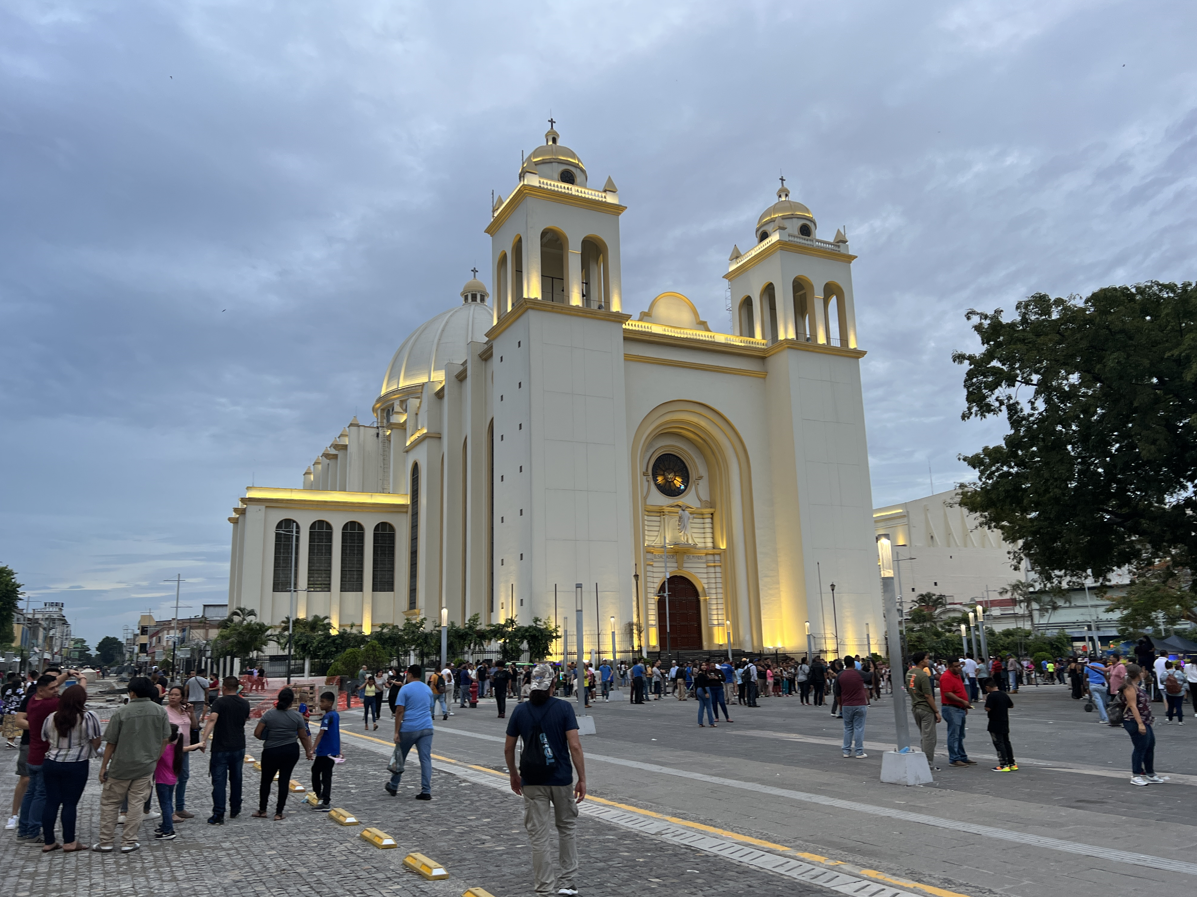
Metropolitan Cathedral of San Salvador
Three cathedrals have occupied this corner of Plaza Barrios, and each has been taken by a different force. An earthquake destroyed the first in 1873. Fire consumed the second on August 8, 1951, as a distraught crowd watched it burn. The third, completed in 1999, was designed to endure -- and it has had to, bearing the weight of El Salvador's most turbulent modern history. Inside lies the tomb of Archbishop Oscar Romero, assassinated in 1980 while celebrating Mass. Outside, the plaza has witnessed both massacre and celebration. Pope John Paul II called the cathedral "intimately allied with the joys and hopes of the Salvadoran people." He might have added the sorrows.
Fire, Rubble, and Rebuilding
The cathedral site was sacred long before the current structure rose. The original Temple of Santo Domingo once stood here, on the northern side of the plaza named for the Salvadoran military hero Gerardo Barrios. The first cathedral, established in 1842, lasted three decades before an 1873 earthquake reduced it to rubble. Its wooden replacement, completed in 1888, served as the seat of San Salvador's archbishops for more than sixty years. Then on August 8, 1951, the Old San Salvador Cathedral caught fire and burned beyond saving. Construction of a new cathedral began but proceeded slowly, interrupted by decades of political upheaval and civil war. The building was finally completed and inaugurated on March 19, 1999, and Salvadoran artist Fernando Llort was commissioned to create a vibrant tiled ceramic mural for the facade -- 2,700 hand-crafted tiles in vivid color.
A Tomb, a Funeral, and 44 Lives
Oscar Romero was appointed Archbishop of San Salvador in 1977, expected by the country's elite to be a quiet, conservative voice. He became the opposite -- an outspoken defender of the poor who denounced government violence from the pulpit. On March 24, 1980, he was shot through the heart by a single bullet while celebrating Mass at a hospital chapel. His funeral, held at the Metropolitan Cathedral on Palm Sunday, March 30, drew tens of thousands of mourners. Then gunfire erupted. Whether the shooters were security forces has never been corroborated, but the panic that followed killed 44 people in the stampede. The gunmen were never identified. Romero's tomb became a pilgrimage site. Pope John Paul II knelt before it during visits in 1983 and 1996. U.S. President Barack Obama visited the tomb during his March 2011 trip to Latin America. Romero was beatified on May 23, 2015, in a ceremony held at the nearby Plaza Salvador del Mundo.
From Accords to Celebration
The same plaza that witnessed the horror of Romero's funeral became a site of joy twelve years later. In 1992, the signing of the Chapultepec Peace Accords ended the Salvadoran Civil War, a conflict that had torn the country apart for over a decade and claimed an estimated 75,000 lives. The square in front of the cathedral erupted in celebration. For the people of San Salvador, the cathedral had become something more than a church -- it was the physical anchor of the nation's collective memory, the place where grief and relief converged. The building's role as a gathering point for the country's most significant moments continued to shape its identity well into the 21st century.
The Mural That Disappeared
Fernando Llort's tiled facade had become one of San Salvador's most recognizable landmarks -- a burst of folk-art color framing a shrine to the Divine Saviour of the World, the patron of El Salvador. The shrine itself holds a sculpture by Friar Francisco Silvestre Garcia dating to 1777, while the main altar features an image of the Divine Saviour donated by Holy Roman Emperor Charles V in 1546. Eight large paintings of scenes from the life of Christ, by Andres Garcia Ibanez, surround the altar beneath a Churrigueresque cupola standing 148 feet high with a 79-foot radius. But in late December 2012, the Archbishop of San Salvador, Jose Luis Escobar Alas, ordered the removal of Llort's mural without consulting the national government or the artist. Workers chipped off and destroyed all 2,700 tiles. The decision provoked outrage across the country. The destruction of the mural became a national controversy -- a reminder that even in a cathedral built to endure, nothing is permanent in San Salvador.
From the Air
Located at 13.699N, 89.191W on the northern side of Plaza Barrios in San Salvador's historic center. The cathedral's Churrigueresque cupola (148 feet high) is a visible landmark from low altitude. The city sits in a seismically active valley below the San Salvador Volcano. Nearest major airport is El Salvador International (MSLP), approximately 40 km south. The dense urban grid of the historic center is identifiable by its plaza system and the cathedral's distinctive profile.