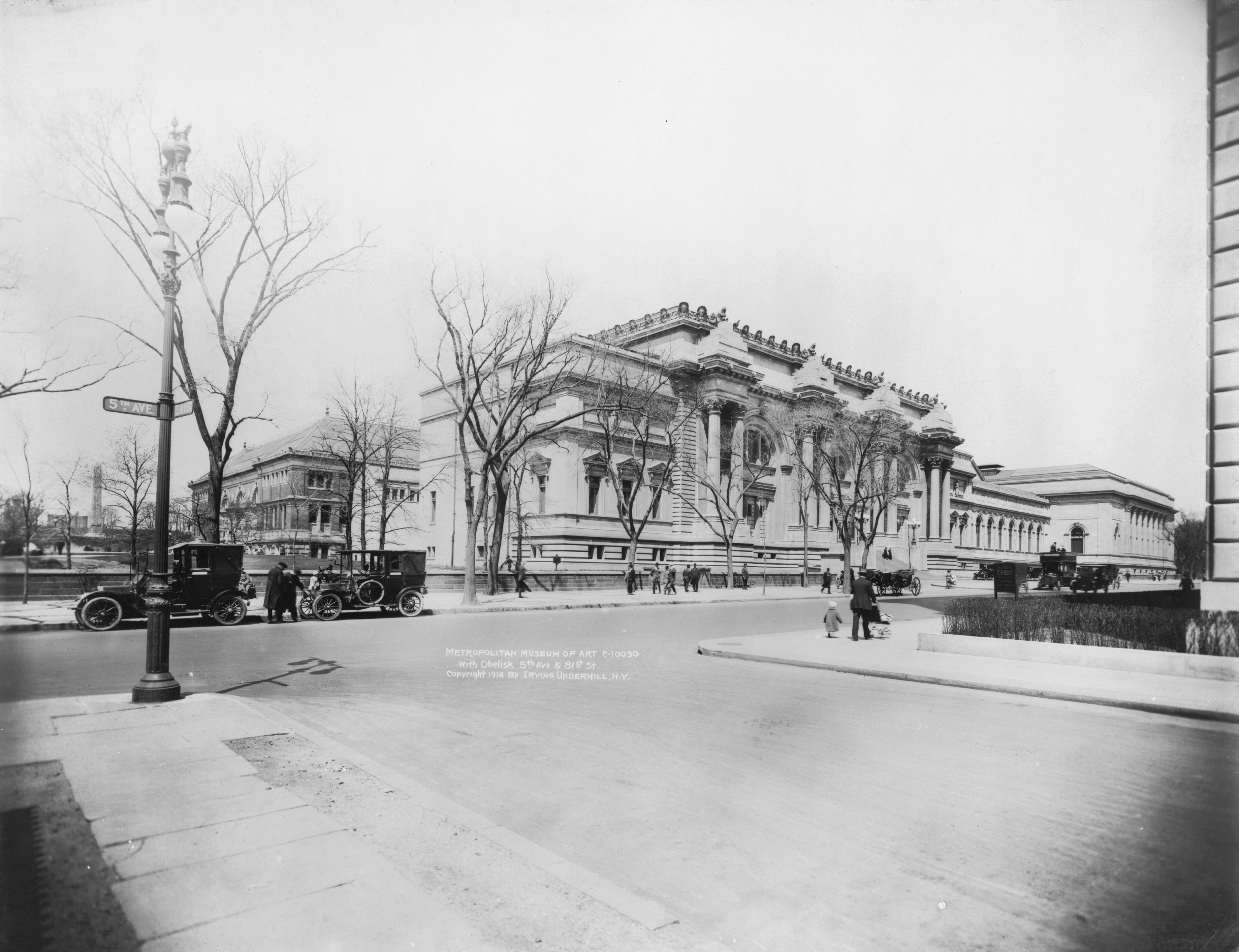
Metropolitan Museum of Art
The Met's oldest objects are flint bifaces, hand-chipped stone tools dating to somewhere between 700,000 and 200,000 BCE. Its newest acquisitions include contemporary fashion displayed in the Costume Institute. Between those two poles sits everything humans have made that someone decided was worth keeping: Egyptian temples, Roman bedrooms, Ming Dynasty gardens, Stradivari violins, suits of armor made for Henry VIII, and a 1720 Bartolomeo Cristofori piano - the oldest surviving instrument of its kind. The Metropolitan Museum of Art opened in 1870 with a Roman sarcophagus and 174 European paintings. It now holds more than two million objects across 17 curatorial departments, receives over five million visitors annually, and occupies a building on Fifth Avenue that has been growing for nearly a century and a half, accreting wings and galleries the way a coral reef accretes limestone.
A Roman Sarcophagus and a Railroad Executive
The Met was founded by a group of Americans who wanted their country to have a world-class museum. John Taylor Johnston, a railroad executive whose personal art collection provided the seed, served as the first president. The publisher George Palmer Putnam became the founding superintendent. Landscape painter Frederic Edwin Church and artist Eastman Johnson acted as co-founders. The first significant acquisition - the Cesnola Collection of Cypriot antiquities - forced the museum out of its original Fifth Avenue location and into a temporary home at the Douglas Mansion on West 14th Street. By 1880, the growing collection moved into its current building on the eastern edge of Central Park. That first structure was a fraction of the present museum. Wing after wing followed, each funded by a new generation of donors: the Rockefeller Wing for African, Oceanian, and American art; the Lehman Wing for Robert Lehman's personal collection; the Temple of Dendur in its glass-walled gallery - each addition another layer in an ever-expanding institution.
Temples, Gardens, and Whole Rooms
Other museums display objects. The Met displays environments. The Temple of Dendur, a sandstone structure built around 15 BCE, was given to the United States by Egypt in 1965 to save it from the rising waters of the Aswan High Dam. It was reassembled inside a purpose-built gallery partially surrounded by a reflecting pool, illuminated by a wall of windows opening onto Central Park. In the Asian wing, the Astor Court reproduces a complete Ming Dynasty garden courtyard modeled on the Master of the Nets Garden in Suzhou. The European sculpture court contains entire period rooms transported from their original locations - a 16th-century patio from the Spanish castle of Velez Blanco, an intarsia studiolo from the ducal palace at Gubbio. The Cloisters, a separate building in Fort Tryon Park in Upper Manhattan, incorporates five medieval French cloisters into a structure completed in 1938, funded by John D. Rockefeller Jr. Inside hang the seven tapestries depicting the Hunt of the Unicorn, among the most famous textile artworks in existence.
Seventeen Departments, One Building
The Met's collection is divided into 17 curatorial departments, each with its own curators, scholars, and conservation specialists. The Egyptian Art department holds over 26,000 pieces, nearly half excavated by the museum's own teams between 1906 and 1941. The Arms and Armor department's 14,000 objects include pieces made for Henry VIII of England, Henry II of France, and Ferdinand I, Holy Roman Emperor. The Costume Institute maintains 35,000 costumes and accessories and hosts the annual Met Gala, where tickets have started at $6,500 per person. The Musical Instruments department holds 5,000 instruments, many of them playable - including several Stradivari violins and that 1720 Cristofori piano. The Robert Lehman Collection, 2,600 works donated by the banker and his father, is housed in galleries designed to evoke the Lehman townhouse at 7 West 54th Street, a deliberate "museum within a museum" that drew both praise and criticism when it opened.
The Paintings Everyone Comes For
The Met's European paintings collection numbers over 2,500 works from the 13th through the early 20th centuries. The department's growth has been driven by a series of transformative gifts: Henry Gurdon Marquand's Old Masters donations in the 1890s, the Robert Lehman Collection in 1975, and the Wrightsman paintings, which have been called the highest in overall quality of any group donated to the museum. The Annenberg Collection, promised in 1991, strengthened the Met's Impressionist and Post-Impressionist holdings with works by Gauguin, Toulouse-Lautrec, Cezanne, Monet, and Van Gogh. In 2013, Leonard Lauder donated a Cubist collection valued at one billion dollars, including works by Picasso, Braque, and Juan Gris. The museum describes its 19th-century French paintings as "second only to the museums of Paris." The Modern and Contemporary Art department adds another 13,000 works, anchored by Picasso's portrait of Gertrude Stein, Jasper Johns's White Flag, and Jackson Pollock's Autumn Rhythm.
Open Doors, Open Data
The Met was chartered in 1870 with legislation requiring its collections be "kept open and accessible to the public free of all charge throughout the year." The museum has interpreted that mandate broadly in the digital age. In 2017, it released over 375,000 photographic images of public-domain works under Creative Commons Zero, making them freely available for any use. Those open-access images and data have since been viewed over 1.2 billion times with more than 7 million downloads. The museum uploads archival films weekly to YouTube from its collection of 1,500 films made and collected since the 1920s. The physical museum, meanwhile, continues to evolve: a $70 million renovation of the Rockefeller Wing's African, ancient American, and Oceanic art galleries began in 2021, and in 2018 the museum hired its first curator of Indigenous American art, Dr. Patricia Marroquin Norby, of Purepecha descent, signaling an institution still reckoning with whose stories it tells and how.
From the Air
Located at 40.7794N, 73.9631W on Manhattan's Upper East Side, along the Museum Mile on the eastern edge of Central Park. The main building at 1000 Fifth Avenue is identifiable from altitude as the large structure fronting the park between approximately 80th and 84th Streets. The Cloisters, the Met's medieval art branch, is located separately in Fort Tryon Park in Upper Manhattan at approximately 40.8649N, 73.9319W. Nearest airports: LaGuardia (KLGA) 7nm northeast, Teterboro (KTEB) 10nm northwest, JFK (KJFK) 15nm southeast. Recommended viewing altitude: 3,000-4,000 feet to see the museum's footprint along Central Park's eastern edge. The museum's distinctive Beaux-Arts facade faces Fifth Avenue.