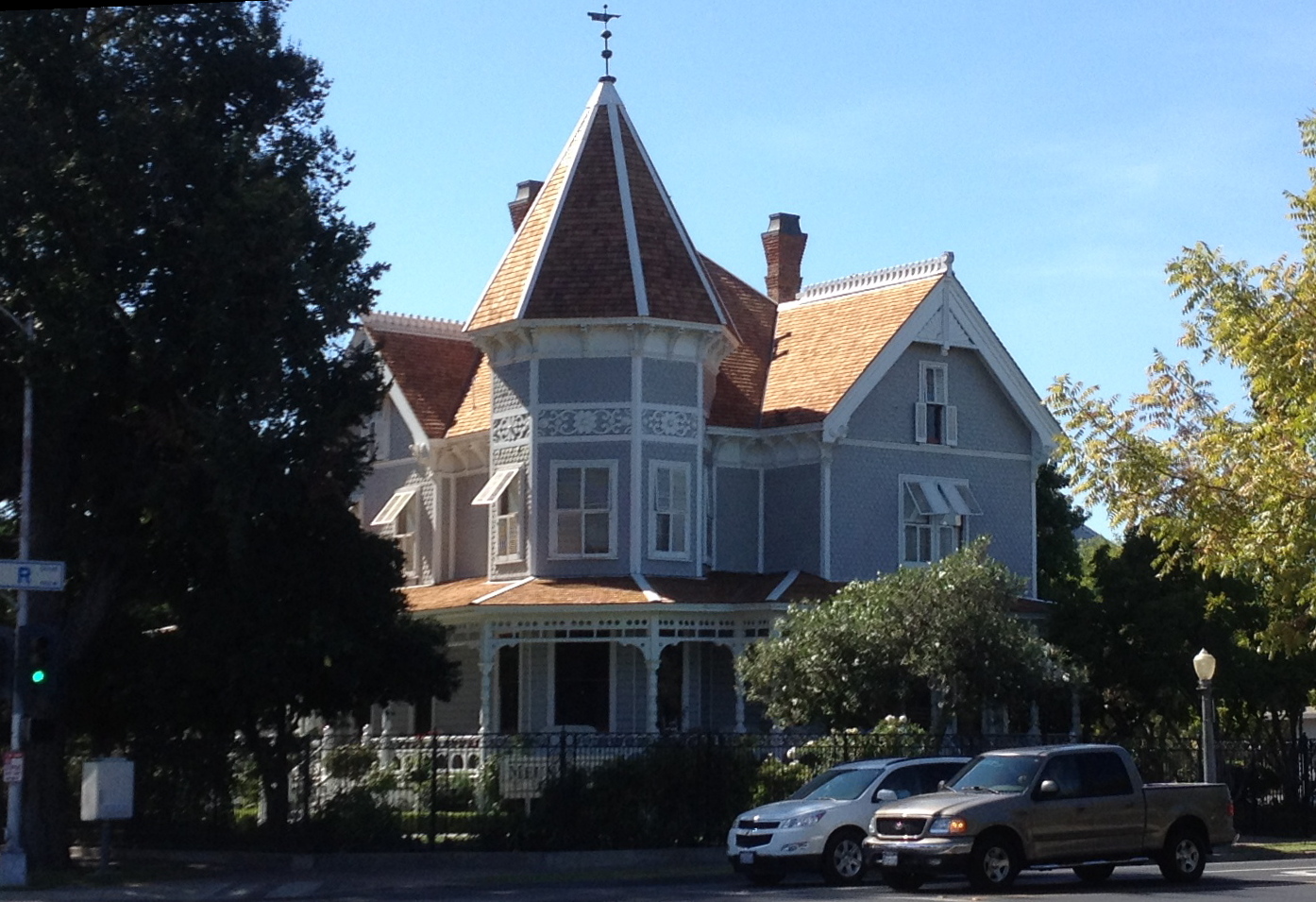
The Meux Home
Anne Meux lived in the same house for seventy-one years. When a Fresno Bee reporter visited her in 1960, the mansion at the corner of Tulare and R streets looked almost exactly as it had when her father finished building it in 1889. The gas fittings on the light fixtures still worked, just in case the electricity failed. The wooden icebox still sat in the kitchen beside a modern refrigerator, as if the family couldn't quite commit to the twentieth century. By the time Anne died in 1970, the house had outlasted nearly every other structure from Fresno's founding generation, preserved not by any grand preservation effort but by a family that simply never saw reason to change anything.
From Shiloh to the San Joaquin
Thomas Richard Meux was born near Stanton, Tennessee, in 1838. He studied at the University of Virginia, then earned his medical degree from the University of Pennsylvania in 1860, just as the country was splitting apart. He and his brother John enlisted in the 9th Tennessee Infantry Regiment on May 24, 1861. John died a year later from wounds sustained at the Battle of Shiloh, one of the bloodiest engagements of the Civil War. Thomas survived and returned to his medical practice in Tennessee after the war ended. He married Mary Esther Davis in 1874, and the couple started a family. But sometime in the mid-1880s, they decided to leave Tennessee behind. In December 1887, the Meux family stepped off a train at the Southern Pacific Hotel in Fresno, a Central Valley town barely a decade old and growing fast.
Building on Empty Ground
Fresno in the late 1880s was still more ambition than city. When Meux chose the corner of Tulare and R streets for his home, the area was nearly empty. Only two other houses stood within sight: William Wyatt's place at R and Mariposa, and O. J. Woodward's at Q and Mariposa. Woodward would later donate the land that became Woodward Park, one of the largest municipal parks in California. But in 1889, this was the edge of town, and Meux was building for a future he could only imagine. The house he commissioned was elaborate for its time and place: two stories with a basement and attic rooms, a wraparound porch with carved railings, and an asymmetrical design that mixed architectural influences the way a confident era tended to do.
Gothic Turrets and Gas Light
The Meux Home's most striking feature is the conical turret anchoring one corner, giving the house a faintly fairytale silhouette against the flat Central Valley skyline. French Renaissance details appear in the chimney work, while Victorian Gothic finials crown the intersections of the roof hips. The siding shifts from staggered shingles to patterned shingles to beveled shiplap, creating a texture that rewards close attention. Because the house was built before electricity reached this part of Fresno, every lighting fixture was designed for gas. Even after electrical service arrived, several fixtures kept their gas fittings as a practical backup. The kitchen eventually gained an electric refrigerator and a gas range, but the old wood-burning stove and wooden icebox remained in place, artifacts of an earlier domestic life coexisting with their replacements.
A Family That Stayed
What makes the Meux Home remarkable is less its architecture than its continuity. Thomas Meux died, but the family never sold the house or altered it significantly. His son John became a Fresno-area rancher. One daughter married Henry E. Barbour, who went on to serve in the U.S. House of Representatives; their 1907 wedding took place in the home's parlor. The other daughter, Anne, simply stayed. She lived in the house from its construction until her death in 1970, a span of eighty-one years during which Fresno transformed from a frontier railroad stop into the fifth-largest city in California. The house became a museum, its rooms frozen in a version of domestic life that most of the Central Valley had long since discarded.
History Reckoned With
In 2021, the museum confronted a question that many institutions named for Confederate veterans have faced: whether to change its name. Thomas Meux served in the Confederate Army, a fact that sits uneasily alongside the house's role as a civic landmark. The discussion produced no name change, but it marked the kind of reckoning that transforms a simple historic house into something more complicated. The Meux Home remains one of the oldest residences in Fresno and one of the most architecturally intact Victorian houses in the Central Valley, its turret and gas fittings and carved porch details testifying to an era when a doctor from Tennessee could arrive in a raw California town and build something meant to last. That it did last, largely unchanged, through more than a century of California's relentless reinvention may be the most improbable thing about it.
From the Air
Located at 36.7397N, 119.7824W on the east end of downtown Fresno at the intersection of Tulare and R streets. The Victorian mansion with its distinctive conical turret is difficult to spot from altitude but sits within the Fresno street grid. Best viewed at 1,500-2,500 feet AGL. Fresno Yosemite International Airport (FAT) is approximately 5 nm northeast. Fresno Chandler Executive Airport (FCH) is about 3 nm south. The flat terrain of the Central Valley provides excellent visibility in clear conditions.