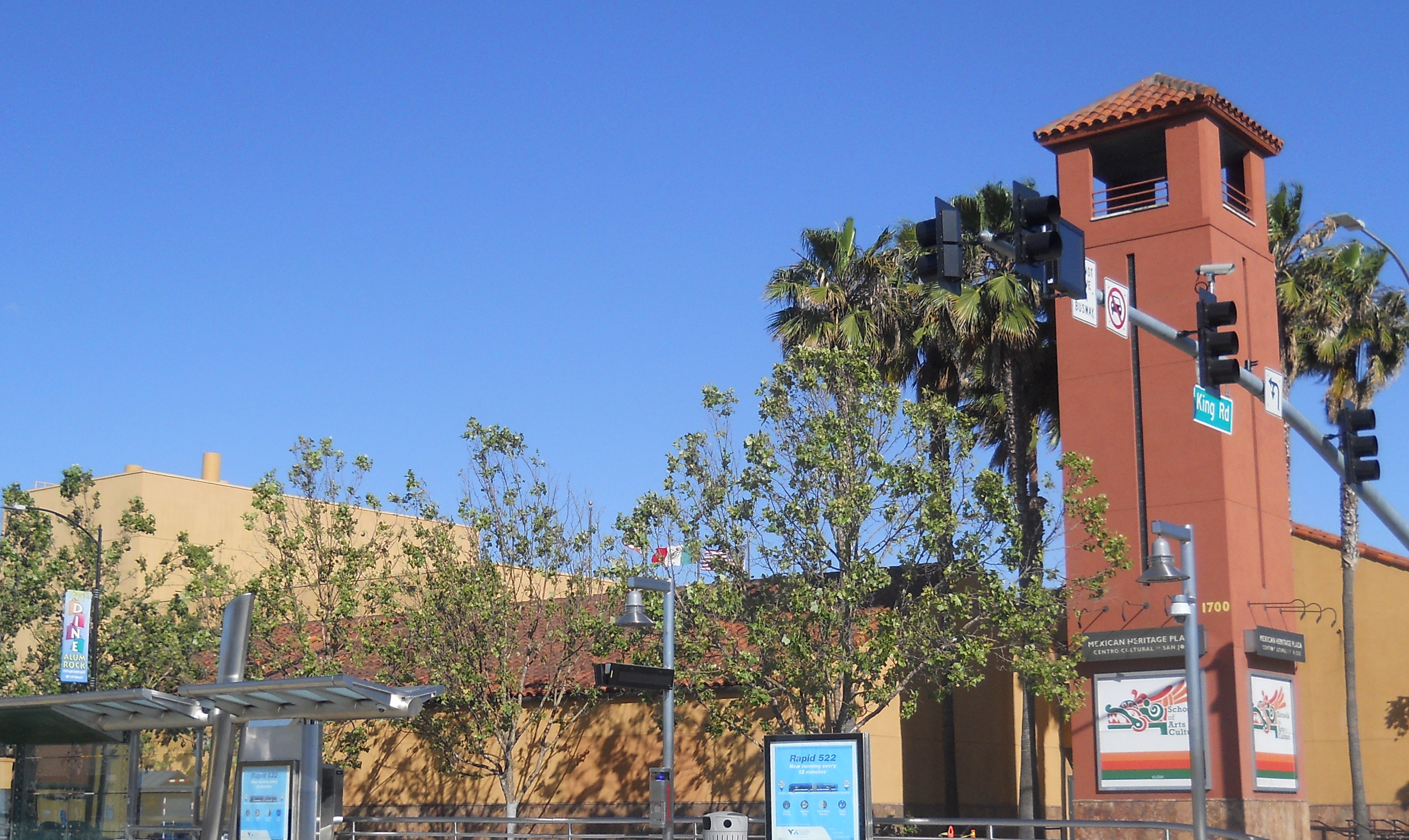
Mexican Heritage Plaza
Walk up to the northwestern entrance of the Mexican Heritage Plaza in San Jose's Mayfair neighborhood and you are greeted by faces you know -- Carlos Santana mid-riff, Los Tigres del Norte in full stride, Linda Ronstadt in song, Luis Valdez commanding a stage. They are rendered in mosaic tile, permanent and public, honoring artists whose roots run deep into the same soil as the community that built this place. Opened in 1999, the Centro Cultural de San Jose stands as one of the most significant Chicano and Mexican-American cultural institutions on the West Coast, a gathering point for a community that had long needed one.
Mayfair's Living Room
East San Jose's Mayfair neighborhood has been home to a large Mexican-American community for generations, but for decades it lacked a dedicated cultural anchor. The Mexican Heritage Plaza changed that. Its 500-seat theater hosts everything from ballet folklorico performances to contemporary theater. Gardens and courtyards offer quieter spaces for gathering, while classrooms and meeting rooms serve the neighborhood's educational needs year-round. Operated by the School of Arts and Culture, the plaza functions less as a museum and more as a living room -- a place where the community comes not just to observe culture but to make it, argue about it, and pass it on.
The Muralists and the Mosaics
Art is not decoration here; it is architecture. The Corazon y Espiritu de Mayfair mural, painted in 2004 by the celebrated Precita Eyes Muralists, anchors the plaza's visual identity. Precita Eyes, based in San Francisco's Mission District, has been creating community murals since the 1970s, and their work at the plaza channels that tradition into East San Jose. The mosaic tributes at the entrance tell a more specific story. Each portrait honors an artist with direct ties to the region: Santana, a Bay Area native whose guitar reshaped rock music; Los Tigres del Norte, the norteno legends who launched their recording career in San Jose; Valdez, the playwright and filmmaker who grew up in the area and founded El Teatro Campesino; and Ronstadt, who serves as honorary chair of the San Jose Mexican Heritage Festival. These are not distant icons -- they are local ones.
Ironwork and Identity
Details matter at the Mexican Heritage Plaza, and the Aztec-inspired ironwork throughout the complex carries its own quiet weight. The geometric patterns reference a pre-Columbian artistic tradition that predates the Spanish missions, the Mexican republic, and the American annexation of California -- all of which shaped the community that gathers here today. It is a design choice that insists on depth, reminding visitors that Mexican-American culture in the Santa Clara Valley did not begin with the bracero programs or the farmworker movements, vital as those chapters are. The roots go further back, and the ironwork says so without a single word.
A Stage for What Comes Next
The plaza's 500-seat theater has become one of the South Bay's important performance venues, hosting not only traditional Mexican and Chicano arts but also contemporary work that pushes boundaries. The School of Arts and Culture runs programming for young artists and students, ensuring that the institution is not merely preserving the past but actively cultivating the next generation. In a city where the technology industry often dominates the cultural conversation, the Mexican Heritage Plaza offers a different kind of innovation -- one rooted in community, memory, and the stubborn belief that art matters as much as algorithms.
From the Air
Located at 37.353N, 121.854W in the Mayfair neighborhood of East San Jose. The plaza is situated in a residential area east of downtown San Jose, identifiable from the air by its courtyard layout amid the surrounding neighborhood grid. Nearby airports include San Jose International (KSJC) about 5 nm to the northwest and Reid-Hillview Airport (KRHV) roughly 2 nm to the south. Best viewed at 2,000-3,000 feet AGL where the distinctive plaza complex stands out from the residential fabric.