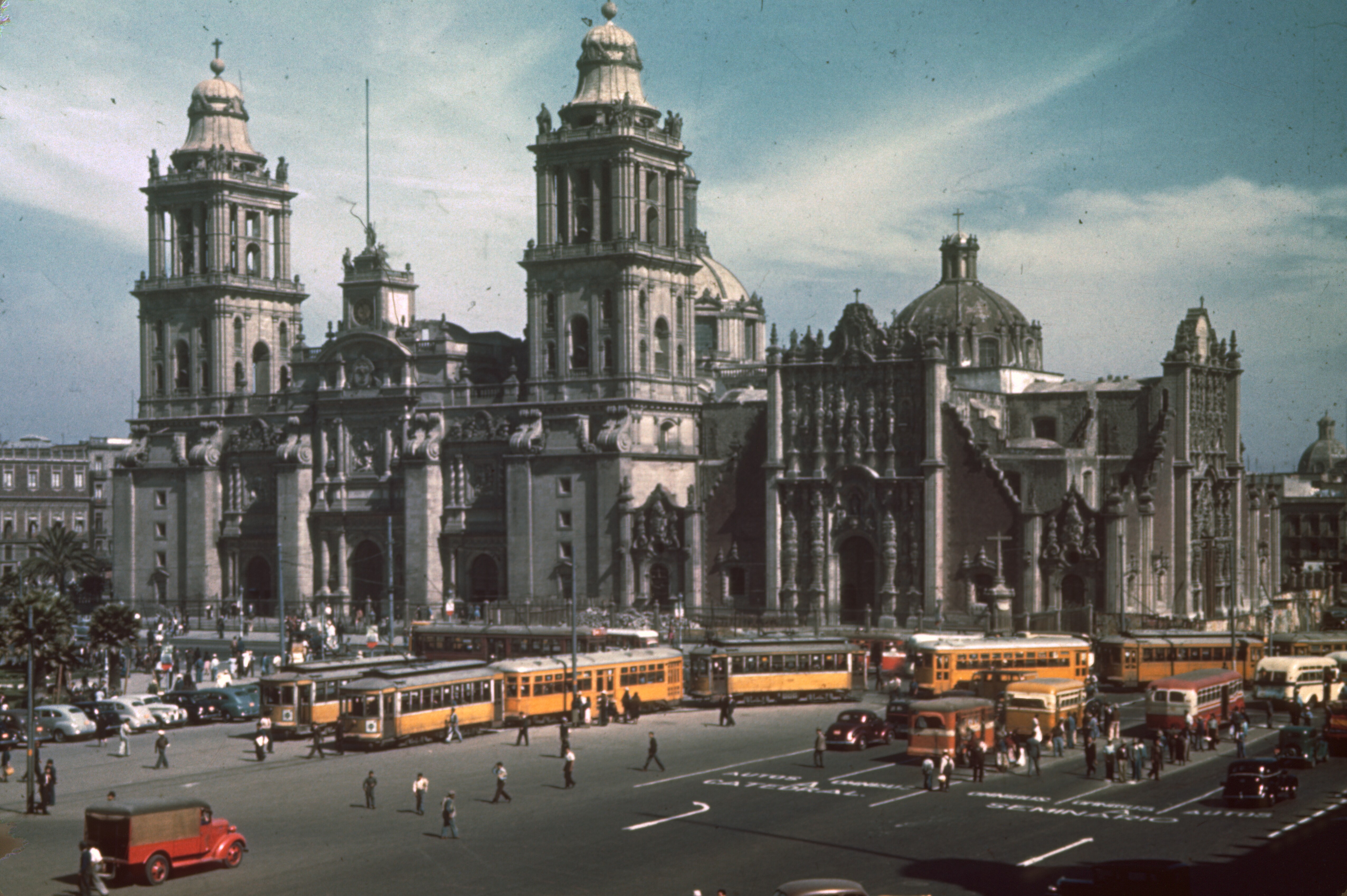
Mexico City Metropolitan Cathedral
It took 240 years to build and it has been sinking ever since. The Mexico City Metropolitan Cathedral sits on the northern edge of the Zocalo, directly atop the sacred precinct of the Aztec capital Tenochtitlan, and the ground beneath it has never been solid. Construction began in 1573 and was not completed until 1813, a span so long that the Gothic arches of the earliest sections gave way to Baroque altarpieces, then Churrigueresque ornamentation, then Neoclassical facades - each generation of architects adding their era's fashions to a building that was already a palimpsest of styles. Virtually every significant architect, painter, sculptor, and gilding master of the entire colonial period worked on it at some point. The result is less a unified design than a geological record of Mexican artistic history, compressed into a single structure.
Conquest Stones
The Spanish chose the location deliberately. After Hernan Cortes conquered Tenochtitlan in 1521, the conquistadors decided to build a church on the site of the Aztec sacred precinct - specifically just southwest of the Templo Mayor, the great pyramid where human sacrifices had been conducted. Evidence suggests the precinct once included temples dedicated to Quetzalcoatl, Huitzilopochtli, and Tonatiuh. The architect Martin de Sepulveda directed the first phase of construction between 1524 and 1532, under Bishop Juan de Zumarraga, the first bishop of the New World. This initial church was modest, but the ambition grew quickly. By 1552, the Spanish Crown, the Comendadores, and indigenous communities under the Archbishop's authority agreed to share the cost of a grand new cathedral. Construction stones from Aztec temples were incorporated into the new structure - the conquered literally built into the walls of the conqueror's church.
A Cathedral of Every Style
Because the cathedral took nearly 250 years to complete, it became an accidental encyclopedia of colonial architecture. The earliest sections reflect the austere Gothic sensibility of 16th-century Spain. As the Baroque arrived in the 17th century, it transformed the interior: gilded altarpieces, dramatic sculpture, rich ornamentation. The Metropolitan Tabernacle, built between 1749 and 1760 by Lorenzo Rodriguez, represents the height of Baroque exuberance. By the time the facade was completed in the late 18th century, Neoclassical restraint was in fashion, and architect Manuel Tolsa added the clock tower, bell towers, and balustrades that define the building's exterior today. The Cathedral also contains the Chapel of Our Lady of Antigua, built between 1653 and 1660 by a brotherhood of musicians and organists. Inside this chapel sits the Nino Cautivo - a 16th-century Christ Child figure sculpted by Juan Martinez Montanes in Spain. On its way to Veracruz, pirates attacked the ship carrying it, and a ransom had to be paid to recover the image.
The Weight of History
The cathedral has never stopped settling. Built on the soft clay of the drained lakebed that was once Lake Texcoco, the building tilts visibly. A massive engineering project beginning in the 1990s worked to stabilize the structure, but the fundamental problem remains: the entire historic center of Mexico City sits on ground that compresses as the city extracts groundwater from the aquifer beneath. In September 1629, a catastrophic flood interrupted construction for years. The damage from settling has required continuous repair across centuries. Despite these challenges, the cathedral has served as the stage for some of Mexico's most consequential events. Emperor Agustin I was crowned here. The remains of independence leaders including Miguel Hidalgo are interred within its walls. Emperor Maximilian attended services during his brief, doomed reign in the 1860s.
Sacred Art Under a Tilting Roof
The cathedral's interior holds one of the most significant collections of colonial sacred art in the Americas. Fourteen side chapels line the nave, each endowed by different patrons and guilds over the centuries. The Altar of the Kings, a masterwork of Churrigueresque carving, fills an entire wall behind the main altar with gilded saints and angels. The choir area contains two massive pipe organs from the 18th century. Five monumental oil paintings depicting scenes from the cathedral's history hang on the walls, placed during an 1895 restoration. The tabernacle's altar, slightly damaged by fire in January 1967, was restored and remains one of the finest examples of Baroque gilding in Mexico. A 1967 fire also destroyed important parts of the interior, prompting a restoration that recovered much of what was lost. What the cathedral offers today is not a museum piece frozen in time but a living building, still holding services, still settling into the earth, still accumulating the layers that make it unlike any other cathedral in the world.
From the Air
Located at 19.434°N, 99.133°W on the north side of the Zocalo (Plaza de la Constitucion) in the historic center of Mexico City. The cathedral's twin bell towers and central dome are prominent from low altitude, standing adjacent to the open excavation of the Templo Mayor ruins to the northeast. The vast Zocalo - one of the largest public squares in the world - makes the cathedral easy to identify. The National Palace borders the square to the east. Nearest major airport is Mexico City International (MMMX/MEX). From altitude, the cathedral is part of the dense colonial grid of the Centro Historico, contrasting with the wider avenues of later development radiating outward.