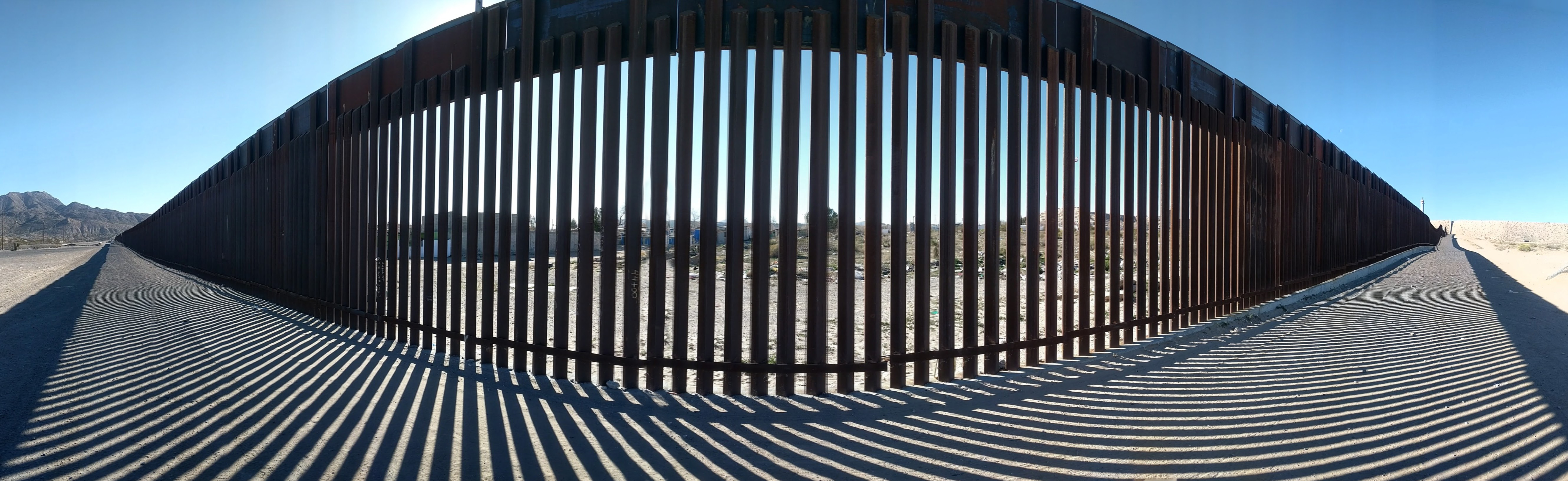
Mexico–United States Border Wall
The line between Mexico and the United States runs 3,145 kilometers from the Pacific to the Gulf of Mexico. For most of that distance, for most of American history, the line was marked by surveyor's monuments, rivers, or nothing at all — a legal boundary with minimal physical presence. The construction of barriers began in earnest in the 1990s, accelerated through the 2000s, and became one of the most contested subjects in American politics. What exists today is neither a single wall nor a continuous fence, but a discontinuous system of barriers — steel bollards, concrete slabs, vehicle barriers, razor wire — concentrated at the busiest crossing points and absent across hundreds of kilometers of remote desert and mountain terrain.
San Diego: Where the Wall Is Densest
The San Diego sector, encompassing the border from the Pacific coast east through Imperial County, has the most intensive barrier infrastructure on the entire border. This concentration reflects history: San Diego–Tijuana was for decades the highest-volume illegal crossing point in the United States, and policy responses focused resources here. Operation Gatekeeper, launched in 1994 under the Clinton administration, massively increased infrastructure and personnel in the San Diego sector, with the explicit goal of making urban crossings too dangerous to attempt. A double fence system runs from the Pacific Ocean eastward — the inner fence of steel mesh or bollards, an enforcement zone, and a secondary fence — for much of the western San Diego sector. The result was a significant reduction in documented crossings in this sector and a corresponding shift of crossing activity to more remote and dangerous terrain.
Legislative History
The construction of border barriers has proceeded under multiple legislative authorities and presidential administrations. The Immigration Reform and Control Act of 1986 funded initial barrier construction. The Illegal Immigration Reform and Immigrant Responsibility Act of 1996 authorized the triple fence in the San Diego sector. The Secure Fence Act of 2006, passed with bipartisan support, mandated construction of 700 miles of fencing along the highest-priority border segments. The American Recovery and Reinvestment Act of 2009 provided additional funding. The most recent large construction phase occurred under the Trump administration, which declared a national emergency to redirect military funding to barrier construction and contracted for hundreds of miles of new or replacement fencing. The Biden administration paused and then partially resumed construction. At each juncture, the barriers built reflect political consensus or political will rather than a single unified design.
What the Wall Looks Like
The physical infrastructure varies substantially by location and era of construction. The earliest barriers were made from surplus military landing mats — the corrugated steel panels used to create temporary airstrips during the Vietnam War, repurposed as a border fence in the early 1990s. These have been largely replaced by steel bollards — vertical steel tubes set in concrete, typically 9 to 11 meters tall, spaced to prevent passage but allow some visibility. In some areas, concrete slabs or other solid barriers are used. Vehicle barriers — low structures designed to stop cars but passable on foot — extend the barrier system into remote areas where pedestrian crossings are less likely. The San Diego section, particularly near the coast, features the double-fence system with stadium lighting and surveillance equipment between the barriers.
The View From the Air
From altitude, the border infrastructure at San Diego is unmistakable. The fence lines run from the Pacific surf eastward, visible as dark parallel lines against the tan terrain. The urban density of Tijuana ends abruptly at the border; the lower-density development of San Diego's South Bay communities continues on the northern side. The contrast between the two cities — their building heights, street grids, color palettes — is visible without needing to know where the line is. The border marks it clearly enough. Where the fences run into the Pacific Ocean, creating the literal edge of the wall in the surf, the structure is particularly arresting from above: infrastructure designed to divide a continent ending in breaking waves.
From the Air
The U.S.–Mexico border wall in the San Diego sector runs from Monument No. 258 at the Pacific coast (32.54°N, 117.12°W) eastward. The double fence system is clearly visible from altitude. San Diego International Airport (KSAN) is approximately 20 km north of the Pacific terminus. The border runs through Otay Mesa (KMYF area) and continues east. The contrast between Tijuana's dense urban fabric and San Diego's lower-density development makes the border unmistakable from altitude even without the fence.