Miagao Church
Two priests, two bell towers, two different designs. The asymmetry of Miagao Church is not an accident or a flaw -- it is a record of how buildings actually get built when construction spans decades and the men directing it change. The west belfry, older and taller at four levels, was completed with the church in 1797 after ten years of construction. The east belfry originally had only two levels until Father Francisco Perez added a third story in 1830. They still do not match. Standing at the highest point in the town of Miagao, Iloilo, the church's lopsided silhouette has become one of the most recognizable outlines in the Philippine archipelago -- proof that imperfection, given enough time and purpose, becomes character.
A Fortress Against the Sea
Miagao Church was built to perform two functions simultaneously: house God and repel raiders. The Moro pirates who terrorized the Visayan coasts for centuries made defensive architecture a matter of survival, not preference. Royal Decree 111 of 1573, known as the Law of the Indies, stipulated that colonial churches in vulnerable areas must serve as fortifications. The Augustinian friars who supervised construction took the mandate seriously. The church's stone walls are 1.5 meters thick, reinforced by setback buttresses extending four meters deep. The bell towers doubled as watchtowers, their elevation providing early warning of approaching vessels. The church sits on the highest point in town precisely because hilltops make better defensive positions. This is what historians call Fortress Baroque -- architecture shaped as much by the threat of violence as by the desire for beauty.
The Facade That Tells a Story
The west-facing facade of Miagao Church is considered the finest example of Filipino Baroque decoration in the country. At its center, above the wooden entrance doors, a carved image of Saint Thomas of Villanueva -- the church's patron saint -- presides over the composition. Flanking the door are images of Saint Henry of Bavaria on the left and Pope Pius VI on the right, each topped by their respective coats of arms. But the facade's most famous element rises above them all: Saint Christopher, dressed not in European robes but in native Filipino clothing, carrying the Christ Child on his back while gripping a coconut palm. The entire surface erupts with tropical flora carved in deep relief. This is horror vacui -- the Filipino decorative instinct to fill every available space -- applied to religious architecture with exuberant confidence.
Destroyed and Rebuilt, Again and Again
The history of Miagao Church is a cycle of destruction and restoration. Before gaining its own parish in 1731, Miagao passed through the jurisdiction of Oton (until 1580), Tigbauan (until 1592), San Joaquin (until 1703), and Guimbal (until 1731). Construction of the current church began in 1787 and was completed in 1797. Then the damage began. The Spanish Revolution of 1898 severely damaged the structure. A fire in 1910 gutted portions of the interior. World War II brought further destruction, and an earthquake in 1948 cracked walls and destabilized foundations. The restoration completed in 1962 stabilized what remained, and in 1973, President Ferdinand Marcos declared it a national historical landmark. Twenty years later, UNESCO inscribed it as part of the Baroque Churches of the Philippines World Heritage Site.
Gold Behind Stone Walls
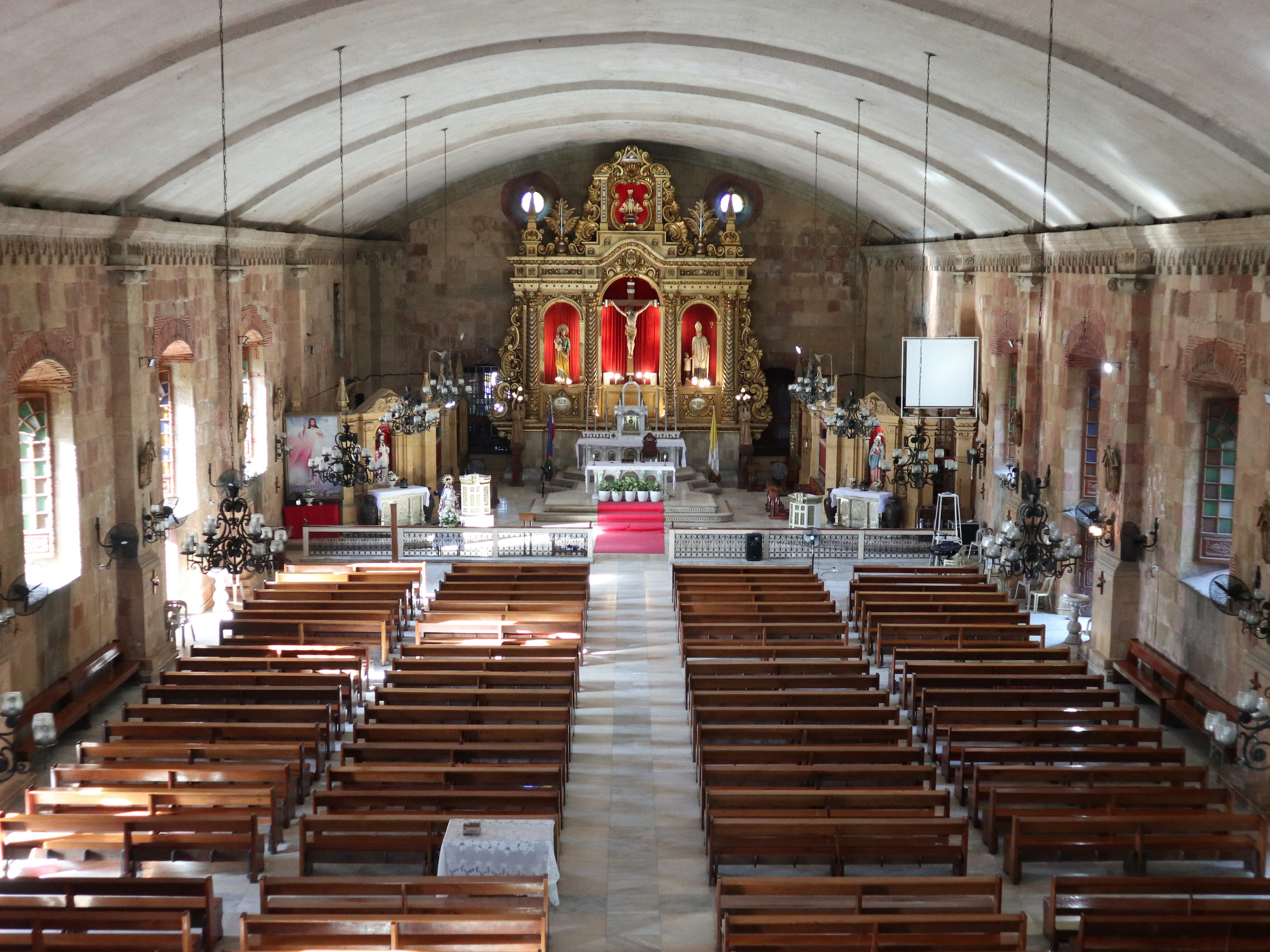
Step through the fortress walls and the interior reveals a different sensibility. The sanctuary centers on a gold-plated retablo -- an altarpiece thought to be the original from the 1700s, lost in a fire and recovered in 1982. Three alcoves hold effigies of Saint Thomas of Villanova on the right, Saint Joseph on the left, and a crucifix at the center, with a statue of the Santo Nino crowning the composition. Shrines flanking the altar house the Sacred Heart of Jesus and the Immaculate Heart of Mary. The original late-1790s images of Saint Thomas of Villanova survive in a glass case at the rear of the church, quietly present while their gilded counterparts command the sanctuary. The contrast between the martial exterior and the devotional interior captures the paradox of Miagao: a place built for war but consecrated to peace.
From the Air
Located at 10.642N, 122.235E in Miagao, Iloilo, on the southern coast of Panay Island. The church sits on the highest point in town and is visible from altitude as a substantial stone structure. Nearest major airport is Iloilo International Airport (RPVI), approximately 40 km northeast. Best viewed at 2,000-5,000 feet AGL. The southern Panay coastline offers dramatic scenery on approach.