Miaoying Temple
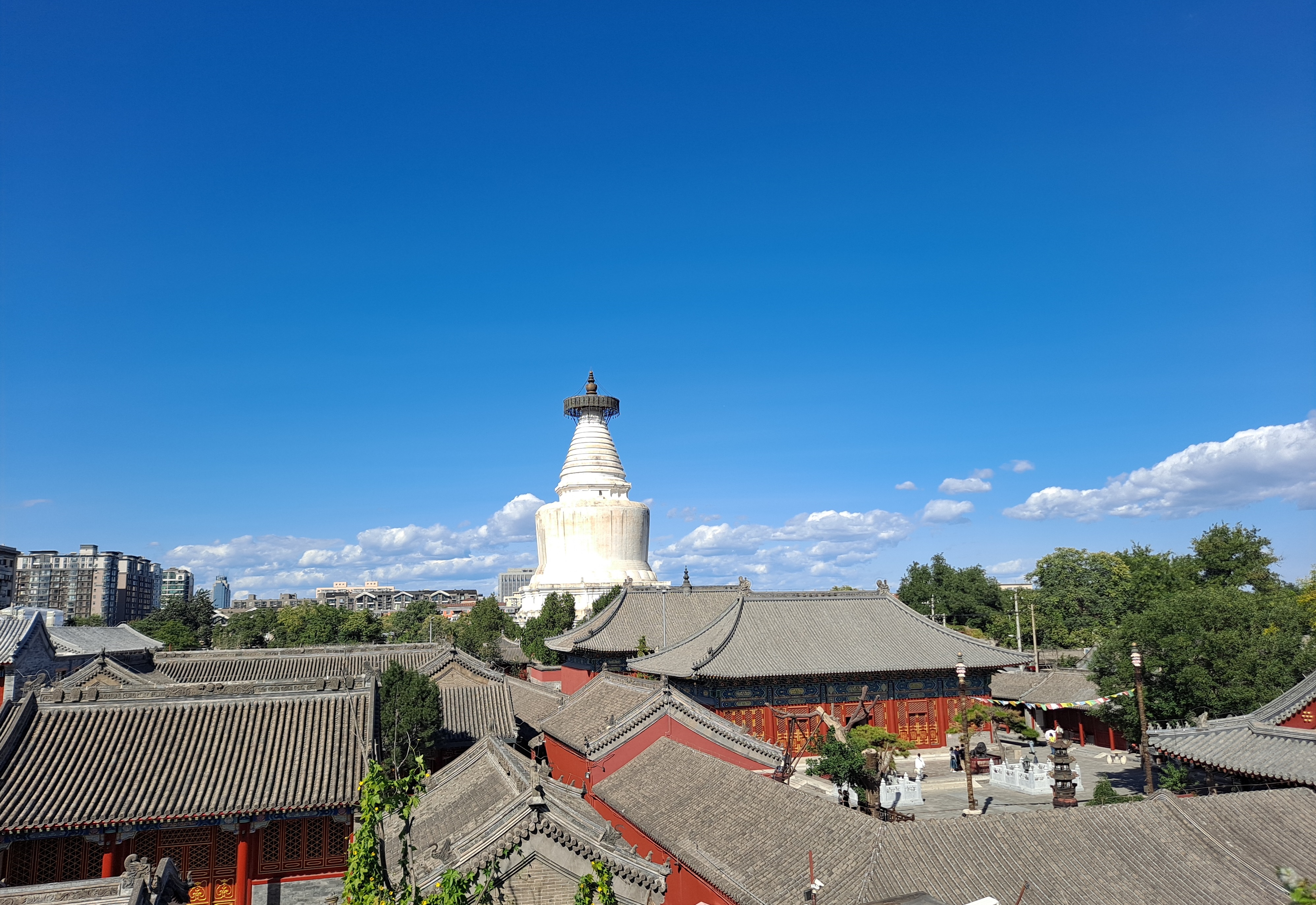
A white stupa rises above the low rooftops of Beijing's Xicheng District, visible for blocks in every direction -- a bell-shaped dome of whitewashed brick that looks as though it belongs in Lhasa or Kathmandu, not in the heart of China's capital. This is the White Pagoda of Miaoying Temple, the oldest and largest Tibetan Buddhist pagoda in China. It was built in 1279 under the orders of Kublai Khan, designed by a Nepali architect named Arniko, and it has survived seven and a half centuries of earthquakes, invasions, and political upheaval. Its endurance is not entirely a matter of luck.
A Nepali Architect in the Mongol Court
Arniko arrived at the court of Kublai Khan as a young man from Nepal, part of a mission of craftsmen invited to serve the Mongol empire. He impressed the khan by repairing a bronze statue that no Chinese artisan had been able to fix, and from that demonstration of skill, his career in China was launched. Kublai Khan commissioned him to build the White Dagoba -- a Tibetan-style stupa that would stand on the site of a previous pagoda from the Liao dynasty. The stupa was completed in 1279, and the temple built around it was originally named Dashengshou Wan'an Temple. The structure reflected the religious syncretism of the Yuan dynasty: a Mongol emperor, a Nepali architect, a Tibetan Buddhist form, on Chinese soil.
Temple of Marvellous Response
The temple's current name, Miaoying Si -- Temple of Marvellous Response -- dates to the Ming dynasty, when the complex was rebuilt. The name survives from an era when the site had been a Sakya school monastery of Tibetan Buddhism. During the Ming and Qing dynasties, the temple evolved but the White Pagoda remained its centerpiece, dominating the surrounding neighborhood from a height that modern buildings have only recently begun to rival. The pagoda's bell shape, topped by a parasol-like finial, follows a form common across the Tibetan Buddhist world, but at this scale and in this location, it became something singular -- a Himalayan monument in the Chinese capital.
Saved by a Proclamation
In 1961, Premier Zhou Enlai signed a proclamation designating Miaoying Temple as a National Treasure, part of the first batch of national key cultural relics protection units. This status would prove crucial during the Cultural Revolution of the 1960s, when Red Guards destroyed religious sites across China. The proclamation kept the White Stupa safe -- not by physical force but by bureaucratic authority, the power of a piece of paper signed by the premier. Then in 1976, the Tangshan earthquake struck. The massive quake, centered 150 kilometers to the southeast, tilted the top of the stupa, crumbled its supporting masonry, and broke many of the temple's relics. Two years later, the Beijing Department of Cultural Relics began an extensive restoration of the courtyards, pavilions, and the stupa itself.
White Against the Gray
Today Miaoying Temple operates as a museum, its halls restored and its courtyards quiet compared to the busy street outside. A statue of Arniko stands in the complex, honoring the foreign artisan whose work has outlasted the dynasty that commissioned it. The Hall of the Buddhas of the Three Ages, the Hall of the Heavenly Kings, and the Hall of the Seven Buddhas surround the White Pagoda in a sequence of progressively more intimate spaces. The complex was renovated again in 2010. But it is the pagoda that draws the eye, from the street and from farther away -- that improbable dome of whitewash rising above the gray hutong rooftops, a reminder that Beijing has always been a city where cultures meet, overlap, and leave their marks in stone and brick.
From the Air
Located at 39.92N, 116.36E in Beijing's Xicheng District. The White Pagoda is a distinctive white dome-shaped structure visible from moderate altitudes against the gray urban fabric of the old city. It sits north of Fuchengmennei Street. Beihai Park, which contains another famous White Dagoba, is approximately 1.5 km to the east. Beijing Capital International Airport (ZBAA) is about 26 km northeast.