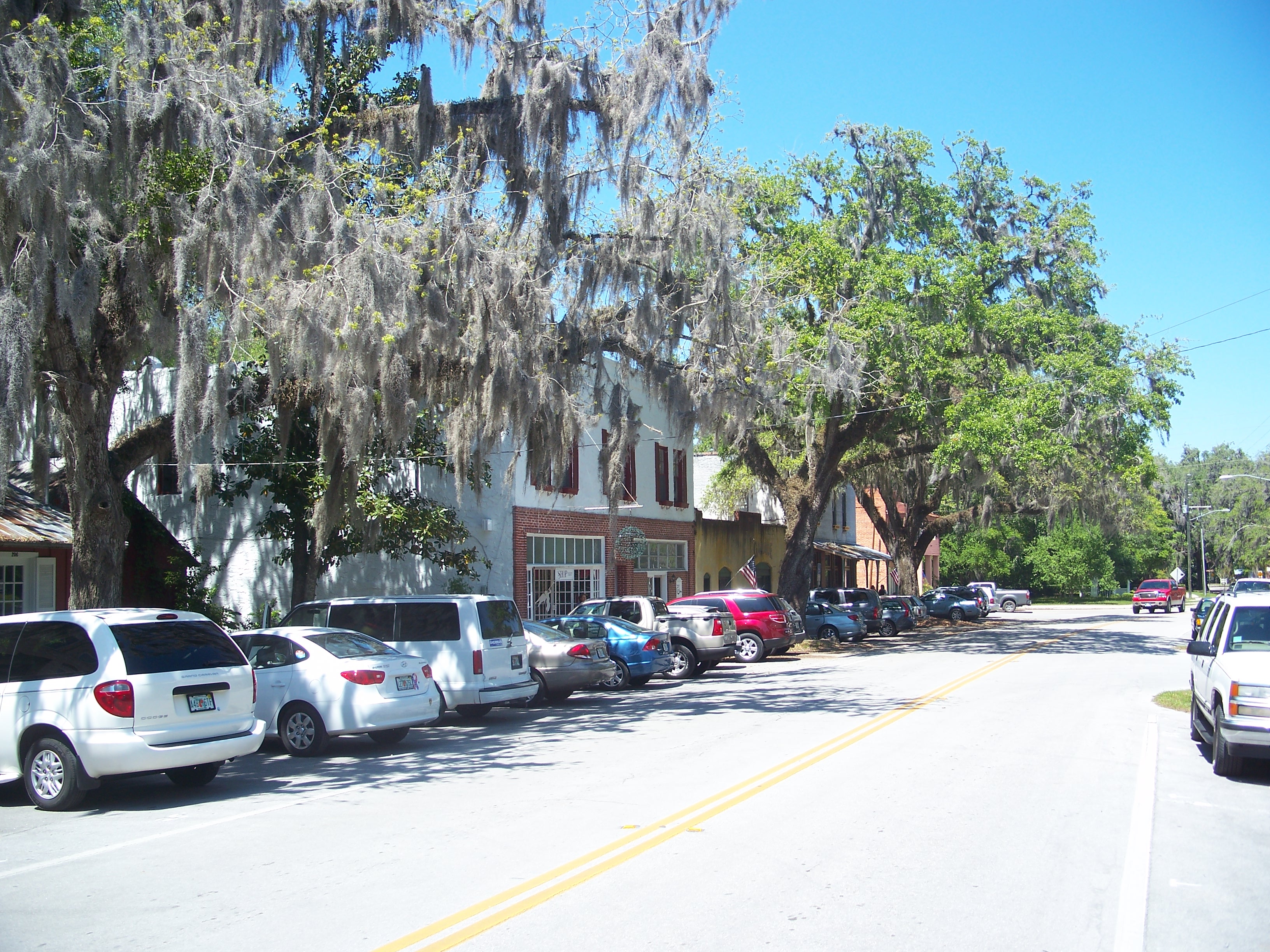
Micanopy, Florida
Tom Petty sang that he'd "been to Brooker, been to Micanopy, been to St. Louis too - I've been all around the world!" The joke lands because Micanopy is exactly the kind of place that feels like the opposite of the world - a town of 648 people tucked into the live oaks south of Gainesville, so small and so still that its own motto is 'The Town that Time Forgot.' But the name carries weight far beyond its size. This is the oldest continuously inhabited community in the interior of Florida, incorporated in 1837 when Florida was still a territory, named for a Seminole chief whose authority over the land the settlers felt compelled to acknowledge even as they displaced his people. Two battlefields from the Seminole Wars lie within the town limits. The downtown is on the National Register of Historic Places. And somewhere in those oak-shaded streets, Michael J. Fox once played a small-town doctor for the cameras.
A Chief's Name, A Settler's Conscience
The town's name is a act of complicated historical guilt. Micanopy was a Seminole chief, and the Florida Association of New York - the earliest Florida development corporation, headquartered in Manhattan - named their settlement after him. Historian C. S. Monaco has suggested the naming was deliberate diplomacy: an attempt "to appease the chief and acknowledge his original authority over the land." The gesture did not prevent war. The Battle of Micanopy and the Battle of Welika Pond, both fought in 1836, took place within what are now the town limits. Archaeological studies have verified the locations of both battlefields, along with the sites of two forts. John Horse, a Black Seminole leader, lived in the area before the Seminole Wars and the forced removal to Indian Territory. Moses Elias Levy, a Jewish businessman and philanthropist, founded both the nearby settlement of Pilgrimage and Micanopy itself. The town's origins are a tangle of ambition, displacement, and uneasy coexistence that mirrors the broader story of Florida's interior.
Antiques and Live Oaks
Walk through Micanopy today and the 21st century feels distant. The downtown is lined with antique stores, their porches shaded by massive live oaks draped in Spanish moss. The Micanopy Historic District, listed on the National Register of Historic Places in 1983, preserves a streetscape that has changed remarkably little since the railroad era. The Thrasher Warehouse, built in 1896, once served a branch of the Atlantic Coast Line Railroad and now houses the Micanopy Historical Society Museum, with exhibits spanning from early Native American settlement through William Bartram's 18th-century travels in the region to the Seminole Wars and the Civil War. A library, a firehouse, a post office, a handful of restaurants - that is essentially the full inventory of Micanopy's municipal life. The population hovered around 600 for over a century, reaching 653 in 2000 before dipping to 600 in 2010, then edging back up to 648 by 2020. The town endures at a pace that most of America has forgotten.
Hollywood's Favorite Small Town
In 1991, a film crew arrived in Micanopy to shoot Doc Hollywood, a comedy starring Michael J. Fox as a hotshot young surgeon whose car breaks down in a tiny Southern town, forcing him to serve as the local doctor. The film, based on Neil B. Shulman's book What? Dead...Again?, used Micanopy's photogenic downtown as its primary location. The town was so perfectly preserved, so convincingly frozen in time, that it required almost no set dressing. Residents still recall the shoot with pride. The film put Micanopy on a map it had largely avoided, and the antique shops that now anchor the downtown economy owe some of their tourist traffic to the lingering association. The town also appears in John Anderson's country hit 'Seminole Wind' and was saluted on the variety show Hee Haw on September 27, 1975. For a place of 648 souls, Micanopy has an outsized presence in American popular culture.
Lives Lived Under the Canopy
Micanopy has attracted an unlikely roster of notable residents. Archie Carr, the renowned zoologist and author whose work on sea turtle conservation shaped modern marine biology, lived here with his wife Marjorie Harris Carr, herself a pioneering conservationist who led the campaign to stop the Cross Florida Barge Canal. River Phoenix, the actor who died tragically at 23, had his cremated ashes scattered at his family's ranch near town. The place draws people who want to step outside the current of mainstream American life - artists, eccentrics, retirees, conservationists. Each autumn, an art festival fills the streets with local and visiting artists, briefly doubling the town's population. The rest of the year, Micanopy sits at the edge of Paynes Prairie, a vast wet prairie south of Gainesville where bison and wild horses roam, living at the tempo it has maintained since long before the cars crossed Paynes Prairie on the Micanopy Causeway in the 1920s.
From the Air
Located at 29.50°N, 82.28°W on the southern edge of Alachua County, about 10nm south of Gainesville. The town itself is very small and can be difficult to spot from altitude - look for the cluster of buildings along US-441 at the northern edge of Paynes Prairie Preserve State Park. Paynes Prairie is the dominant visual landmark: a vast, flat expanse of wet grassland stretching south of Gainesville, unmistakable from the air. Gainesville Regional Airport (KGNV) is approximately 10nm north-northeast. The surrounding terrain is flat and low, characteristic of north-central Florida, with scattered lakes and the dark green canopy of live oaks distinguishing the town from the surrounding open land.