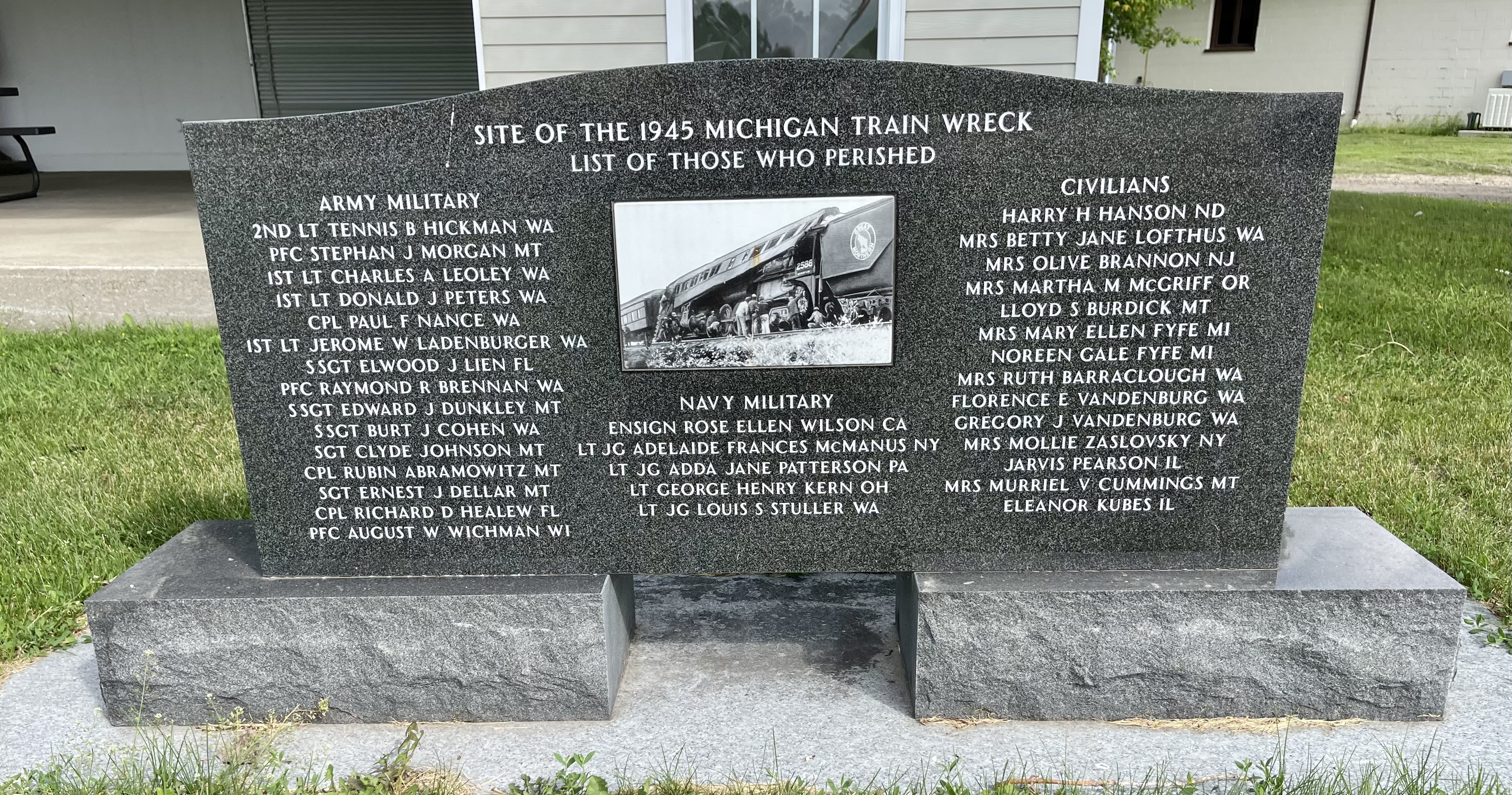
Michigan, North Dakota Train Wreck
The flagman lit a fusee and ran back down the track, but it was already too late. On August 9, 1945 -- the same day the United States dropped the atomic bomb on Nagasaki -- a different kind of catastrophe unfolded on the plains of North Dakota. Near the tiny community of Michigan, the Great Northern Railway's premier train, the Empire Builder, was running in two sections to handle wartime crowds. When the first section stopped on a shallow curve to tend to an overheated journal bearing, the second section came roaring up behind it. The collision that followed became the worst rail disaster in both North Dakota and Great Northern Railway history.
Two Trains, One Name
World War II had overwhelmed America's railroads with passengers. The Empire Builder, Great Northern's flagship route between St. Paul and the Pacific Northwest, was running in two sections designated First 1 and Second 1. Both were hauled by Baldwin-built GN S-2 4-8-4 steam locomotives. They departed St. Paul Union Depot twenty minutes apart, traveling to Fargo via Willmar. After a crew change in Fargo, First 1 left at 3:25 that afternoon headed by locomotive No. 2584, carrying 237 passengers in eleven cars, mostly Pullman sleepers. Second 1 followed with eleven coaches hauled by locomotive No. 2588, carrying between 600 and 700 people. Most passengers on both trains were military personnel and their families, traveling under the control of the Office of Defense Transportation.
A Journal Bearing Smokes
Automatic Block Signal protection covered the route only as far as Fargo. Beyond Grand Forks, the two trains ran on a stretch without that safeguard, relying on time intervals and visual signals. When the trains departed Grand Forks, thirty minutes separated them. Then trouble began. Four miles west of Niagara, a brakeman on First 1 spotted smoke rising from the tender -- a hot box, an overheated journal bearing. The crew repacked it and rigged a water line to cool the journal. First 1 stopped again at Petersburg to check and adjust the hose. Each stop bled away the gap between the two sections. Second 1 was gaining.
Four Minutes at Michigan
First 1 made its final stop at Michigan, on a shallow curve, because the journal was smoking again. The investigation later found the water line had become clogged, rendering the cooling system useless. The engineer climbed down to inspect the bearing. Then the conductor heard it -- the sound of Second 1 approaching. He ordered the fireman to get the train moving. The flagman lit a fusee and sprinted back along the track to warn the oncoming locomotive. Just as First 1 began to inch forward, four minutes after stopping, Second 1 struck the rear car at 45 miles per hour. According to the Interstate Commerce Commission report, the entire front train was driven forward 165 feet by the impact. The rear car -- a bobtail, part observation car and part sleeping berths -- was telescoped practically its entire length by the engine of Second 1 and demolished. The locomotive of Second 1 derailed but remained upright, covered by the crushed top and side sheets of the car it had destroyed.
A Disaster in Wartime Shadow
The wreck killed 34 people and injured scores more, making it the deadliest rail accident in North Dakota history and the worst in the Great Northern Railway's long operational record. Most of the dead and injured were military personnel and their families, men and women who had survived the anxieties of wartime only to meet catastrophe on the home front. The timing compounded the tragedy's obscurity: August 9, 1945 was one of the most consequential days of the twentieth century, dominated by news from the Pacific. The Michigan wreck barely registered in the national consciousness. Today, Michigan, North Dakota remains a small community in Nelson County. No monument marks the curve where the trains collided. The prairie has long since absorbed the evidence, leaving only the historical record -- and the lesson that four minutes can separate routine maintenance from disaster.
From the Air
Located at 48.02°N, 98.13°W in Nelson County, North Dakota. The site is on the former Great Northern Railway mainline between Grand Forks and Minot, now part of the BNSF Railway corridor. The terrain is flat North Dakota prairie -- from the air, look for the rail line curving gently through open agricultural land near the small community of Michigan. Grand Forks International Airport (KGFK) is approximately 50 nm to the east. Devils Lake Regional Airport (KDVL) is about 25 nm to the northwest. Best viewed at 2,000-4,000 feet AGL. The landscape is entirely flat farmland with the railroad as the primary linear feature.