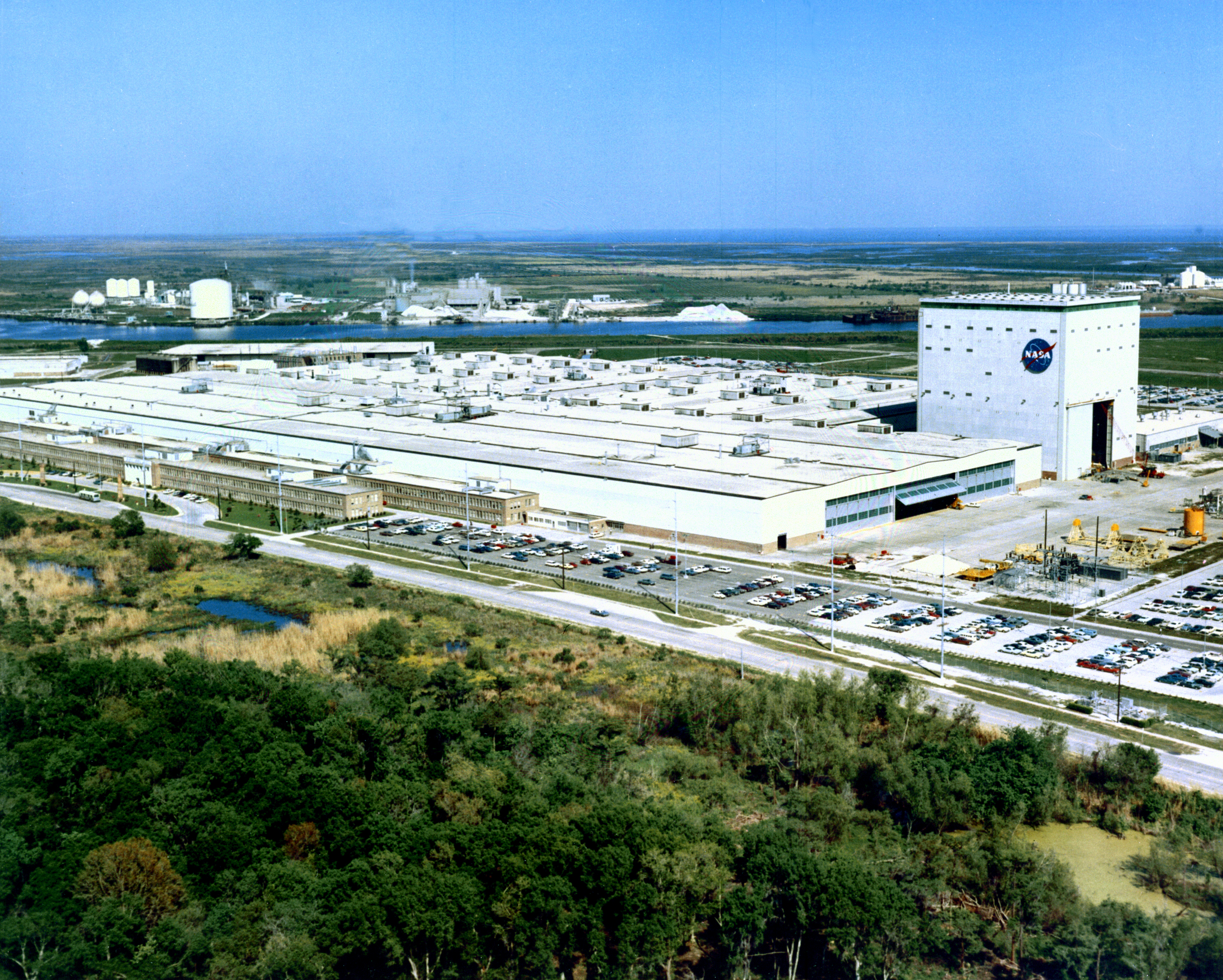
Michoud Assembly Facility
The building is so large that it has its own internal road system. Forty-three acres of factory floor sit under a single roof in New Orleans East, making the Michoud Assembly Facility one of the largest manufacturing plants in the world. Inside this climate-controlled expanse, workers built the first stages of the Saturn V rockets that carried humans to the Moon, assembled the external fuel tanks for every Space Shuttle mission, and today fabricate the core stages of NASA's Space Launch System. The facility's history stretches back even further than the space age, to a World War II factory built by the same man who designed the landing craft that stormed the beaches of Normandy.
From Higgins Boats to the Moon
Andrew Jackson Higgins built the original facility in 1940 at the village of Michoud, Louisiana. Higgins was already famous for designing the flat-bottomed landing craft that would carry Allied troops onto enemy beaches during World War II. The government contracted his Higgins-Tucker division to produce plywood C-76 cargo planes at the new plant, a project that cost $180 million. Production of the C-76 never materialized. The facility produced only two Curtiss C-46 Commando aircraft before orders were cancelled in 1944. During the Korean War, the plant retooled to build engines for Sherman and Patton tanks. It sat largely dormant until 1961, when NASA took over management and transformed it into the birthplace of the Saturn rocket family. Chrysler Corporation built the first stages of the Saturn I and Saturn IB here, while Boeing constructed the massive S-IC first stage of the Saturn V.
The Ceiling That Chose Our Moon Rocket
One of Michoud's most consequential features is invisible to visitors: a ceiling height limitation of 12 meters. When NASA was deciding how to reach the Moon, the originally planned Saturn C-8 rocket was too tall to be assembled inside the factory. This physical constraint became one of the major reasons NASA chose the smaller C-5 design, later renamed the Saturn V, and with it the lunar orbit rendezvous method over the direct-ascent approach. A factory's ceiling, in other words, helped determine the architecture of the Apollo program. After Apollo, Michoud spent nearly four decades building external tanks for the Space Shuttle. Martin Marietta Corporation produced them from 1973 to 2010, when production ended. One tank, ET-94, was never flown and remained at Michoud as a test article. Today, the facility builds core stages and components for the Space Launch System and the Orion spacecraft pressure vessel.
The Jetliner on Saturn Boulevard
On May 24, 1988, TACA Flight 110, a Boeing 737-300 carrying passengers from Belize, lost power in both engines during a severe thunderstorm over New Orleans. Captain Carlos Dardano brought the aircraft down on a grassy levee within the Michoud grounds, a flawless dead-stick landing that saved everyone aboard. The jetliner was towed into the NASA facility, its engines replaced, and on June 6 it took off using Michoud's former runway, a strip that had been converted into a road called Saturn Boulevard. The plane flew the short hop to New Orleans International Airport for full repairs. The old runway, once used by military aircraft in the 1940s, had been gradually transformed through the 1960s, its midsection briefly serving as a heliport before it became the boulevard that today carries rocket components to the shipping port.
Storm, Tornado, and Resilience
Hurricane Katrina struck the facility in August 2005, flooding parts of the complex and forcing evacuation. NASA announced on September 16 that repairs were progressing faster than anticipated, and Michoud officially reopened for essential personnel on October 3, then to all workers by October 31. Twelve years later, on February 7, 2017, an EF3 tornado carved through Orleans Parish and directly hit the factory. Two major buildings, including the main manufacturing building, sustained damage with multiple broken windows. Five people were injured. The repairs and resulting disruptions contributed to the delay of the first Space Launch System launch until late 2022. Through it all, the facility has endured, its massive structure absorbing the worst that Gulf Coast weather can deliver.
Rockets and Movie Stars
More than 4,200 people work at Michoud today. The main manufacturing building stretches 512 by 340 meters and contains over 40 sub-areas for different fabrication and assembly operations. Polished concrete internal roads carry trams and factory vehicles beneath overhead cranes. Completed rocket stages travel down Saturn Boulevard to a shipping port 600 meters southwest, where they are loaded onto the Pegasus Barge for transport to Kennedy Space Center in Florida or Stennis Space Center in Mississippi for testing. NASA also rents portions of the facility to outside tenants. Portions of the films Ender's Game, G.I. Joe: Retaliation, and Dawn of the Planet of the Apes were filmed inside the factory. The U.S. Coast Guard, the Department of Agriculture's National Finance Center, and GE have also operated from the complex, making Michoud one of the most eclectic federal facilities in the country.
From the Air
Located at 30.02N, 89.92W in New Orleans East, the massive Michoud complex is unmistakable from the air: a single enormous rectangular building covering 43 acres, with the North and South Vertical Assembly Buildings flanking it. Saturn Boulevard runs north-south through the complex, and the barge shipping port is visible 600 meters to the southwest. The Intracoastal Waterway passes nearby. Look for the industrial scale of the facility contrasted against the surrounding marshland and residential areas of eastern New Orleans. Nearest airports: New Orleans Lakefront Airport (KNEW) about 10 miles west, Louis Armstrong New Orleans International Airport (KMSY) about 25 miles west. Best viewed at 3,000-5,000 feet AGL.