Microsoft
Bill Gates called MITS in Albuquerque and said he had a working BASIC interpreter for the Altair 8800. He did not. He and Paul Allen had seen the microcomputer on the January 1975 cover of Popular Electronics and recognized the opportunity before the machine even arrived. Allen wrote a simulator; Gates wrote the code. When Allen flew to Albuquerque to demonstrate the interpreter on an actual Altair for the first time, it worked -- a fact that surprised no one more than the two of them. From that bluff, made from a dorm room at Harvard, grew the largest software company on Earth: a corporation that would put an operating system on nearly every personal computer sold for two decades, generate three billionaires and an estimated twelve thousand millionaires among its employees, and reshape the way human beings work, play, and communicate.
Garage to Global Standard
Gates and Allen had been tinkering together since their school days in Seattle, where they founded Traf-O-Data in 1972 to build rudimentary computers for tracking automobile traffic. After the Altair demonstration, they formalized their partnership as Micro-Soft -- the hyphen would not survive long -- and licensed their BASIC interpreter to MITS. The company moved from Albuquerque to Bellevue, Washington, in 1979, and then to its current Redmond campus in 1986, just weeks before its initial public offering on March 13 of that year. The IPO priced at $21 per share. By the end of the first trading day, it closed at $27.75. The operating system that made this possible was MS-DOS, licensed to IBM for its first personal computer in 1981 and subsequently adopted by the vast majority of PC manufacturers. Windows followed, layering a graphical interface over DOS and gradually becoming the default environment for personal computing worldwide.
The Empire on the Eastside
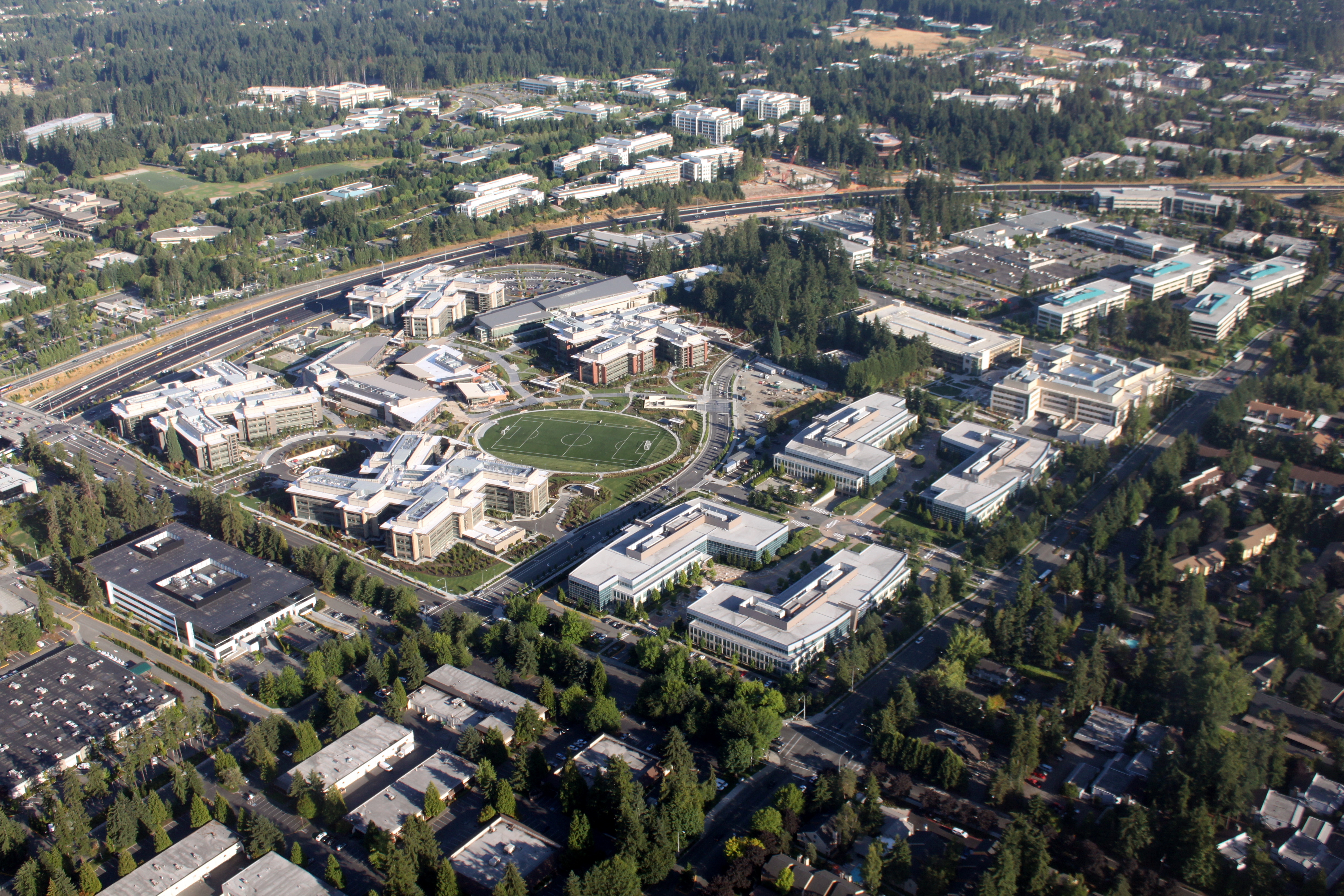
Microsoft's corporate headquarters at One Microsoft Way in Redmond is less a campus than a small city. The complex encompasses over eight million square feet of office space and houses between thirty and forty thousand employees -- a concentration of technical talent that has reshaped Redmond and the broader Eastside suburbs of Seattle. The company moved onto the grounds on February 26, 1986, and has expanded multiple times since. Additional offices in Bellevue and Issaquah bring the regional workforce even higher, while the company's global headcount exceeds ninety thousand. The campus's influence radiates outward: Redmond's restaurants, housing market, traffic patterns, and cultural institutions all bear Microsoft's imprint. The transformation of this once-quiet suburb into a global technology hub happened within a single generation, driven by a company that arrived when the biggest building in town was probably a barn.
Beyond the Desktop
If Microsoft had stayed a PC software company, it would still be historically significant. It did not stay. The Xbox, launched in 2001, pushed the company into gaming hardware and eventually into a console war with Sony and Nintendo that continues today. The acquisition of LinkedIn in 2016 for $26.2 billion gave Microsoft the world's largest professional network. The purchase of GitHub in 2018 made it the custodian of the platform where much of the world's open-source code lives -- an ironic turn for a company once hostile to the open-source movement. In 2022, Microsoft announced its intention to acquire Activision Blizzard for $68.7 billion, a deal that after lengthy regulatory review was completed in 2023, making it the largest acquisition in gaming history. Azure, the company's cloud computing platform, now competes directly with Amazon Web Services for dominance of the cloud infrastructure market. And a multibillion-dollar partnership with OpenAI has placed Microsoft at the center of the current artificial intelligence boom.
Wealth, Power, and Reckoning
Microsoft's cultural impact extends well beyond software. The company's early stock options created a class of sudden millionaires who transformed Seattle's philanthropy, real estate, and arts scenes. The Bill and Melinda Gates Foundation, funded largely by Microsoft wealth, became the largest private charitable foundation in the world. But scale brings scrutiny. The U.S. Department of Justice's antitrust case in the late 1990s accused Microsoft of monopolistic practices in bundling Internet Explorer with Windows, a case that resulted in a settlement and consent decree. Critics have pointed to the company's use of permatemp workers -- employees kept as nominally temporary for years to avoid providing benefits -- and to a culture that, particularly in its early decades, was described as a "Velvet Sweatshop" for its relentless work expectations. In January 2024, Microsoft disclosed that a Russian state-sponsored group had hacked into a small percentage of its corporate email accounts, including those of senior leadership. The company acknowledged the breach might have been prevented by multi-factor authentication, a security measure Microsoft itself recommends.
From the Air
Microsoft's Redmond campus is located at 47.643N, 122.132W, a sprawling complex of low-rise office buildings and connectors visible from altitude as a dense cluster of rooftops and parking structures east of State Route 520. The campus sits between Overlake and downtown Redmond, bordered by the Sammamish River Trail to the north. Lake Sammamish is 2nm east and Lake Washington 4nm west. Nearest airports: Renton Municipal (KRNT) 10nm south-southwest, Boeing Field (KBFI) 13nm southwest, Paine Field (KPAE) 18nm north. Best viewed at 3,000-5,000 feet approaching from the west along SR-520, where the campus scale contrasts with the residential neighborhoods surrounding it.