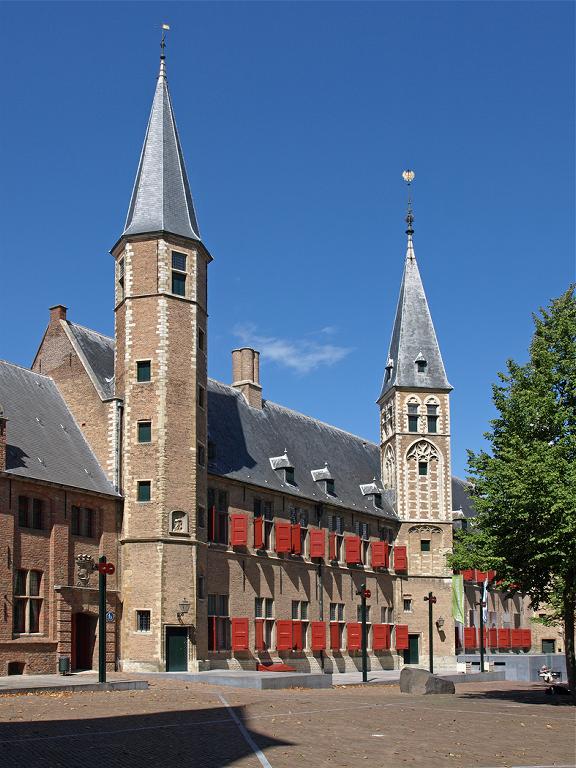
Middelburg Abbey
When the bombs hit Middelburg on the afternoon of 17 May 1940, the abbey burned for two days. The Lange Jan - 'Tall John,' the 91-metre church tower that had pointed skyward over the Zeeland flatlands since the fourteenth century - lost its elaborate upper storeys. The roof of the choir church collapsed. Pews, organs, plaster, eight hundred years of accumulated history all turned to ash and rubble in a single afternoon, and the tower's reconstruction would not be finished until 1955. But before all that, the abbey had spent eight centuries doing almost everything else a building can do. It was a Premonstratensian monastery, then a Catholic cathedral, then a Spanish target, then a Protestant church, then a mint, an admiralty, a court, a Napoleonic prefecture, a provincial parliament. Saying 'Middelburg Abbey' is shorthand for a single set of stones that has worn most of the costumes Western European history has to offer.
Canons on a Carolingian Hill
The abbey's origins reach back further than its formal founding. In the ninth century, Carolingian rulers built three fortified ring-strongholds on the island of Walcheren to defend against Viking raids; one of them stood at what is now Middelburg. In 1127, Premonstratensian canons - a relatively new reforming order, founded only seven years earlier by Norbert of Xanten - arrived from St Michael's Abbey in Antwerp and built a monastery on the old fortified site. They eventually held large tracts of land on Walcheren and across Zeeland, and over the next three centuries they expanded the foundation into a complex of cloisters, chapter houses, kitchens, and two adjoining churches. In 1401 the abbey was placed under direct papal control - a mark of its prestige, but also a sign that the canons preferred Rome's distant supervision to the closer attentions of the bishop of Utrecht. Two devastating fires, in 1492 and 1568, gutted much of the monastic complex. What we see today as 'medieval' is largely a Gothic rebuilding from the second half of the sixteenth century.
The End of the Monks
The abbey's life as a religious house ended on a single date: 1574. The Spanish garrison under Cristóbal de Mondragón had held Middelburg through a two-year Dutch siege, and when Mondragón finally negotiated surrender to William of Orange, William personally guaranteed that the clergy would be left undisturbed. The guarantee did not survive contact with the new Protestant authorities of Zeeland. The abbey was secularised, Catholic worship was forbidden, and the canons - some of whom had lived in those cloisters their entire adult lives - were turned out. Within a year the buildings had been renamed the 'Hof van Zeeland' and converted to government use: the seat of the Staten van Zeeland (the provincial assembly), the local admiralty, a mint, and a court chamber. The Roman Catholic Diocese of Middelburg, which the abbey had briefly hosted under its first bishop Nicolaas van der Borcht (consecrated 1559), was abolished a generation later in 1603. After the Napoleonic reforms of 1812, the whole complex was redesignated the Provinciehuis - 'Province Building' - and the provincial government of Zeeland has had its headquarters there ever since.
Two Churches Under One Roof
South of the cloisters stand two churches that look like one church from the outside and are entirely separate inside. The Choir Church (Koorkerk) replaced the abbey's old church around 1300 - a tall, narrow chancel of seven arches culminating in a five-sided apse over what were once the canons' choir stalls. The elaborate rib vaulting was added during the post-1568 rebuilding. To the west sits the New Church (Nieuwe Kerk), notable for its double nave - an unusual twin-aisle configuration that the previous building, demolished after the 1558 fire, also featured in smaller form. The eastern wall of the New Church is the western wall of the Choir Church; the two interiors were once connected by an arch, but the opening was bricked up centuries ago. To move between them now you have to leave one building and enter the other. The New Church's most striking feature is its organ - a 1954 instrument by Pels & Van Leeuwen of Leiderdorp, but housed in a magnificent carved 1693 cabinet originally built for an Amsterdam church by the carpenter-craftsman Jan Albertsz Schut. The case alone is worth crossing the country for.
Lange Jan
The Lange Jan is one of the great church towers of the Low Countries. The lower section of the brick tower dates from the fourteenth century. The elaborate octagonal upper stages were added in 1712, in the high Baroque style that was sweeping through Dutch civic architecture. In May 1940 the upper stages were destroyed when German bombers hit the abbey complex - part of the broader bombing of Middelburg that was meant, in the German command's reasoning, to convince the Dutch army not to hold out on Zeeland against the invasion. Whether the bombers actually destroyed the upper tower or French artillery counter-firing into the burning city was responsible has been argued over for eight decades. The result, either way, was the same: the most recognisable landmark in Zeeland was a stump for the next quarter-century. The reconstruction, completed in 1955, restored the silhouette to its pre-war appearance. Today, at ninety-one metres, Lange Jan remains the tallest church tower in the province and the visual centre of every aerial view of Walcheren.
Visiting the Abbey
The abbey complex now houses the provincial government of Zeeland, the Zeeuws Museum (which moved into the cloisters in 1972), and since 1986 the Roosevelt Study Center - a research institute on Dutch-American relations named for Theodore and Franklin Roosevelt, whose ancestors emigrated from Zeeland. The Koorkerk and Nieuwe Kerk function as a single Protestant congregation and are open to visitors. The Lange Jan can be climbed - 207 steps - and the view from the top takes in the whole of Walcheren, the Westerschelde, and on clear days the Belgian coast and the storm-surge barriers of the Eastern Scheldt. From the air, the tower is the unmistakable centrepoint of Middelburg's compact medieval street plan, surrounded by canals and merchant houses that have miraculously survived eight hundred years of fire, war, and weather.
From the Air
Coordinates 51.5003 N, 3.6156 E - the abbey complex sits at the centre of Middelburg, the capital of Zeeland, on the island of Walcheren in the southwestern Netherlands. Recommended viewing altitude FL040-FL080 - low enough to pick out the Lange Jan tower as it punctures the otherwise flat Walcheren skyline. Visual landmarks: the diamond-shaped old city of Middelburg with its concentric canals, the Mid-Zeeland canal cutting east-west, the Westerschelde to the south, and the North Sea coast 8 km to the west. Nearest airport: Midden-Zeeland (EHMZ) 7 km west; larger fields include Antwerp (EBAW) 60 km southeast and Rotterdam (EHRD) 65 km northeast.