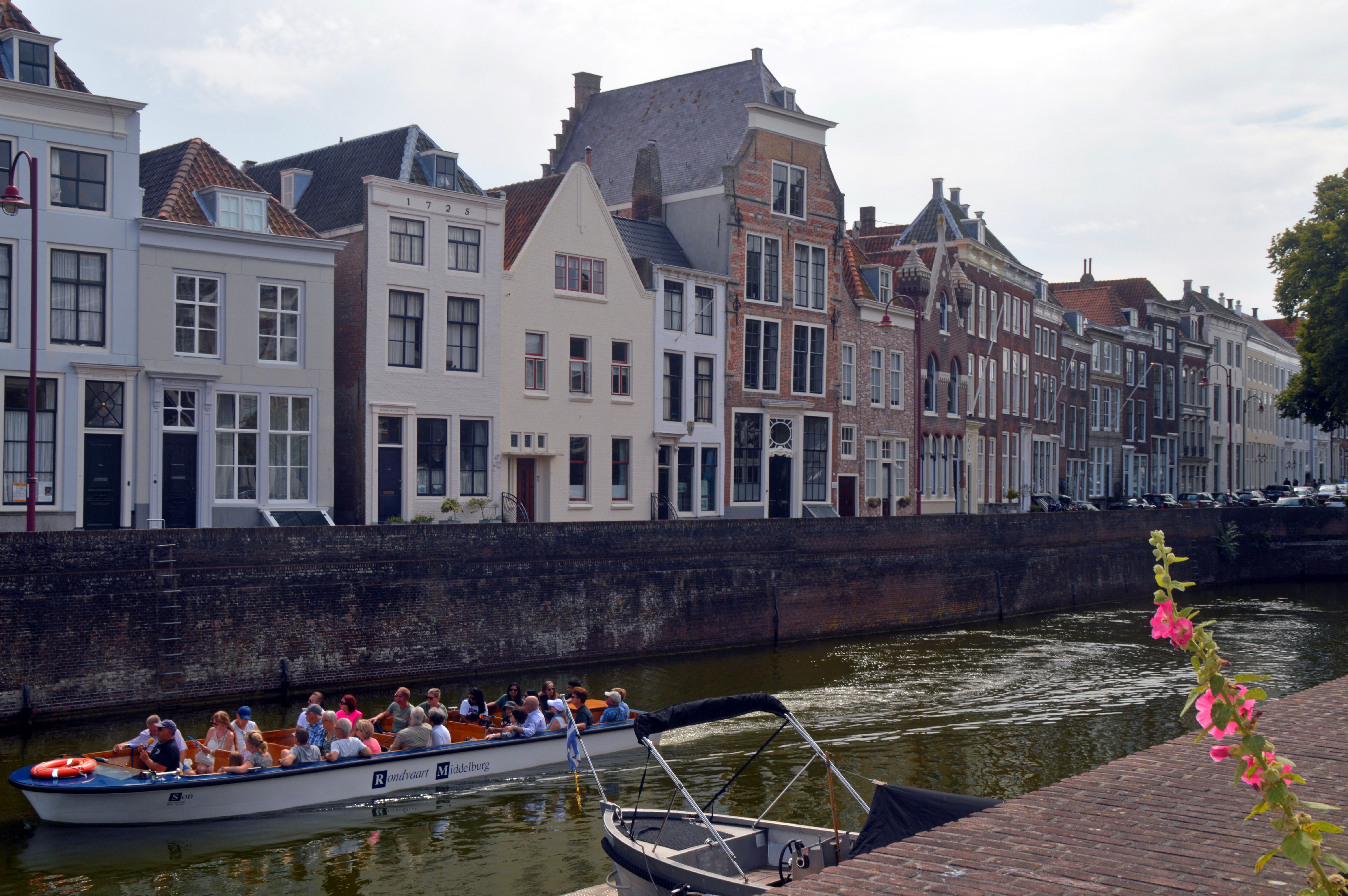
Middelburg, Zeeland
Chaucer namechecked Middelburg in 1387. In the Merchant's prologue to the Canterbury Tales he writes of the importance of keeping the sea safe 'bitwixe Middelburgh and Orewelle' - between this Zeeland port and the mouth of the River Orwell on the English coast. That a London poet, writing about Kentish pilgrims, would single out a town in the southwestern Netherlands tells you how thick the trade was. Middelburg had been a major port between England and Flanders for two centuries by then, and over the next three centuries it would become one of the most important commercial cities in Europe - second only to Amsterdam in the Dutch Republic, home to the second chamber of the Dutch East India Company, and, in a quieter way, possibly the birthplace of modern optics.
From Viking Fort to City
Middelburg's origin story begins with Vikings. In the late eighth or early ninth century, Carolingian authorities built three fortified ring-strongholds (borgs) across the island of Walcheren to defend against Norse raiders. One of them stood at what would become Middelburg - 'middle stronghold' in old Dutch, set between the other two. In 844 a monastery was founded on the site, and a Catholic religious community persisted there until the Reformation. The settlement was granted city rights in 1217 and gradually grew into a regional trading centre. Middelburg's medieval prosperity came from a simple geographical accident: the island of Walcheren sat squarely on the sea route between England and the rising textile cities of Flanders, and Middelburg controlled the natural harbour on Walcheren's eastern side. By the fourteenth century it was wealthy enough to underwrite the abbey, the great church, and a wall of fortifications. By the time Chaucer wrote, Middelburg was already an old name in the international wool trade.
Lenses and Telescopes
Two of the men who shaped early modern science worked from Middelburg shops a few minutes' walk apart. Zacharias Janssen (c. 1585-c. 1632) was a Dutch spectacle-maker who lived most of his life in the town and is one of the people history credits with the invention of the compound microscope. Hans Lipperhey, another local spectacle-maker, filed a patent application for an optical instrument 'for seeing things faraway' in 1608 - the first known telescope patent. The application was eventually denied because the basic design was already in circulation around Middelburg, but the document survives, and the year 1608 is now taken as the conventional birthdate of the telescope. Galileo heard about the Dutch instrument the following year and built his own. The grand revolution in astronomy that followed began with Middelburg lens grinders working out how to stack two convex pieces of polished glass. The Scientific Revolution had to start somewhere, and a remarkable amount of its early infrastructure came out of a small Dutch port town.
The Second Chamber of the VOC
When the Dutch East India Company - the Verenigde Oost-Indische Compagnie, or VOC - was founded in 1602, its operations were divided among six city 'chambers' that each controlled a portion of the company's ships, cargoes, and Asian trade. Amsterdam was the dominant chamber. Middelburg was the second, the Zeeland chamber, and it accounted for roughly a quarter of VOC business. Middelburg's quaysides bustled with returning Indiamen carrying pepper, cloves, silk, porcelain, tea. Warehouses lined the canals. The merchant houses that still front the Rouaansekaai and the Londensekaai were built with the profits of that trade. Middelburg's role also extended into the darker side of the Republic's commerce: as a major port of the Zeeland chamber of the West India Company, it played a significant role in the seventeenth-century Atlantic slave trade. Ships outfitted at Middelburg crossed to the West African coast, then to the Caribbean and the Guianas, carrying enslaved Africans torn from their homelands. The merchants of Zeeland grew rich on that traffic. The wealth that built Middelburg's golden-age cityscape was real, and so was the human cost of how it was earned.
Two Days in May 1940
On 17 May 1940, during the German invasion of the Netherlands, about a third of Middelburg's old city centre was destroyed by bombing and the fires that followed. The German air raid was meant to pressure the Dutch army on Walcheren into surrendering. The destruction was catastrophic. The abbey, the Lange Jan, dozens of merchant houses, the archives of the city itself - all of it burned. To this day historians argue whether some of the fire damage was caused by French artillery that was returning fire into the city or by the German bombers alone. The result was the same: an irreplaceable cultural and historical inventory turned to ash in a single afternoon. After the war, the Dutch chose painstaking reconstruction over modernist replacement. Most of the lost streets were rebuilt along their pre-war lines, with the old gabled facades reconstructed from photographs and memory. The result is a city that looks medieval but is, in many of its most photographed corners, only seventy-five years old. British troops eventually liberated Middelburg on 6 November 1944, in the closing days of Operation Infatuate.
Walking the Old Town
Modern Middelburg has about 48,000 people, two universities (University College Roosevelt and a HZ University campus), a working harbour, and a compact diamond-shaped old city laced with canals. Two of the medieval gates - the Koepoort and the Varkenspoort - still stand. The moats still hold water. The Lange Jan still dominates the skyline. The Markt fills with stalls on Thursday mornings as it has since the Middle Ages. A plaque at the railway station remembers the Jews of Zeeland who were deported from that platform to the death camps, a quieter scar than the bombing but no less permanent. Notable sons and daughters include the explorer Jacob Roggeveen, born here in 1659, who blundered into Easter Island on Easter Sunday 1722; the Bosschaert dynasty of Dutch Golden Age still-life painters; and Etty Hillesum, the diarist who was deported from Westerbork in 1943 and died in Auschwitz. The city is small enough to walk across in twenty minutes and dense enough to need a week to see properly.
From the Air
Coordinates 51.4997 N, 3.6136 E - capital of Zeeland province, on the central peninsula of Walcheren-Beveland in the southwestern Netherlands. Recommended viewing altitude FL040-FL080. Visual landmarks: the diamond-shaped old city with its concentric canals, the soaring Lange Jan church tower at the centre, the Mid-Zeeland canal cutting across Walcheren from Vlissingen (south) to Veere (north), and the surrounding flat Walcheren polders. The Westerschelde lies 8 km south, the North Sea 8 km west. Nearest airport: Midden-Zeeland (EHMZ) 7 km west on Walcheren; Antwerp (EBAW) 60 km southeast; Rotterdam (EHRD) 65 km northeast.