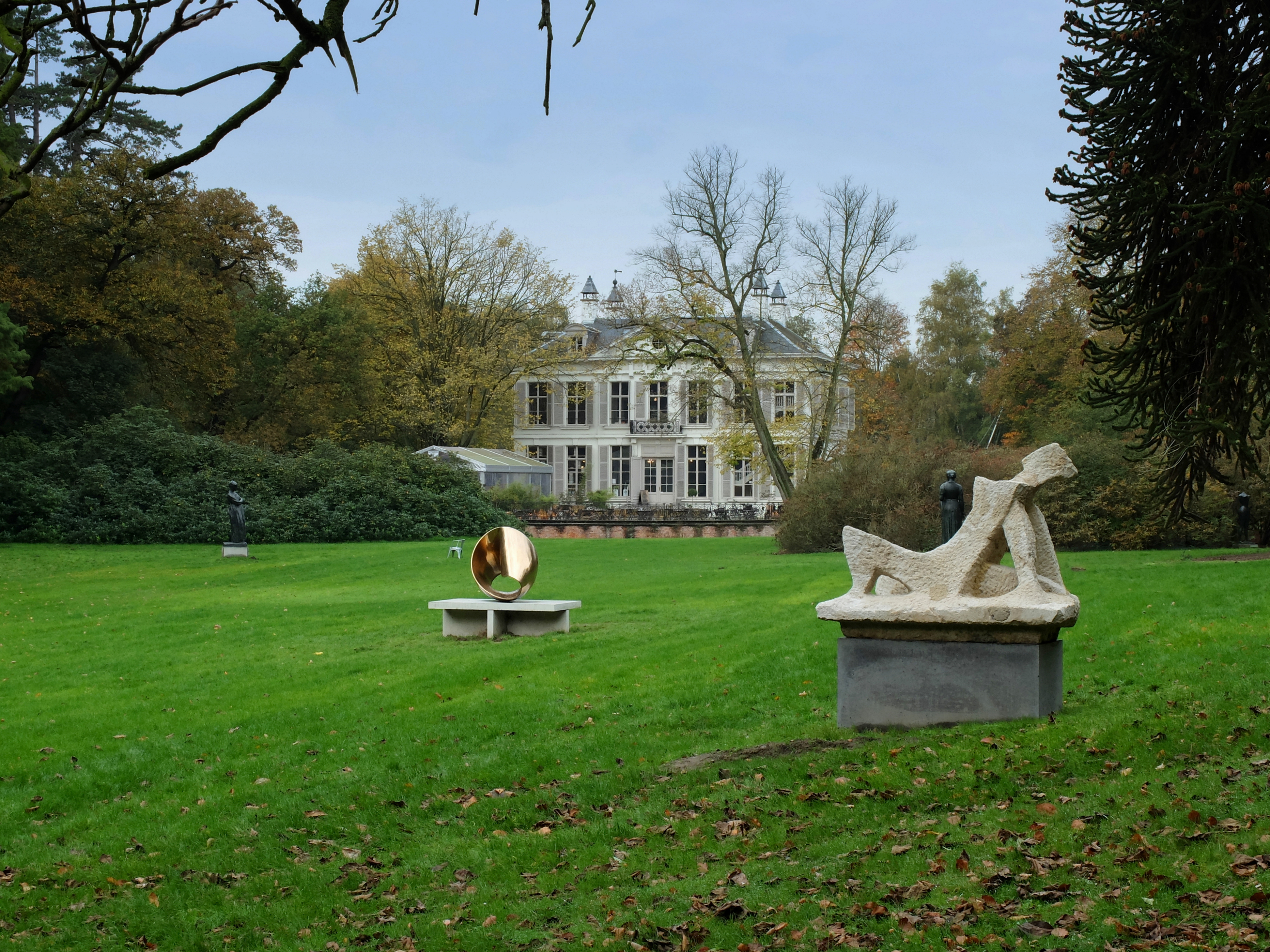
Middelheim Open Air Sculpture Museum
Rodin's bronze Balzac stands in a meadow on the southern edge of Antwerp, brooding under Belgian rain the way it never could behind museum glass. A few hundred meters away, Henry Moore's reclining King and Queen watch the trees. Ai Weiwei's recycled bridge waits to be walked across. The Middelheim Open Air Sculpture Museum has been doing this since 1950 - taking the most prestigious sculptures of the 20th century out of climate-controlled rooms and trusting them to the weather. Nearly three-quarters of a century later, the experiment is still running, and the works still look better for it.
A Postwar Idea
Middelheim opened in 1950, just five years after the liberation of Antwerp from German occupation, with a single proposition: that sculpture belonged outdoors, in a public park, free of admission and free of vitrines. The first 'Biennale Middelheim' followed in 1951 and ran every two years until 1989, each edition adding works to what is now a permanent collection of around 215 sculptures spread across thirty hectares. The site itself is older than the idea behind it. A document from 1342 mentions a 'stede geheten Middelheim'; from the 16th century onward, wealthy Antwerp merchants used it as a summer estate. The Le Grelle family sold the grounds to the Antwerp municipality in 1910. Forty years later the city handed the trees and meadows over to bronze and steel.
Bronze in the Weather
The placement is part of the art. Rodin's Balzac (cast from the 1892 monument), his Bronze Age, his John the Baptist - all three sit in open air, the green of their patina darkened by Antwerp's reliable drizzle. Henry Moore's King and Queen, modeled in 1952-53, gaze across a lawn. Aristide Maillol's River reclines among shrubs; Alexander Calder's The Dog stands ready to be circled. Carl Andre's 74 Weathering Way, acquired in 2001, is exactly what it sounds like: seventy-four identical steel plates laid flat on the ground, designed to be walked across and to rust differently depending on which feet land where. The work is the dirt as much as the steel. Inside the Braem Pavilion - a low, light-flooded structure designed by Renaat Braem and finished in 1971 - the fragile pieces shelter: Giacometti's thin figures, Jean Arp's smooth forms, the works that cannot stand a winter outside.
The Bridge Without a Name
In 2012 the museum commissioned Ai Weiwei to make something for the park. The Chinese artist, never one to import more material than necessary, found a small wooden bridge already crossing one of the paths and decided to reuse it. He replaced its decking with planks cut to trace the outline of China's borders. Visitors walk across the country without knowing it. He called the piece The Bridge Without a Name, and it sits in conversation with everything around it: Lawrence Weiner's 1995 wall text near the entrance reading 'IJZER & GOUD IN DE LUCHT STUIFMEEL & ROOK OP DE GROND' - iron and gold in the air, dust and smoke on the ground - the artist's quiet reference to the First World War, when planes and shells changed what came down from a Belgian sky.
Living Roster
The collection reads like a syllabus of modern sculpture. Belgian and Dutch figures - Rik Wouters, George Minne, Constantin Meunier, Mari Andriessen - stand alongside Barbara Hepworth, Louise Nevelson, Germaine Richier, Antony Gormley, Tony Cragg, Franz West. Pablo Gargallo's iron Prophet from 1933 catches afternoon light. Pericle Fazzini's Sibilla seems to murmur. Olivier Strebelle's fountain bubbles where Braem's planned construction never finished, an accidental sculpture in its own right. Every year more pieces arrive, often produced for specific spots in the park after the museum invites a contemporary artist to converse with the existing collection. In 2012 the neighbouring botanical garden Hortiflora joined the museum, and Paul Robbrecht added a low transparent pavilion called The House, sized, the architect said, for 'a temporary one-to-one relationship with art.'
Walking the Garden
There is a 750-meter path that begins at the Braem Pavilion, passes the old Middelheim Castle, crosses the tree-lined Middelheimlaan, and ends in the flowers of Hortiflora. Admission is free. The Antwerp tram system reaches the southern districts within a short ride of the gates. There is no audio guide as such - the trees and gravel make their own sound, and you encounter Rodin the way an Antwerp child might, by walking up to him on the grass. Open from dawn to dusk most of the year, the museum changes with the seasons: bare branches in February revealing pieces hidden by leaves in August, mist softening the steel plates in autumn, snow turning Henry Moore's figures into ghosts. Each visit is a different exhibition by the same artists.
From the Air
Located at 51.18°N, 4.41°E on Antwerp's southern outskirts in the district of Wilrijk, about 4 km south of Antwerp's old city centre. Visible from the air as a large green block between the southern motorway ring (R1) and the railway corridor. Nearest major airport is Antwerp International (EBAW), roughly 5 km east; Brussels (EBBR) lies about 40 km south. Best viewed at low altitude in clear morning light.