Middleton Place
The camellias were a gift from a French botanist. In 1786, Andre Michaux visited Middleton Place and brought with him four Camellia japonica plants -- the first camellias ever grown in an American garden. Three of those original four survive today, towering fifteen feet above the parterre corners where they were planted nearly two and a half centuries ago. They have outlasted the main house, two wars, an earthquake, and every generation of the family whose ambition created one of the most extraordinary plantation landscapes in the American South. Middleton Place, perched on a bluff above the Ashley River in South Carolina's Lowcountry, is a place where the garden outlived the mansion -- and the garden is what the builder intended to be the masterpiece all along.
The Butterfly Lakes
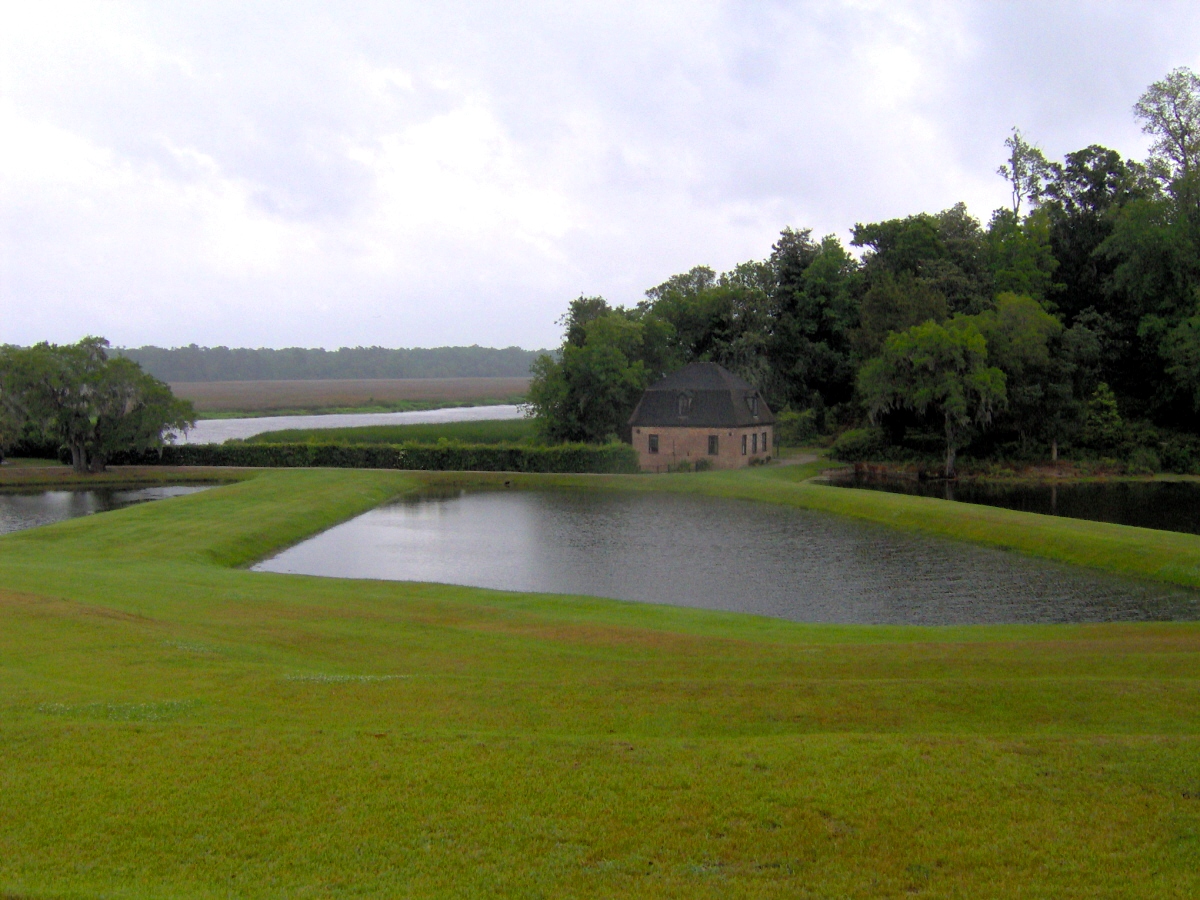
Henry Middleton married into the property in 1741, inheriting land his father-in-law John Williams had begun developing in the late 1730s. Middleton was rich, competitive, and determined to outshine his planter neighbors. While they laid out neat four-squared parterres in the conventional style, Middleton hired an English gardener named Simms and together they worked from the engraved plates in Dezallier d'Argenville's influential garden manual, "The Theory and Practice of Gardening." They extended a central axis from the main house through a gravel carriageway, past six shaped turf terraces with bowed centers, down to the river floodplain where they excavated a pair of ornamental lakes. Seen from above, these lakes resemble butterfly wings spread on either side of a turf causeway -- the Butterfly Lakes, still the visual signature of Middleton Place. Rice Mill Pond flanks one side; leveed rice fields once flanked the other. The scheme married English garden aesthetics with the practical infrastructure of a working rice plantation, and it remains the oldest landscaped garden in the United States.
Founding Fathers on the Ashley
The Middleton family left fingerprints across the founding of the nation. Henry Middleton served as President of the First Continental Congress in 1774. His son Arthur, born at Middleton Place in 1742, signed the Declaration of Independence in 1776. Four years later, during the Siege of Charleston, British troops landed in force, ransacked the plantation, beheaded the garden statuary, and looted the artwork and furniture. Arthur was captured and imprisoned until 1781. The original main house, completed around 1741, was a three-story Jacobean-style brick structure. Henry added two free-standing flanker wings in 1755 -- the north wing held a library and ballroom, the south wing served as a guest house. At the height of the family's wealth, the Middletons controlled twenty plantations and enslaved roughly eight hundred people. The grandeur of the gardens and the refinement of the house were inseparable from the forced labor of the people who built and maintained them.
Water Buffalo and Botanical Wonders
Middleton Place was a site of agricultural experimentation as much as aristocratic display. Newly discovered records revealed that the plantation imported water buffalo from Constantinople in the late 18th century -- the first in the United States. These animals served as experimental draft labor, their broad hooves suited to the deep muck of rice paddies. In the gardens, the botanical ambitions were equally striking. Beyond the famous camellias, the younger Henry Middleton filled greenhouses with exotic imports, transforming the plantation grounds into something approaching a botanical garden. When he died in 1846, his son Williams Middleton inherited a property that straddled two worlds -- a showplace of horticultural refinement and a working rice plantation built on enslaved labor. In 1860, Williams signed South Carolina's Ordinance of Secession, and the consequences arrived five years later with Union troops.
Fire, Earthquake, and What Remains
In February 1865, Union soldiers captured Middleton Place and set fire to the main house and north flanker. The south flanker -- the 1755 guest house -- burned partially but survived. What the war left standing, nature nearly finished. The Charleston earthquake of 1886 toppled the remaining walls of the main house and north wing, reducing the once-grand Jacobean structure to ruins. Only the south flanker endured, and it stands today as the Middleton Place House, a museum perched on a hill that rises just above the Ashley River with an unobstructed view nearly a mile downstream. The ruins of the main house are still visible as a gap in the treeline beside the surviving wing. Behind the south flanker, an 18th-century springhouse -- originally used for refrigeration -- had its second story converted into a chapel in 1850. And Eliza's House, a freedman's residence built around 1870, is named for its last occupant, Eliza Leach, who lived there until 1986.
A Landscape That Endures
From the air, the geometry of Middleton Place is unmistakable. The east-west axis that aligned the original roadway, main gate, and the levee between the Butterfly Lakes reads as a clear line through the Lowcountry marshland. The terraced gardens step down from the hilltop residence toward the river in a pattern unchanged since the 1740s. The Ashley River bends sharply to the east just below the property, and the rice mill pond curves along the southern edge. Today the plantation operates as a National Historic Landmark District and museum. The stableyard demonstration area, built in the 1930s, re-creates the crafts and trades of the plantation era. But the real draw remains what Henry Middleton began designing in 1741 -- a landscape that was meant to impress and endure, and has done both for nearly three centuries.
From the Air
Located at 32.90°N, 80.14°W on the southwest bank of the Ashley River, about 14 miles northwest of downtown Charleston, SC. From the air, look for the distinctive Butterfly Lakes -- twin ornamental ponds shaped like butterfly wings -- and the terraced gardens stepping down to the river. The Ashley River bends sharply to the east at this point. Ashley River Road (SC Highway 61) forms the western boundary of the property. Charleston International Airport (KCHS) is approximately 10 miles to the east-southeast. Best viewed at 1,500-2,500 feet AGL to appreciate the formal garden geometry and the river relationship.