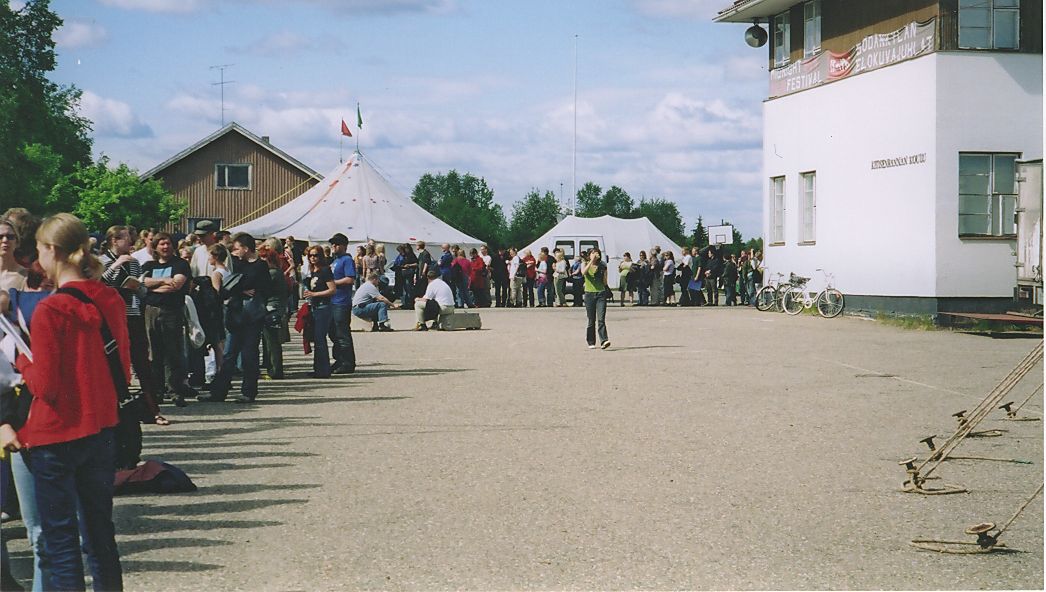
Midnight Sun Film Festival
Picture Francis Ford Coppola watching a film at 3 a.m. in a town of 8,000 people above the Arctic Circle, the sun still bright through the cinema windows. This is the Midnight Sun Film Festival in Sodankyla, Finnish Lapland, and the image is not hypothetical -- Coppola was a guest in 2002. Since 1986, this five-day festival in the second week of June has exploited one of the planet's most disorienting natural phenomena -- continuous daylight -- to screen films without interruption, around the clock, for audiences who lose track of time because the sky gives them no reason to keep it.
A Festival Without Prizes
The Midnight Sun Film Festival is non-competitive. There are no awards, no juries, no red-carpet rivalries. The program blends films directed by the main guests with 20 to 30 international features, contemporary Finnish cinema, and classic restorations. Film theory experts present master classes, and each edition introduces four or five emerging directors as festival guests. The absence of competition changes the atmosphere entirely. Without prizes at stake, the conversations between filmmakers become more honest, the screenings more relaxed, and the audience -- between 15,000 and 25,000 attendees in recent years -- more focused on the films themselves rather than on the industry politics that dominate festivals like Cannes and Venice. Sodankyla is too remote for networking. People come here because they genuinely want to watch movies.
The Guest List Tells the Story
The roster of directors who have traveled above the Arctic Circle to attend reads like a history of world cinema. Samuel Fuller and Jonathan Demme were among the first international guests in 1986. Michael Powell came in 1987, the year Jim Jarmusch and Thelma Schoonmaker also attended. The decades that followed brought Krzysztof Kieslowski, Roger Corman, Abbas Kiarostami, Terry Gilliam, Wim Wenders, Milos Forman, and Alfonso Cuaron. Agnes Varda visited in 1991; the Dardenne brothers in 2005; Bela Tarr in 2012. The festival has a particular talent for catching masters late in their careers -- directors with nothing to prove, drawn by the novelty of the setting and the festival's reputation for genuine cinephilia. Many have returned more than once, suggesting that the experience of watching and discussing film in perpetual daylight offers something the major festivals cannot.
Sodankyla's Unlikely Magic
Sodankyla is not an obvious place for anything, let alone a world-class film festival. It sits at roughly 67.4 degrees north latitude, well above the Arctic Circle, in a municipality larger than some European countries but home to fewer than 9,000 people. In June, the sun does not set. The landscape is boreal forest, rivers, and fells -- the Finnish term for the rounded Arctic mountains that define Lapland's horizon. The festival screens films in the town's cinemas and in a large tent, and the continuous daylight means there is no natural boundary between one screening and the next. Audiences drift from film to film, conversation to conversation, pausing for coffee and reindeer stew but never for nightfall. The disorientation becomes part of the experience -- a kind of temporal freedom that mirrors the way great cinema bends your sense of time.
Sodankyla Forever
The festival's co-founder, the Finnish film critic and historian Peter von Bagh, captured the spirit of the gathering in a four-hour documentary titled Sodankyla Forever. Assembled from footage of panel discussions over the festival's history, the film features directors including Forman, Kiarostami, Coppola, Ettore Scola, Michael Powell, and Elia Suleiman talking not about their own films but about the broader meaning of cinema within history and culture. The documentary is a remarkable artifact -- a record of filmmakers speaking freely in a setting stripped of industry pretense. Von Bagh understood that the festival's real product was not the screenings but the conversations they generated, and that Sodankyla's isolation was not a limitation but the condition that made those conversations possible. When the nearest distraction is a hundred kilometers of forest, people tend to focus on what brought them together.
From the Air
Located at 67.42N, 26.58E in Sodankyla, Finnish Lapland, well above the Arctic Circle. Sodankyla Airfield (EFSO) serves the area, though most visitors arrive via Rovaniemi Airport (EFRO), approximately 130 km to the south. The town sits along the Kitinen River in a landscape of boreal forest and fells. From the air in June, the midnight sun illuminates the landscape around the clock. The municipality is vast and sparsely settled -- look for the small cluster of buildings along the river. Best viewed at 3,000-5,000 feet.