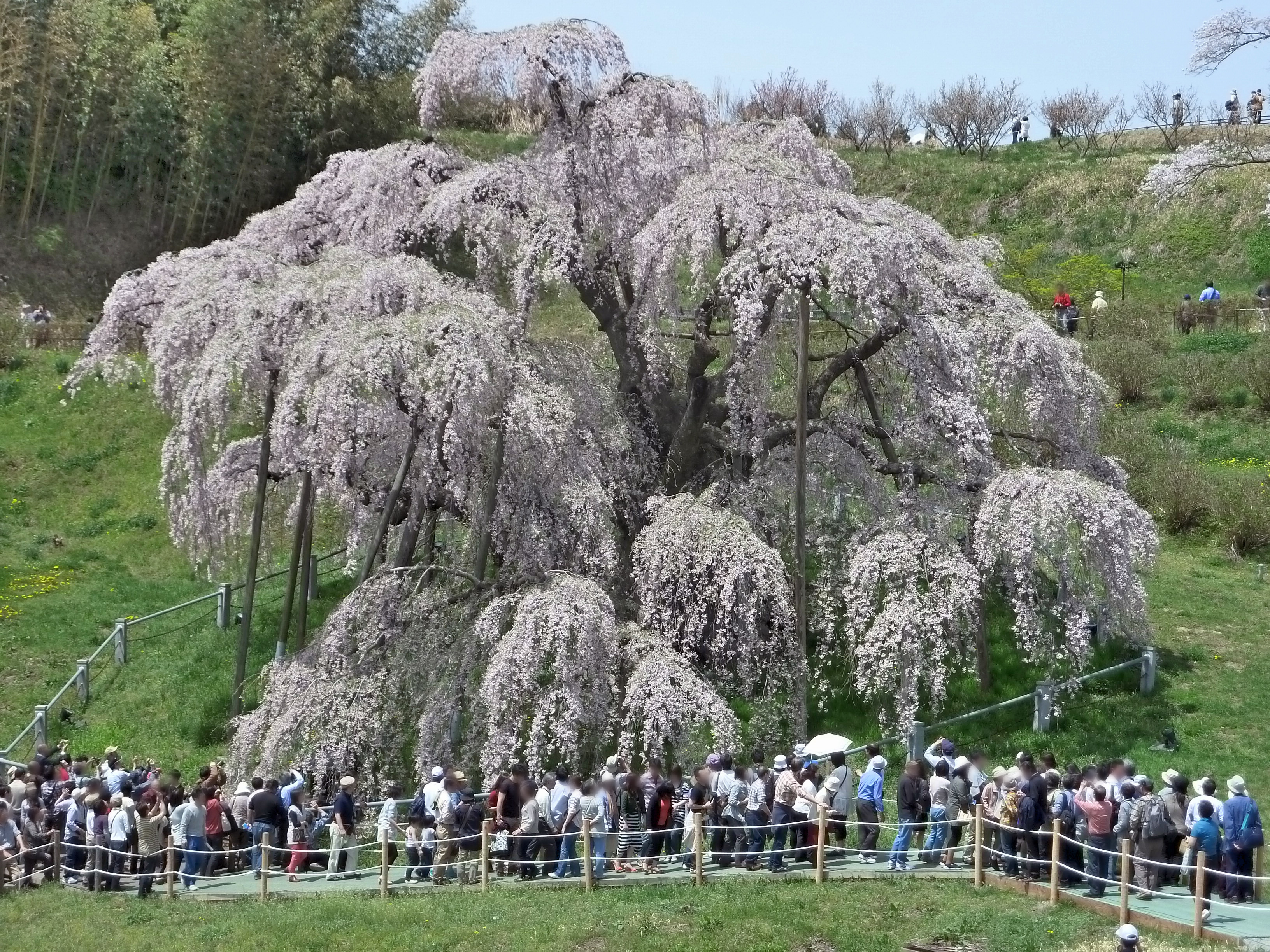
Miharu Takizakura: The Thousand-Year Waterfall of Blossoms
The name gives it away. Takizakura -- waterfall cherry -- describes exactly what happens every mid-April when this ancient tree erupts into bloom. Light pink petals cascade from branches that stretch 22 meters east to west and 18 meters north to south, spilling downward from a trunk 12 meters tall with a circumference of 9.5 meters. The effect is not metaphorical. Standing beneath the Miharu Takizakura in full flower feels like standing inside a waterfall made of blossoms, each branch a rivulet pouring color from a source over a thousand years old. In a country famous for its cherry trees, polls frequently rank this one as the single finest in all of Japan.
A Tree Among Monuments
Japan designated the Miharu Takizakura a natural monument in 1922, placing a single tree on the same register as the nation's most significant cultural properties. It is classified as one of Japan's Five Great Cherry Trees and one of the Three Giant Cherry Trees of Japan. The species is a weeping higan cherry -- Prunus subhirtella var. pendula, known in Japanese as benishidare-zakura. Its exact age is uncertain, but estimates consistently place it at over one thousand years, rooting it deep in the Heian period, when the imperial court in Kyoto was at its artistic peak. The tree has outlasted every dynasty, earthquake, and war that has swept through Fukushima. It stands on a hillside in Miharu, a farming town of around 17,000 people whose economy tilts sharply toward agriculture -- except for a few weeks each April, when the tree transforms the town into one of Japan's most visited natural destinations.
Three Hundred Thousand Pilgrims
Around 300,000 people visit the Miharu Takizakura each year, a number that dwarfs the town's permanent population by a factor of nearly eighteen. For Miharu, the tree is not just a natural wonder but an economic engine. Visitors fill local inns, buy regional specialties, and crowd the hillside paths that wind toward the tree. The viewing season lasts roughly two weeks, from mid to late April, when the blossoms open in waves along the drooping branches. Timing matters: arrive too early and the buds are still tight; too late and the petals have already carpeted the ground below. At peak bloom, the tree glows pink against the green hillside, its branches touching the earth like a living fountain frozen mid-cascade. Night illumination extends viewing hours and transforms the scene into something closer to theater, the pale blossoms luminous against the dark Fukushima sky.
Surviving the Unthinkable
In January 2005, heavy snow cracked several of the tree's ancient branches. Miharu residents responded by hand-brushing snow from the limbs and constructing wooden supports to bear the weight. Their intervention saved branches that had been growing for centuries. The greater test came in March 2011, when the Tohoku earthquake and tsunami devastated the region and triggered the Fukushima Daiichi nuclear disaster. The Takizakura, located roughly 65 kilometers west of the plant, was physically unharmed. But the nuclear crisis emptied the roads. In 2011, fewer than half the usual number of visitors came -- fear of radiation kept people away from the entire prefecture. Headlines in the New York Times and the Telegraph framed the tree as a symbol of resilience, a thousand-year-old organism blooming on schedule while the region around it struggled with an invisible threat. By 2012, the visitors returned.
Children of the Waterfall
The Takizakura has not simply endured -- it has propagated. Around 1960, researchers Denjuro Kimesawa and Kichishiro Yaginuma surveyed the area surrounding the tree and discovered more than 420 weeping cherry trees with trunk circumferences exceeding one meter within a 10-kilometer radius. The trees radiated outward from the Takizakura in concentric circles, growing thinner and younger the farther they stood from the parent. All were determined to be descendants. Between 1974 and 1995, Kichishiro's son Kichizaemon Yaginuma distributed 4,700 saplings grown from the Takizakura throughout Japan. Seeds and saplings later traveled further -- to Austria, Bhutan, Hungary, Poland, South Korea, Taiwan, the United Kingdom, and the United States. A thousand-year-old tree in a small Fukushima farming town now has offspring on four continents, each one carrying forward the genetic code of a waterfall that blooms once a year.
From the Air
Located at 37.408°N, 140.500°E on a hillside in Miharu, Fukushima Prefecture. From altitude, Miharu appears as a small rural settlement in the hilly interior of the Abukuma Highlands, east of the Nakadori valley. The Takizakura stands on a prominent hillside and during peak bloom in mid-April, the tree's massive pink canopy is visible as a distinctive color splash against the surrounding green terrain. Best viewed at 1,500-2,500 feet AGL for detail. Fukushima Airport (RJSF) lies approximately 15 nautical miles to the southwest. The Abukuma River valley to the west provides a clear navigation corridor.