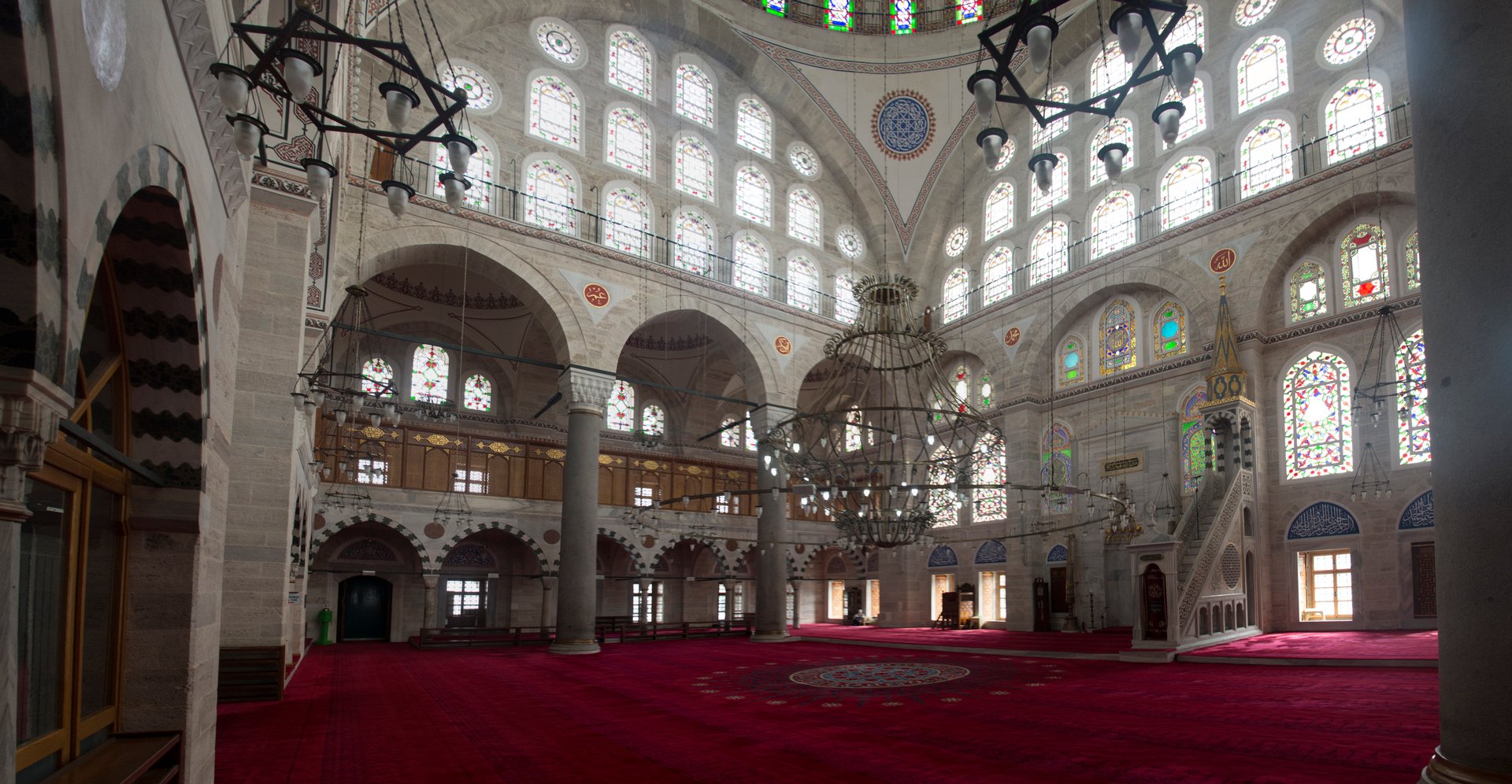
Mihrimah Sultan Mosque, Edirnekapi
Sinan filled the walls with windows. That is what visitors notice first inside the Mihrimah Sultan Mosque at Edirnekapi: a building that should feel heavy with stone instead floats on light, the cobalt and amber of stained glass throwing shifting patterns across the marble floor. The chief Ottoman architect built dozens of mosques across the empire. He saved this kind of luminous experiment for the daughter of the sultan he served, sited at the highest point in Istanbul, where her mosque could be seen from anywhere in the old city.
The Sultan's Daughter
Mihrimah Sultan was the only daughter of Suleiman the Magnificent and his beloved Hurrem Sultan, the Ukrainian-born concubine who became Suleiman's legal wife and one of the most powerful women in Ottoman history. As a princess of the dynasty, Mihrimah commanded resources that few women in any 16th-century court could match. She used them to commission two mosques in Istanbul, both designed by Sinan. The first, on the Asian side at Uskudar, was a smaller, gentler building. The second, here at Edirnekapi near the old Byzantine land walls, was larger and more ambitious. Construction began in 1563 and finished by 1570, with no foundation inscription to mark the exact dates. Mihrimah herself is not buried at her own mosque. Her tomb lies at her father's great Suleymaniye Mosque, where she rests near Suleiman.
Sinan's Cube of Light
The mosque sits on a terrace above the main road, a single dome 20 meters across rising to 37 meters at its peak. Sinan supported it with four corner towers rather than the half-domes typical of imperial mosques, freeing the tympana on each face to be pierced with windows. The result is one of the lightest buildings of his career. Triple arcades on the north and south sides open onto galleries above side aisles, each capped with three smaller domes. The original carved white marble mimbar, the pulpit from which sermons are given, has survived from the 1560s. The rest of the painted wall decoration is modern, replaced after centuries of damage. Outside, a courtyard wrapped in a portico of small domed cells, originally a medrese for religious study, surrounds a marble ablutions fountain at its center.
The Earthquake Years
Istanbul sits on the North Anatolian fault, and the mosque has paid the price. In 1719 part of the minaret stairs collapsed. In 1766 a major earthquake brought down the minaret entirely along with the main dome. In 1894 another quake sent the slender minaret crashing through the northwest corner of the roof. Each time, the mosque was repaired but its outlying buildings, the smaller pieces of the original complex, received less attention and gradually disappeared. The 1999 Izmit earthquake, which killed more than 17,000 people in the wider region, damaged the dome again. The most recent restoration, completed between 2007 and 2010, repaired the structure, paved the courtyard, and rebuilt the outer portico that had vanished centuries before. The hamam, or Turkish bath, that was part of the original complex is still in use today.
The Sixth Hill
Istanbul, like Rome, was built on seven hills. The Mihrimah Sultan Mosque crowns the sixth, near the Edirne Gate in the old Theodosian land walls, the same walls Mehmed the Conqueror breached in 1453 to take the city. From here the ground slopes down toward the Golden Horn in one direction and toward the Sea of Marmara in the other. There is a long-running legend in Istanbul that on the spring equinox, the sun sets behind this mosque just as the moon rises behind the Mihrimah Sultan Mosque at Uskudar across the Bosphorus, the two buildings briefly framing the city in symmetry. Whether or not the alignment is exact, the legend persists, and people still climb the hill to look. The story carries another claim: that Sinan, who designed both mosques, was in love with the princess and built the buildings to honor her name, which means sun and moon. Historians find no documentary evidence for the romance. The mosques remain anyway.
From the Air
Mihrimah Sultan Mosque, Edirnekapi: 41.0292 N, 28.9358 E, in the Fatih district of Istanbul, on the Sixth Hill near the old Byzantine land walls. Best viewed below 4000 feet. Identifiable as a single large dome with a tall slender minaret at the highest point of the historic peninsula, immediately inside the Edirne Gate. Istanbul Airport (LTFM) is about 15 nm northwest, Sabiha Gokcen (LTFJ) about 25 nm east. The Theodosian Walls run north to south just outside the mosque. Class C airspace covers central Istanbul; expect significant ATC coordination and restricted overflight near the historic peninsula.