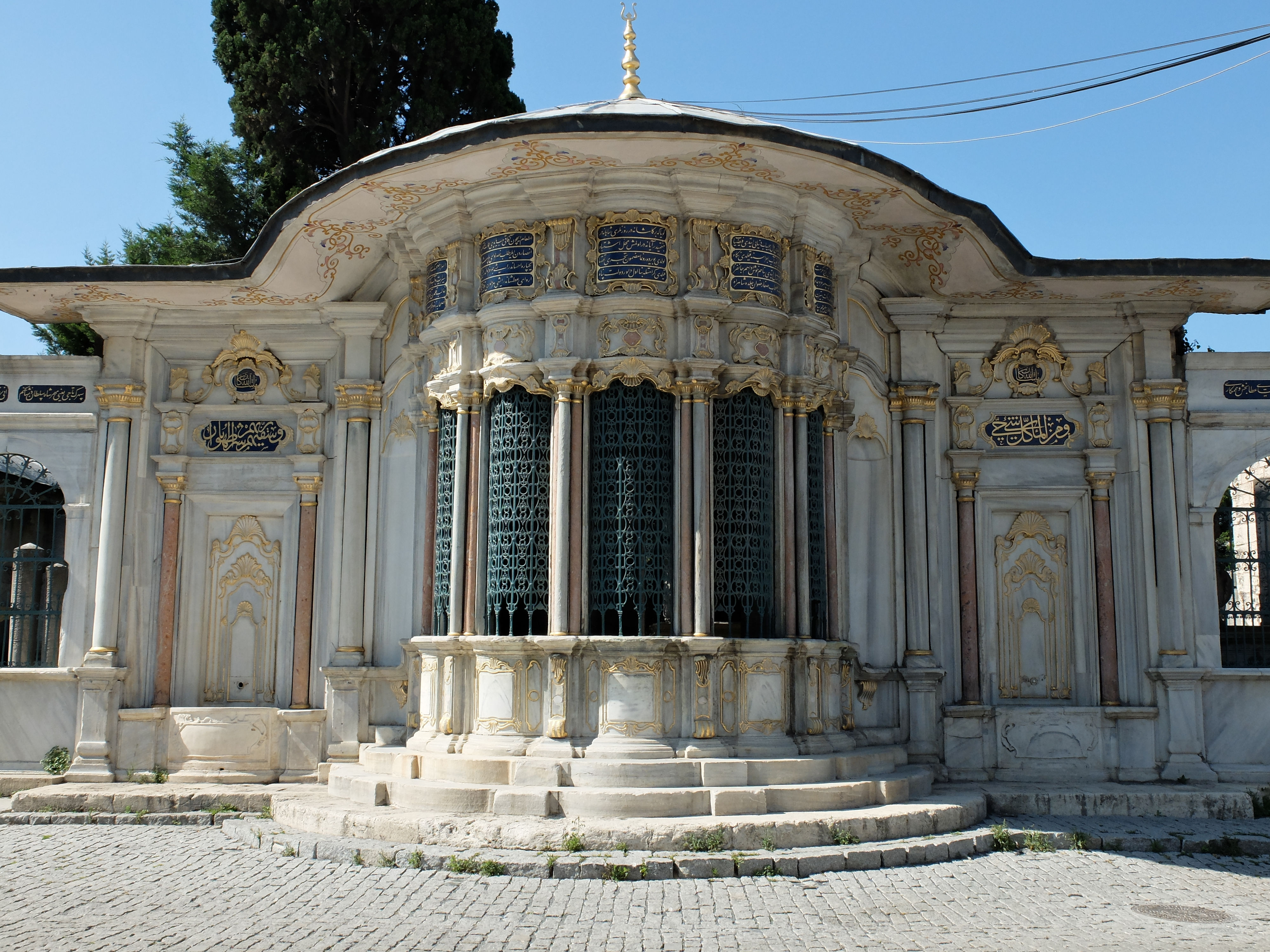
Mihrisah Sultan Complex
Two centuries after it opened, the soup kitchen is still serving food. That alone makes the Mihrisah Sultan Complex unusual among Istanbul's 18th-century imperial monuments. Most of the city's old imarets, the public kitchens that once fed students, travelers, and the poor as a religious obligation of wealthy Ottoman patrons, were closed or repurposed long ago. The one Mihrisah Sultan built next to the Eyup Sultan Mosque in 1796 has held its purpose almost without interruption: meals for refugees, for the homeless, for anyone who comes hungry, served from the same U-shaped building her architects laid out under the reign of her son Selim III.
Mother of a Reformer
Mihrisah Sultan, born around 1745, became the mother of Sultan Selim III, who ruled the Ottoman Empire from 1789 to 1807. As valide sultan, the queen mother, she held a position of enormous influence in the court, controlling vast revenues that custom directed toward charitable works. Selim III is remembered as one of the empire's most ambitious modernizing rulers, a sultan who tried to reform the Janissary corps and reshape the military along European lines, efforts that eventually cost him his throne and his life. His mother's monument is more peaceful in legacy. She commissioned this complex, called a kulliye in Ottoman terminology, between 1792 and 1796, choosing a site in the Eyup neighborhood that was already among the most sacred ground in Istanbul. Eyup is named for the Companion of the Prophet whose tomb is venerated at the nearby Eyup Sultan Mosque. Selim himself rebuilt that mosque between 1798 and 1800.
Baroque on the Bosphorus
By the late 18th century, Ottoman architecture had absorbed influences from European Baroque, producing a hybrid style that scholars call Ottoman Baroque. The Mihrisah complex is one of the most exuberant examples in Istanbul. The street-facing facade combines a semi-circular sebil, a public water dispensary with five grilled windows for serving cool drinks to passersby, with the founder's circular mausoleum and two flanking wall fountains. The whole composition curves and swells, divided into convex sections by columns and pilasters, decorated with sculpted shells and shell-like leaves that the architectural historian Dogan Kuban compared to the French Rocaille style. The columns are made of verd antique, a green-mottled marble, and pink granite. The same kind of ornament appears in the private apartments built for Selim III and his predecessor Abdulhamid I at Topkapi Palace, suggesting that the same craftsmen worked in both places.
The Imaret
Behind the ornate street facade stands the imaret itself, a large U-shaped building wrapped around a garden courtyard, entered through a monumental gate. Porticos line three sides of the courtyard. Inside, domed rooms with fireplaces and ventilation openings handle the work of cooking for hundreds. A mektep, an Ottoman primary school, sits along the western portico, and beyond that lies a small cemetery from which the founder's mausoleum is reached. The food itself has changed with the times. In the 19th century the kitchen fed students from the religious schools nearby. Today it serves daily meals to people displaced by Syria's war and to homeless residents of Istanbul, continuing the practical purpose its founder set out in the 1790s. Few buildings anywhere have stayed this true to their original mission for this long.
The Mausoleum
Mihrisah Sultan died in 1805, two years before her son was deposed in a Janissary revolt. Her tomb is the circular domed structure tucked into the southwest corner of the complex. The exterior is divided into twelve convex bays, each holding two windows stacked vertically and bordered by engaged columns of verd antique below and pink granite above. Curved Baroque windows have projecting pink keystones. Inside lie not only Mihrisah but several other women of the dynasty: Hatice Sultan and Beyhan Sultan, daughters of Mustafa III; Rahime Perestu Sultan, the first legal wife of Sultan Abdulmejid I, who died around 1906; and the modern Turkish writer and economist Alev Alatli, who died in 2024 and was buried among the Ottoman princesses, almost a quarter millennium after the complex was built.
From the Air
Mihrisah Sultan Complex: 41.0486 N, 28.9347 E, in the Eyup district of Istanbul, just outside the old city walls and inland from the upper Golden Horn. Best viewed below 3500 feet. Identifiable next to the much larger Eyup Sultan Mosque, which has multiple domes and twin minarets and sits at the head of the Golden Horn. The complex itself is smaller, with a curved Baroque street facade and a single dome over the founder's mausoleum. Istanbul Airport (LTFM) is about 12 nm northwest. The Golden Horn and the historic peninsula lie south. Class C airspace; coordinate with Istanbul approach for low-level flight near the city center.