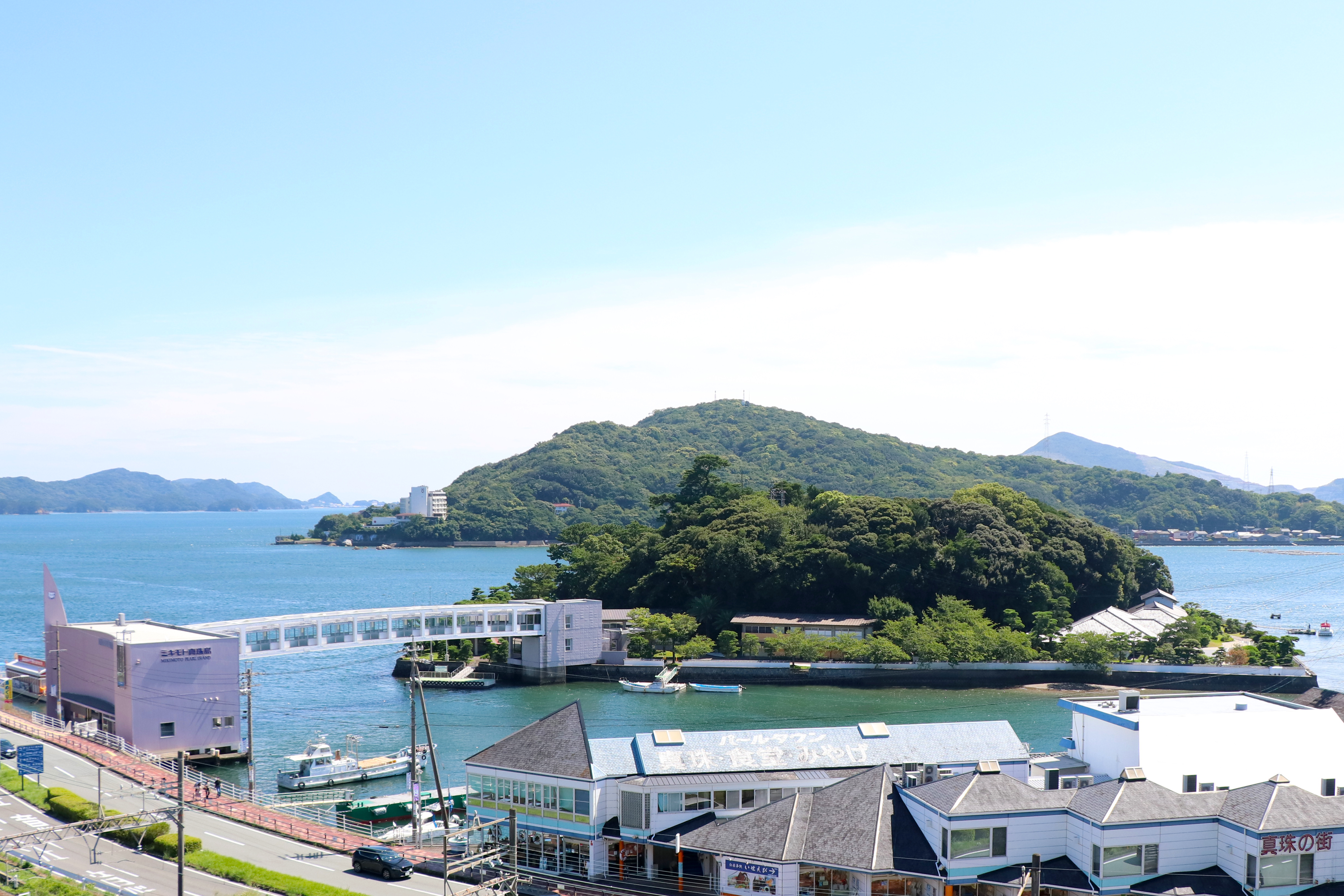
Mikimoto Pearl Island
The son of an udon shop owner changed the world from a speck of rock in Ise Bay. Kokichi Mikimoto was born in 1858 in Toba, a fishing town on Japan's Kii Peninsula, where ama divers had plucked natural pearls from the seafloor for centuries. By thirteen, his father had fallen ill and young Kokichi had dropped out of school to sell vegetables. But he had watched the pearl divers unloading their hauls at the Ise shore since childhood, and something about those luminous spheres would not let go. In 1888, he borrowed money and started an oyster farm at Shinmei inlet. Five years of failed experiments and near-bankruptcy later, on July 11, 1893, he pried open an Akoya oyster on this island and found what he had seeded there: a cultured pearl, the first one ever produced. The global pearl industry would never be the same.
From Oyster Farm to Empire
That first pearl was hemispherical -- a half-pearl, not the perfectly round gems that would come later. But it proved the concept: human intervention could coax an oyster into producing something that nature had previously offered only by accident. Mikimoto opened his first pearl store in 1899 and spent the following decades perfecting his technique, eventually producing fully spherical cultured pearls that were virtually indistinguishable from natural ones. The breakthrough democratized a luxury that had been reserved for royalty and the ultra-wealthy. Before Mikimoto, a single strand of matched natural pearls could cost more than a mansion. After him, pearls became accessible to the middle class worldwide. The pearl industry fought back fiercely, with Parisian jewelers publicly burning cultured pearls and declaring them fake. Mikimoto won the argument by winning the market. He lived to ninety-six, long enough to see himself known universally as the Pearl King.
The Ama and the Oysters
Mikimoto's invention would have been impossible without the ama, the traditional free-diving women of the Ise-Shima coast. For over two thousand years, ama divers have descended into cold coastal waters without breathing equipment, harvesting abalone, seaweed, and shellfish. When Mikimoto launched his oyster farms, it was ama divers who collected the oysters for pearl nucleus implantation, returned them to the sea after seeding, and retrieved them months later. When red tides threatened or typhoons approached, the ama moved the oyster beds to safety. The cultured pearl industry could not have developed without their skill and endurance. Today, Mikimoto Pearl Island hosts regular ama diving demonstrations, where divers in traditional white clothing plunge into the waters of the bay, surfacing with their distinctive whistle-like breathing technique -- a living link to the human labor behind every pearl.
A Museum of Impossible Objects
The Pearl Museum on the island is less a conventional exhibit than a cabinet of obsessive ambition. Among its highlights: a globe constructed from 12,541 pearls, 377 rubies, and 373 diamonds, measuring 33 centimeters in diameter. A replica of the Liberty Bell crafted from 12,250 pearls and 366 diamonds, first displayed at the 1939 New York World's Fair. A 1/90 scale reproduction of Himeji Castle assembled from 19,000 pearls, 447 diamonds, and assorted sapphires, emeralds, and rubies. A model pagoda made of 12,760 pearls, exhibited at the 1926 Sesquicentennial Exposition in Philadelphia. A crown styled after Queen Mary's state crown, used at the coronation of King George V in 1911, rendered in 872 pearls and 188 diamonds. These objects are not merely decorative -- they were instruments of persuasion, touring the great expositions of the early twentieth century to demonstrate that cultured pearls were the equal of any natural gem.
The Island Today
Mikimoto purchased the island in 1929 from the town of Toba, which used the proceeds to build an elementary school. He renamed it Mikimoto Pearl Island in 1951 and established a tourism company to welcome visitors. A commemorative museum documenting his life opened in 1958, complete with a reproduction of the family udon shop where he was born. The Pearl Museum followed in 1962 and was rebuilt in 1985. A bridge connecting the island to the mainland was completed in 1970, making the five-minute walk from Toba Station one of the most convenient cultural pilgrimages in Japan. A bronze sculpture of Mikimoto stands on the island grounds alongside the Shrine of Pearl, a quiet acknowledgment that what happened here was something close to alchemy -- the transformation of irritation into beauty, of sand into luminescence, of one man's stubborn curiosity into an industry that spans the globe.
From the Air
Located at 34.483N, 136.847E in Ise Bay, just offshore from the port town of Toba on the Kii Peninsula. The island is a small but distinct landmass connected to the mainland by a bridge, visible at low altitude. Toba's harbor and surrounding islands make for identifiable landmarks. Nearest major airport: Chubu Centrair International (RJGG), approximately 65nm north-northeast across Ise Bay. The island sits in a protected cove area with numerous small islands visible along the Shima coast to the south. Ise Bay conditions include frequent haze and marine layer, especially in early morning. The bridge to the mainland is a useful visual reference.