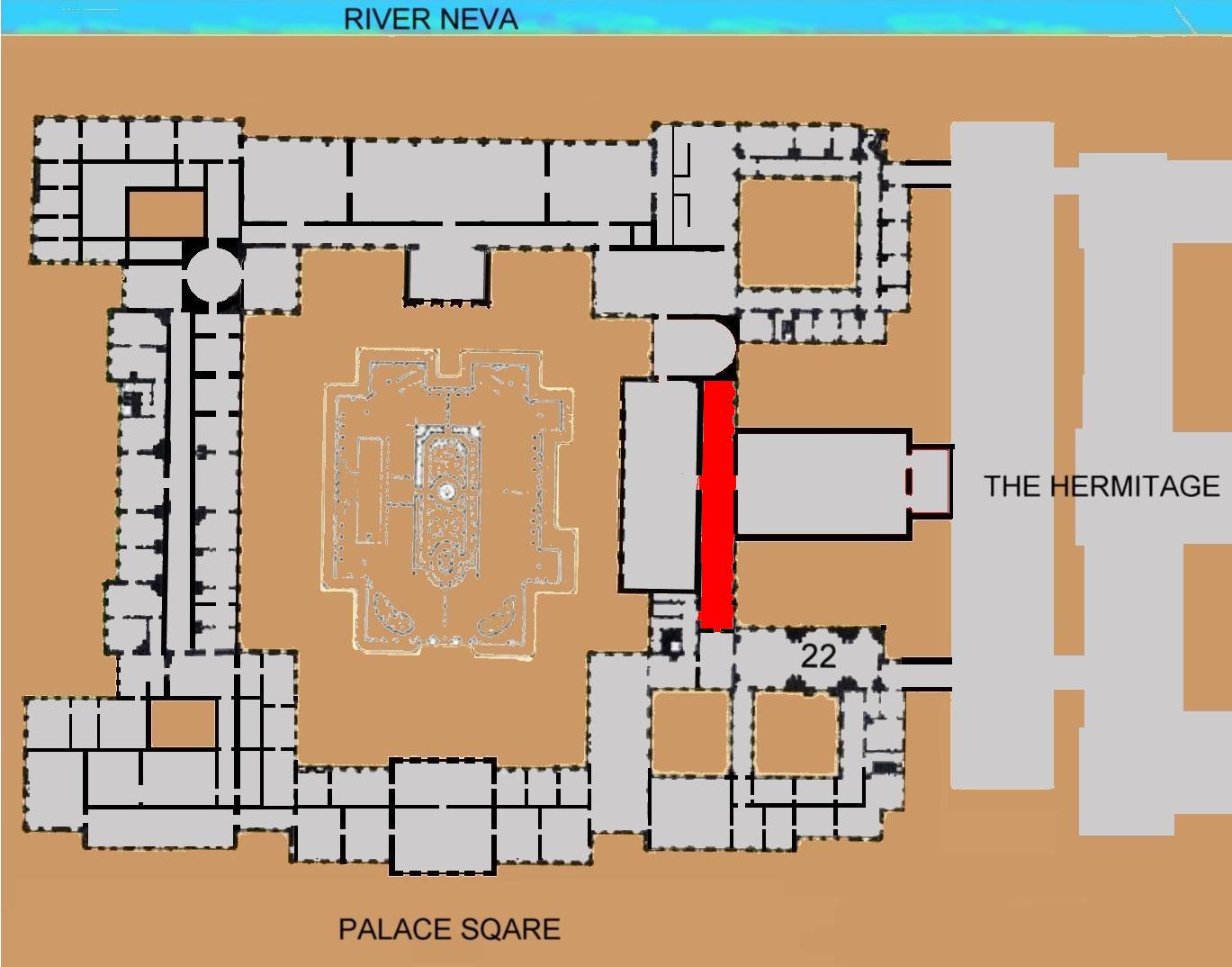
Military Gallery of the Winter Palace
Pushkin walked into this room and wrote a poem about it. The Military Gallery of the Winter Palace is a long barrel-vaulted hall lined with 332 portraits of the Russian generals who fought Napoleon, painted between 1819 and 1828 by an English portraitist named George Dawe with two assistants who almost no one remembers: Alexander Polyakov, a serf, and Wilhelm August Golicke. Alexander I had commissioned the project to settle, finally, the question of who had saved Russia. The gallery opened on Christmas Day 1826. Pushkin's poem The Commander, written in 1835, contemplates the portrait of Barclay de Tolly: the foreign-born general who took command, retreated and burned, was replaced by Kutuzov, and was vindicated by history.
An Englishman in the Hermitage
George Dawe arrived in Saint Petersburg in 1819, already a fashionable London portraitist with a knighted father and a Royal Academy reputation. Alexander I wanted every Russian general above a certain rank who had fought between the French invasion of 1812 and the capture of Paris in 1814 painted from life or, where the subject had died, from existing portraits. Dawe ran a workshop in the Winter Palace itself for nearly a decade, churning out canvases at industrial speed. Polyakov, the serf assistant, did much of the actual painting on many of the portraits while Dawe took the credit and the fees; only after Polyakov's early death in 1835 did the scale of his contribution become clear. Most of the 332 portraits in the gallery are signed Dawe. Many are at least partly Polyakov.
The Hall Carlo Rossi Made
The architect Carlo Rossi, the Italian who had reshaped imperial Petersburg with the General Staff Building and the Mikhailovsky Palace, designed the gallery itself. He took several small rooms in the middle of the Winter Palace, between the White Throne Hall and the Greater Throne Hall just steps from the palace church, and replaced them with a single top-lit barrel-vaulted hall built from June to November 1826. The opening on December 25 of that year, with Nicholas I newly on the throne after the Decembrist revolt, was a ceremony heavy with the politics of military legitimacy. Less than eleven years later, in December 1837, the great Winter Palace fire destroyed the room. The fire burned slowly enough that Dawe's portraits were rescued. The architect Vasily Stasov rebuilt the hall exactly as Rossi had designed it.
Faces of 1812
The gallery is a directory of an entire war. Mikhail Kutuzov, the one-eyed field marshal who let Napoleon take Moscow and waited for winter to do its work. Pyotr Bagration, killed at Borodino. Barclay de Tolly, the Baltic German whose fighting retreat earned him both vindication and Pushkin's poem. Matvey Platov, the Cossack ataman whose horsemen harried the Grande Armée all the way back to the Berezina. Aleksey Yermolov, brutal future conqueror of the Caucasus. Mikhail Miloradovich, who would be shot dead on Senate Square during the Decembrist revolt of 1825. Alongside them hang allies: Wellington, Frederick William III of Prussia, Francis II of Austria, the future Leopold I of Belgium. Three Russian sovereigns watch them from larger frames. The single bulb that once lit the hall at night, Vladimir Littauer remembered from his 1912 cadet guard duty, gave the painted generals a strange unstable life.
What the Room Holds Now
Today the Military Gallery is a room in the Hermitage Museum, walked through by visitors on the way to other galleries, and most of them barely pause. The decor is original. The four added portraits of Palace Grenadiers, painted by Dawe in 1828 as a kind of postscript honoring the ceremonial unit created from 1812 veterans, hang where the Soviet curators put them. Two paintings by Peter von Hess from the 1840s show specific battles. A few Dawe-workshop copies of generals in the room (Boris Vladimirovich Poluektov, Dmitry Vladimirovich Golitsyn) hang in the Pushkin Museum in Moscow. The 332 stay where they were hung in 1826, looking down at whoever passes, remembering a war whose costs the official portraits cannot quite contain.
From the Air
The Military Gallery is inside the Winter Palace at 59.941 N, 30.314 E on the south bank of the Neva in central Saint Petersburg, the palace's green-and-white facade unmistakable along Palace Square. The gallery itself sits between the White Throne Hall and the Greater Throne Hall in the main block. From altitude the Hermitage complex is one of the most recognizable buildings on Earth, with the General Staff Building's arch curving across the square. Nearest airport is Pulkovo (ULLI), 20 km south. Restricted city-center airspace; observe Russian regulations.