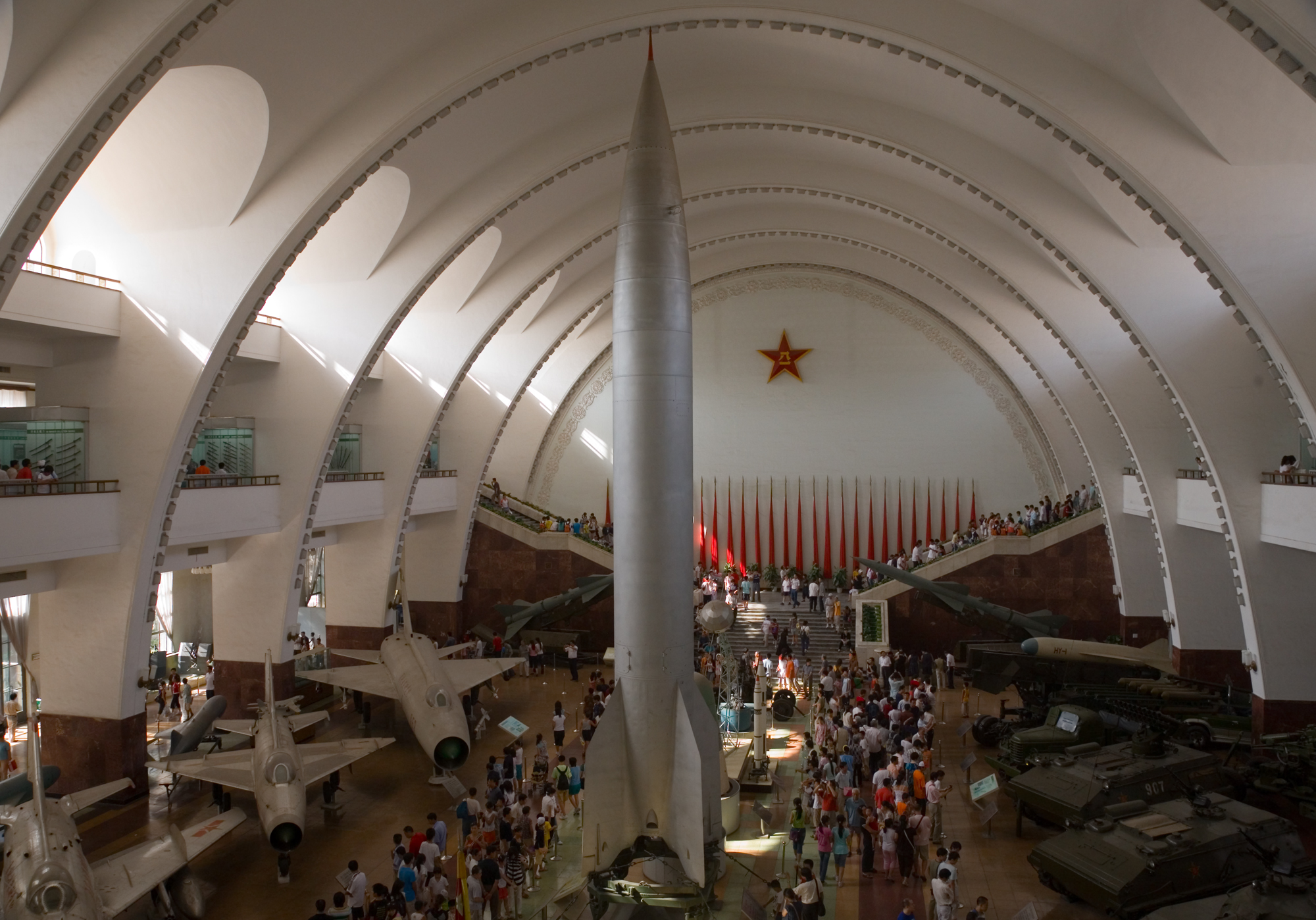
Military Museum of the Chinese People's Revolution
Mao Zedong inscribed the museum's name in his own calligraphy. That detail says something about the institution's place in the political landscape of the People's Republic: this is not just a collection of weapons and uniforms but a monument to the narrative the Communist Party tells about its own rise to power. The Military Museum of the Chinese People's Revolution, located in Beijing's Haidian District, opened on August 1, 1960 -- Armed Forces Day -- and its ten halls walk visitors through four thousand years of Chinese military history, with the heaviest emphasis on the 20th century's wars that brought the party to power.
Built for an Anniversary
The museum was one of the Ten Great Buildings, a group of monumental structures erected to celebrate the tenth anniversary of the People's Republic's founding in 1949. Construction began in October 1958 and was completed by August 1960 -- a pace typical of the Great Leap Forward era, when political will routinely overrode practical constraints. The building was designed in the Soviet-influenced style that defined early PRC architecture: symmetrical, imposing, topped with a star. In 2012, a comprehensive reconstruction began that would not finish until 2017, expanding the exhibition space from 60,000 to 159,000 square meters and creating a soaring central hall large enough to display aircraft and missiles.
The Hall of Weapons
The largest hall is devoted to military hardware, and its holdings tell the story of China's 20th-century wars through the machines that fought them. Soviet tanks purchased or donated during the 1950s and 1960s sit alongside Japanese weapons captured during the Second Sino-Japanese War. American M46 Pattons, taken during the Korean War, share floor space with M4 Shermans and M24 Chaffees captured from Kuomintang forces during the Chinese Civil War. A T-62 tank, serial number 545, was seized during the 1969 Sino-Soviet border conflict. Overhead hang aircraft: MiG-15s, a captured P-51 Mustang, a Lockheed U-2 spy plane shot down over Chinese airspace. In a glass case rests the casing of China's first atomic bomb.
Conflicts Through the Party's Lens
The museum's nine other halls are organized by conflict, each presenting history through the party's official interpretive framework. The Hall of the Agrarian Revolutionary War covers the 1927-1937 struggle between the Communist Party and the Kuomintang. The Hall of the War to Resist Japanese Aggression addresses the Second Sino-Japanese War. The Hall of the War of Liberation chronicles the civil war's final phase. The Hall of Ancient Wars reaches back four millennia, well before the Qing dynasty. Each hall combines plaster sculptures, maps, paintings, artifacts, and films, with text primarily in Chinese and selected English translations. The cumulative effect is immersive, though visitors will find the interpretive lens consistent throughout.
Trophies and Gifts
Two halls stand apart from the historical narrative. The Hall of Presents displays gifts given to the Chinese military or state by foreign militaries and governments -- a curated collection of diplomatic objects that reflects China's international relationships across decades. The Hall of Cheng Yunxian's Sculptural Arts contains plaster reproductions of world leaders, historical figures, party leaders, and scientists, created by the sculptor Cheng Yunxian. Among the most poignant artifacts in the broader collection is the flag of the U.S. 31st Infantry Regiment and a United Nations insignia, both captured during the Korean War. They sit in glass cases, trophies of a conflict that defined the People's Republic's first decade and still shapes its relationship with the United States.
From the Air
Located at 39.91N, 116.32E in Beijing's Haidian District, along Fuxing Road west of Tiananmen Square. The museum building, with its Soviet-style architecture and star-topped tower, is a recognizable landmark from moderate altitudes. It sits near the Military Museum subway station on Line 1. Beijing Capital International Airport (ZBAA) is approximately 27 km to the northeast.