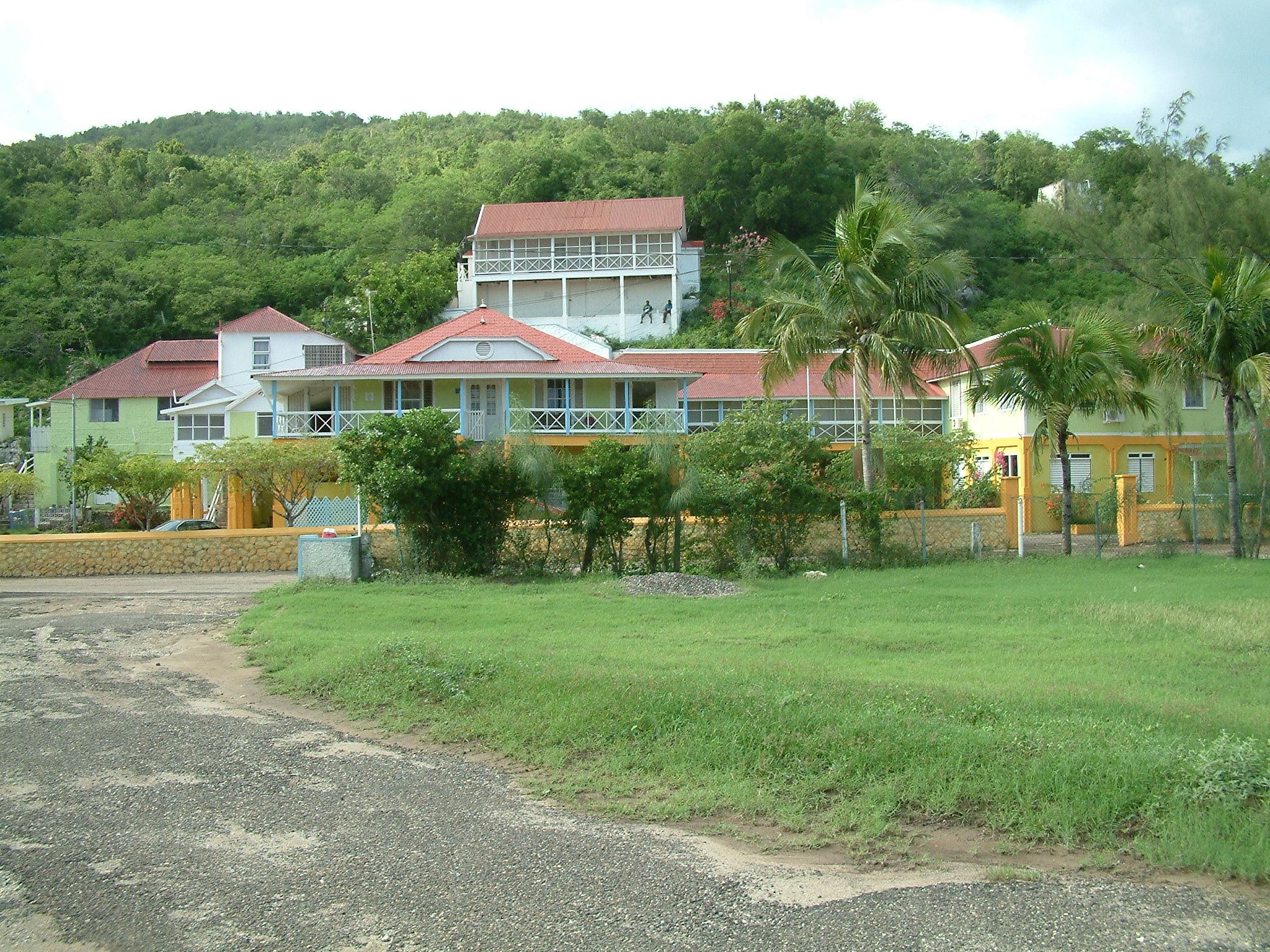
Milk River Bath
Fifteen minutes. That is the recommended soak at Milk River Bath -- not because the waters are too hot or too cold, but because they are too radioactive. The mineral spring that rises where the Carpenter's Mountains meet the Vere Plains in Clarendon Parish produces water nine times more radioactive than the famous baths at Bath, England, and three times the level at Karlovy Vary in the Czech Republic. The Jamaican government has owned this spa since 1794, making it one of the oldest continuously operated bathing establishments in the Western Hemisphere, and the instructions have apparently always been the same: get in, soak, get out. Do not linger.
The Slave Who Came Back
The origin story of Milk River Bath belongs to the 17th century, and like many origin stories, it carries both legend and uncomfortable truth. An enslaved man, beaten so severely by his enslaver that he was left for dead, disappeared into the countryside. When he returned some time later, fully recovered, his enslaver struck a deal: show me where you were healed, and I will never punish you again. The promise itself reveals the era's casual brutality -- a man's body broken on a whim, his healing treated as a curiosity to be bartered for, the "deal" offered from a position of absolute power to someone with none. What the enslaved man found, whether by desperation or local knowledge, was a mineral spring whose waters carried heat and dissolved minerals from deep underground. His discovery would eventually become a government institution. His name was not recorded.
What the Water Carries
The spring emerges at the base of a hillside, tepid and mineral-laden, flowing fast enough that the baths continuously refresh themselves. Chemical analysis reveals a cocktail dominated by chloride at 1.4 percent and sodium at 0.78 percent, with traces of calcium, magnesium, sulphate, and silica. The bicarbonate content is negligible; carbonate is absent entirely. But the number that sets Milk River apart is the radioactivity: 16 nanocuries per liter, or 43 Mache Units. This is not the kind of radioactivity that requires a hazmat suit -- the levels are low enough for therapeutic bathing -- but it is high enough to warrant the fifteen-minute limit. The radioactivity comes from naturally occurring radon and radium dissolved from the rock formations through which the water travels on its journey to the surface. Whether the radioactivity has genuine therapeutic effects or whether the mineral content and warmth deserve the credit remains a matter of debate, but people have been coming here for over two centuries betting on the former.
Six Tiled Rooms and a Hotel
The facilities at Milk River Bath are modest in a way that feels deliberate, as though the place has resisted the urge to become something it is not. Six public baths occupy small private rooms off a shared seating area. The rooms are smartly tiled and large enough to hold several people, though the changing area accommodates only one at a time. The tepid water flows swiftly through each bath -- there is no stagnation here, no soaking in yesterday's minerals. Above the baths sits a hotel with about 20 rooms, most with ensuite bathrooms, a cocktail bar, and a restaurant where food can be specially prepared outside regular mealtimes. A swimming pool fed by the mineral waters sits nearby, though it is not always open. The whole complex has the feel of a place that has been doing one thing for a very long time and sees no reason to change the formula.
Finding the Spring
Reaching Milk River Bath requires intention. The spa sits about two miles south of the village of Milk River, itself about twelve miles south of the A2 road at Toll Gate in Clarendon Parish. The approach road is, by many accounts, badly potholed -- passable in an ordinary car, but only with care and patience. The Milk River itself flows past the spa at a distance of about 100 meters on the other side of the road. This is deep rural Jamaica, far from the resort strips of Montego Bay and Negril. The surrounding landscape is where the mountains yield to the Vere Plains, a transitional zone of limestone and scrub that has never attracted the kind of development that reshapes a place. The spa exists here because the spring exists here, and nothing else about the location is convenient. That inconvenience may be part of what has preserved it.
From the Air
Milk River Bath is located at approximately 17.85N, 77.35W in Clarendon Parish, southern Jamaica. The nearest significant airport is Norman Manley International Airport (MKJP) in Kingston, roughly 80 km to the east-southeast. Sangster International Airport (MKJS) in Montego Bay lies about 150 km to the northwest. From the air, look for the transition zone where the Carpenter's Mountains meet the Vere Plains on Jamaica's southern coastal plain. The Milk River itself is visible as it flows south toward the Caribbean. The area is rural and flat near the coast, with rugged hills rising to the north.