Millbank Prison: Where Convicts Embarked and Art Now Hangs
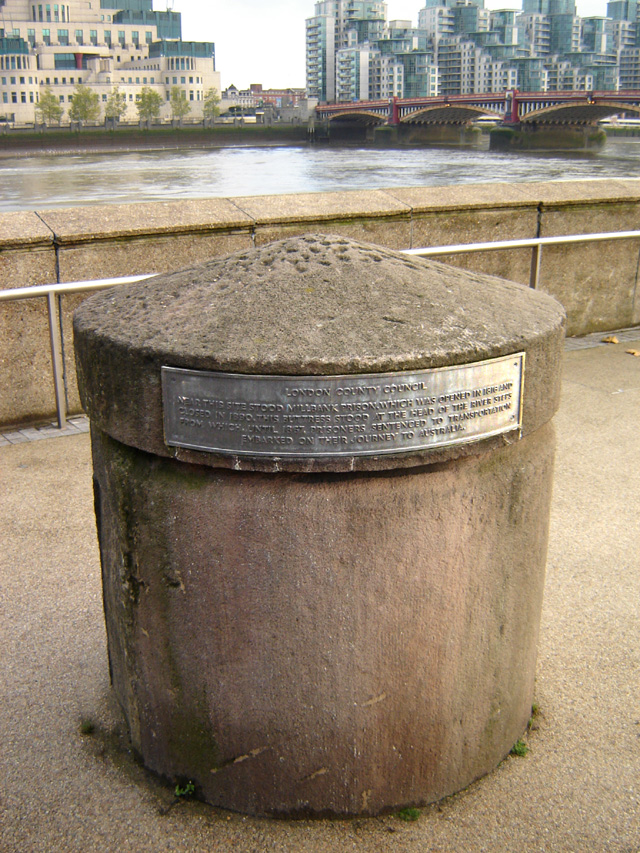
Stand outside Tate Britain today and you are standing on a prison. From 1816 to 1890, the Millbank Penitentiary occupied this stretch of Thames riverbank -- a vast, star-shaped structure inspired by Jeremy Bentham's Panopticon, designed so that guards at the center could observe every cell. A large circular bollard still stands by the river, inscribed with a reminder: 'Near this site stood Millbank Prison which was opened in 1816 and closed in 1890. This buttress stood at the head of the river steps from which, until 1867, prisoners sentenced to transportation embarked on their journey to Australia.'
Bentham's Vision, Built and Failed
Millbank Prison was conceived as a reformatory experiment. Jeremy Bentham had proposed his Panopticon -- a circular prison where a single watchman could observe all inmates without them knowing whether they were being watched -- as a revolution in penal design. Millbank was not a true Panopticon but drew heavily on Bentham's ideas. Designed by Robert Smirke and completed in 1821, it was built on a marshy tract of riverbank, its foundations requiring a massive concrete raft to prevent subsidence. The prison's six pentagonal wings radiated from a central chapel, forming a distinctive star shape visible on maps for decades. It could hold around a thousand prisoners and served as a holding facility for convicts awaiting transportation to the Australian colonies. The building was plagued from the start by damp, disease, and the psychological toll of solitary confinement -- problems Bentham's elegant theory had not anticipated.
The River Steps
Until penal transportation was abolished in 1867, the river steps at Millbank were the last piece of England that thousands of convicts would ever touch. Men and women convicted of crimes ranging from theft to political agitation were marched from their cells to the Thames, loaded onto boats, and taken downstream to the hulks and transport ships that would carry them to New South Wales, Van Diemen's Land, or Western Australia. For many, it was a journey of no return. The bollard that marks the site of the river steps is one of the few physical traces of the prison that survive above ground, though archaeologists working in the late 1990s and early 2000s uncovered significant remains of the prison's foundations beneath Tate Britain and the Chelsea College of Art.
A Prison in Literature
Millbank Prison lodged itself firmly in the Victorian literary imagination. Charles Dickens describes it in chapter 52 of Bleak House. Arthur Conan Doyle sends Sherlock Holmes and Watson past the Millbank Penitentiary by boat in The Sign of Four. In Conan Doyle's The Lost World, Professor Challenger jokes that he dislikes walking along the Thames because 'it is always sad to see one's final destination' -- meaning Westminster Abbey, though his rival Professor Summerlee responds that he understands Millbank Prison has been demolished. Henry James visited Millbank on 12 December 1884 to gather material for The Princess Casamassima. Sarah Waters set key scenes of her novel Affinity within its walls.
From Prison to Gallery
The prison was progressively demolished beginning in 1890. In its place rose three very different institutions. The National Gallery of British Art -- now Tate Britain -- opened on the site in 1897, transforming a place of punishment into a temple of painting. The Royal Army Medical College occupied another portion until 2005, when its buildings were adapted to house the Chelsea College of Art and Design. Most remarkably, the Millbank Estate, a housing development built by the London County Council between 1897 and 1902, was constructed using the prison's own bricks. The estate comprises seventeen buildings, each named after a distinguished painter -- a poetic inversion of the prison's legacy. A remnant of the perimeter ditch survives between Cureton Street and John Islip Street, now used as a clothes-drying area by residents of Wilkie House. Art, education, and domestic life replaced confinement and exile -- but the prison's outline endures in the pattern of streets and buildings that succeeded it.
From the Air
The site of Millbank Prison (51.49N, 0.13W) is on the north bank of the Thames in Westminster, now occupied by Tate Britain and surrounding buildings. The Tate's classical facade faces the river. Nearby airports: Battersea Heliport 1nm south across the river, London City (EGLC) 7nm east. Best viewed from 2,000ft with the Thames curve at Vauxhall visible.